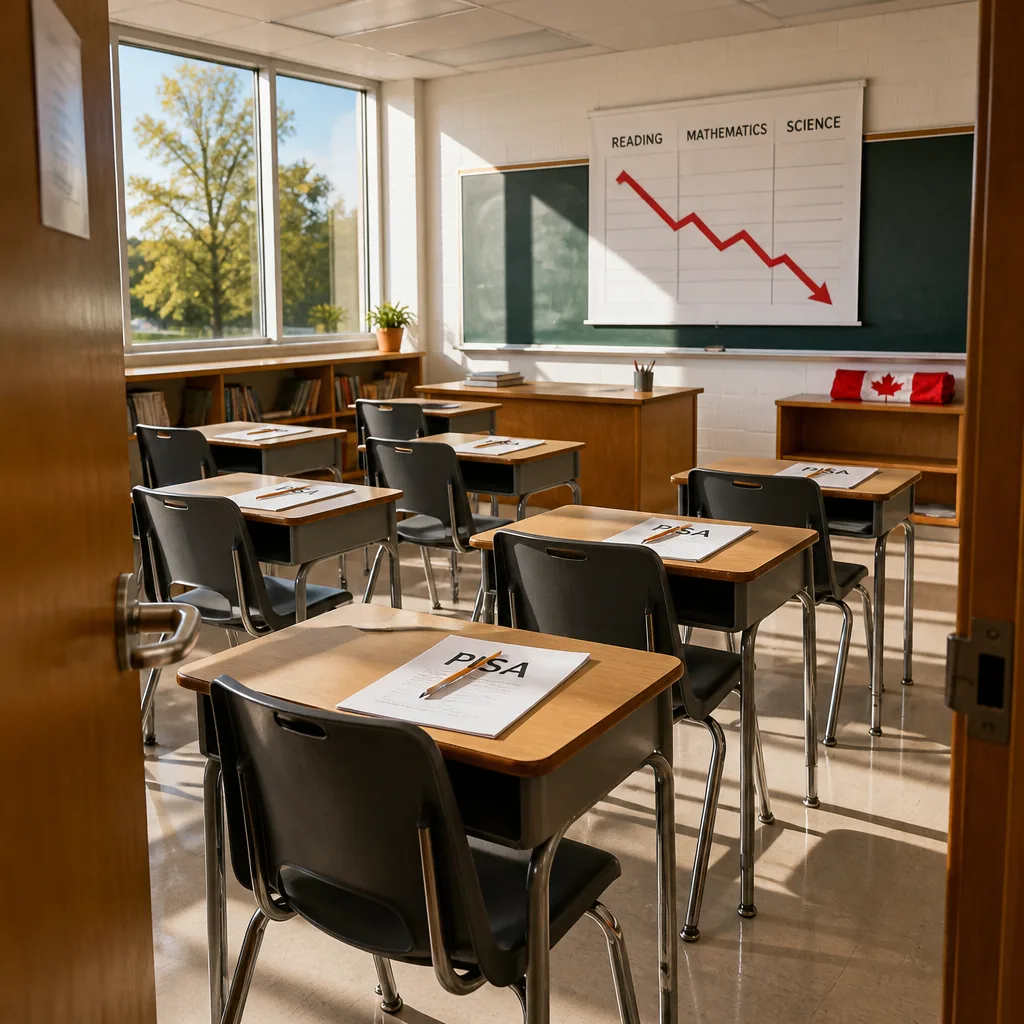
Israel’s performance on the 2025 Programme for International Student Assessment (PISA) revealed sharp declines across the three main domains tested, prompting concerns about the state of the country’s education system and its capacity to prepare young people for the future.
Scores drop sharply across core subjects
The Organisation for Economic Co‑operation and Development (OECD) benchmark shows Israel’s average scores fell substantially from the previous PISA cycle. Reading dropped by 38 points to a score of 436, mathematics declined by 25 points to 433, and science decreased by 23 points to 442. These are Israel’s lowest recorded PISA results and place the country below the OECD average in all three subjects.
Those shifts represent a striking reversal in a system that previously produced higher average results, and they have been described as evidence of deeper, systemic weaknesses rather than marginal issues confined to particular sectors of schooling.
Participation and equity concerns
Commentary accompanying the results highlights complexities in interpreting the national picture. One notable factor is the uneven participation of certain school sectors in the PISA sampling frame. Ultra‑Orthodox (haredi) schools, many of which did not take part, are underrepresented in the tested sample. A Knesset Research and Information Center review of PISA 2022 showed haredi boys composed only about 3 per cent of the unweighted sample despite haredim being a substantially larger share of the youth population.
That absence clouds attribution of the overall decline, but analysts say the fall cannot be blamed solely on non‑participation: the deterioration is broad and appears to affect the mainstream system as well.
Proficiency and performance distribution
The 2025 results also point to weaker proficiency overall. In mathematics, nearly half of students are not reaching baseline competency: 46 per cent of Israeli students failed to achieve even the OECD baseline level, compared with an OECD average of 35 per cent.
“Only 68% of students in Israel agreed or strongly agreed with the statement ‘I am curious about many different things,’”
That finding on student attitudes — included in the OECD report — was singled out as another area of concern, with commentators arguing that declines in curiosity and engagement may be linked to falling achievement.
- Reading: down 38 points to 436
- Mathematics: down 25 points to 433
- Science: down 23 points to 442
| Domain | 2025 score | Point change since 2022 |
|---|---|---|
| Reading | 436 | -38 |
| Mathematics | 433 | -25 |
| Science | 442 | -23 |
Political and policy implications
The timing of the release, on the eve of an election campaign, has intensified scrutiny. Observers and policymakers are confronting difficult questions about curriculum quality, resource allocation, teacher training, and assessment participation — particularly in sectors that opted out of testing. The government faces pressure to identify concrete steps to halt the slide and to address disparities that the PISA data expose.
While non‑participation by some schooling sectors complicates analysis, the breadth of the declines suggests multiple contributing factors. Analysts will be watching for government and education ministry responses that address both system‑wide improvement and targeted supports for underperforming groups.
The PISA findings are likely to elevate debates about accountability, inclusion and long‑term workforce readiness in Israel, as leaders weigh short‑term political considerations against the need for sustained educational reform.