A British Columbia judge has ordered $275,000 in damages for a Surrey journalist after finding that defamatory statements were published during a prolonged protest outside his home in 2020.
Judge finds leader published defamatory material
B.C. Supreme Court Justice Richard Hewson concluded that defendant Yun Fei Zhu made and published statements that defamed Bing Chen Gao, who worked as a journalist and was an outspoken critic of both the Chinese Communist Party and supporters of the New Federal State of China movement.
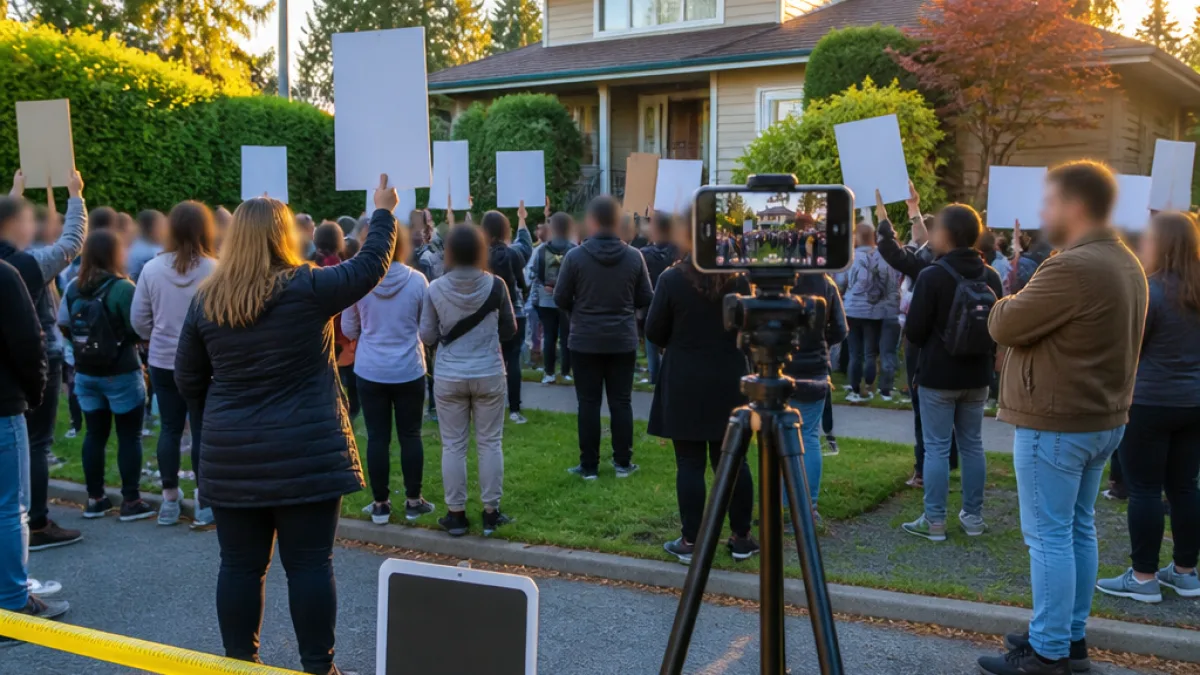
Gao testified that protests began on Sept. 15, 2020, and continued daily until Dec. 1, 2020. Crowds outside his Surrey house ranged from roughly 10 to 60 people, and the activity was livestreamed, primarily by Zhu, for periods described at trial as nearly five hours a day to online audiences. Additional protests and livestreams were alleged to have occurred at Gao's home from Jan. 20–25, 2023.
"Some viewed Guo Wengui as a courageous dissident exposing corruption, while others regarded him and the NFSC as unreliable, conspiratorial and cult‑like,"
— excerpt from Justice Hewson's decision
Allegations and tactics used at the protests
According to testimony cited in the decision, the protestors publicly labelled Gao a "Chinese Communist Party spy," distributed pamphlets that disclosed his home address and played funeral music outside his residence. The court treated Zhu as a rallying figure or "leader" for the events, which were organised by supporters of Chinese tycoon Guo Wenghui, the founder of the New Federal State of China (NFSC) movement.
- Duration: 77 days of protests in 2020 (Sept. 15–Dec. 1)
- Crowd size: Approximately 10–60 people
- Livestreaming: Mostly by Zhu, about five hours daily
- Additional activity: Further protests Jan. 20–25, 2023
Context: the group and its leader
The court record links the protestors to supporters of Guo Wenghui, who had promoted the NFSC, a movement aiming to replace the Chinese Communist Party. The decision notes a divided public view of Guo and the NFSC. The ruling also referenced a recent development: Guo was sentenced in the United States to 30 years in prison on fraud charges, a fact cited in the judgment.
Local implications and legal precedent
The damages award signals the court's assessment that repeated public accusations, disclosure of a private address and sustained targeted livestreaming can cross into defamation and harassment, with tangible monetary consequences for organisers. For Surrey residents, the ruling underscores how community safety and personal privacy concerns can arise from foreign political disputes played out on local streets and online platforms.
| Item | Detail |
|---|---|
| Damages awarded | $275,000 |
| Protest dates (2020) | Sept. 15–Dec. 1, 2020 |
| Additional protests | Jan. 20–25, 2023 |
| Alleged crowd size | 10–60 people |
The decision does not address broader criminal charges; it is a civil ruling on defamation and related conduct. It also highlights the interplay between real‑world protests and digital amplification, with livestreaming of sustained activity forming part of the basis for the court's findings.
As Surrey continues to grow as a multi‑ethnic city, cases like this reflect the local impact of transnational political movements and the strain they can place on neighbourhoods and individuals. The ruling provides a legal benchmark for residents and community groups about the limits of protest activity when it targets an individual's reputation and safety.