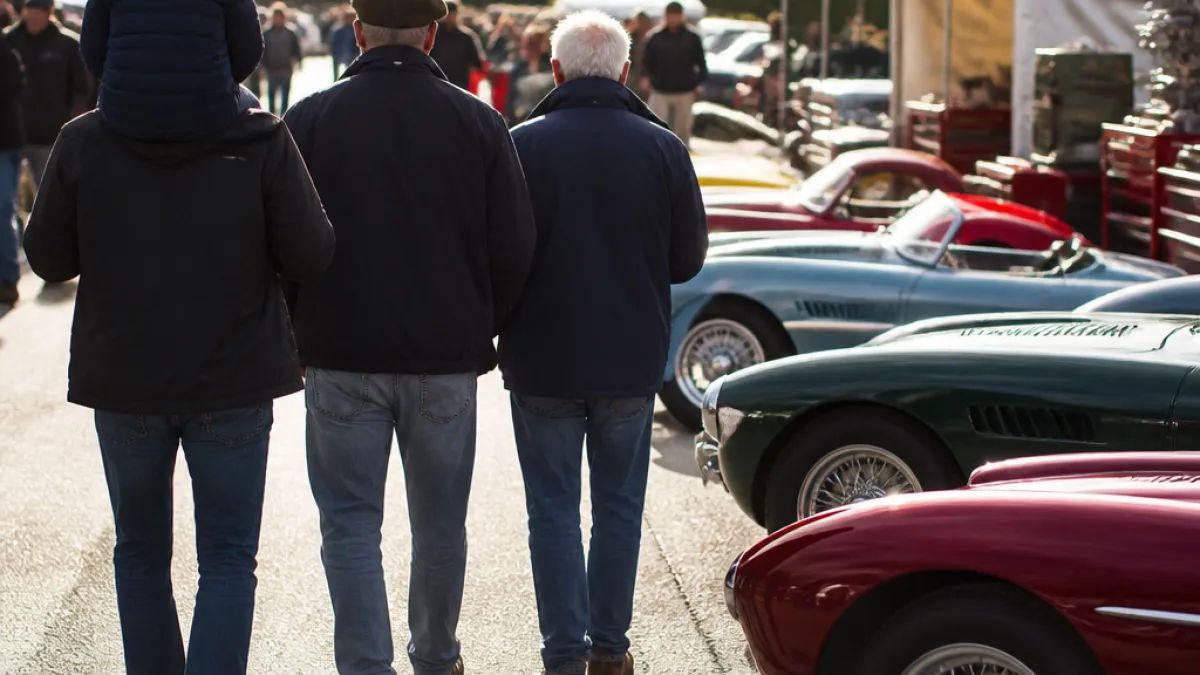
The sight of a child transfixed by a row of gleaming classic cars is a familiar one at motoring events, but a recent dispatch from the Goodwood Members' Meeting asks a sharper question: can today’s children, raised on app-based screens and factory-warrantied cars, inherit a love of hands-on motoring from older generations?
Bridging three generations at Goodwood
Writing about his family visit to the Goodwood Members' Meeting, the author describes taking three generations — himself, his brother and his young son — to a sprawling south-of-England gathering of enthusiasts and restored classics. The trip was intended as a test of whether the spark that draws older people to mechanics and restorations can survive into an era dominated by digital interfaces and increasingly complex modern vehicles.
The piece maps a familiar arc for many car lovers: early memories of motor shows with a parent, adolescent dreams of performance cars and, eventually, real-world encounters with mechanical failure, tinkering and restoration. The writer contrasts that pathway with the present-day reality of new cars that are largely sealed, software-driven and delivered with long warranties — a world in which learning to fix a vehicle may be rarer than ever.
What does a ‘petrolhead’ look like now?
The author’s own motoring origin story is modest: a second-hand Peugeot 106, a small 1.2-litre engine and a handful of memorable quirks. Those tactile experiences — the smell of oil, the feel of a choke, the ritual of opening a reluctant door — provide a shorthand for how older generations became mechanically literate. Against that, he asks whether today’s children will have the same opportunities to tinker.
“Will my son become a ‘petrolhead’?”
That single question anchors the report. The writer suggests that, for some families, automotive enthusiasm is sustained through shared experiences — displays, shows and trips that allow newer generations to encounter the machines in a social, celebratory context rather than through the grind of maintenance.
- Generational transmission: The story emphasises the role of family memories and outings in creating car interest.
- Changing technology: New cars’ complexity and warranty models reduce opportunities for hands-on learning.
- Cultural continuity: Enthusiast events may serve as a bridge between showroom gloss and grease-stained learning.
What the Goodwood example signals more broadly
Although the report is set at a British motoring event, the questions it raises are widely applicable. Car culture has long been an arena where identity, craft and leisure intersect. For communities that prize do-it-yourself skills, the decline of accessible, older mechanical systems could mean a shrinking pool of informal mentors. Conversely, enthusiast gatherings and restorers’ workshops provide concentrated spaces where knowledge survives.
The writer pays particular attention to the social aspect: a father or uncle pointing out the engineering of a classic, a child pressing a button, the shared laugh over an engine that coughs to life after a long restoration. Those small rituals, the piece argues, are as important as the vehicles themselves in passing on interest.
| Generation | Representative memory |
|---|---|
| Parent/father | Motor show visits and nurturing early interest |
| Author (middle generation) | First car: second-hand Peugeot 106 with mechanical quirks |
| Child | Introduced to supercars and classic cars through family outings |
For Richmond readers, the account is a reminder that cultural practices persist through shared experience rather than technology alone. Whether a child becomes fascinated by the elegance of a vintage chassis or the interface of a modern electric vehicle, the pathways to enthusiasm may simply look different.
Events like Goodwood crystallise these dynamics: they celebrate nostalgia and engineering craft while also inviting a new generation to imagine what mobility means. The piece does not offer a definitive answer, but it highlights a choice communities face — whether to preserve hands-on mechanical culture through active mentorship and gatherings or to accept its slow fade in a more sealed, digital automotive world.
At minimum, the story argues, those grey-haired restorers in backyard sheds offer more than restored metal; they act as custodians of a lived craft, and their presence at events may be the vital link that keeps car culture alive for the next generation.