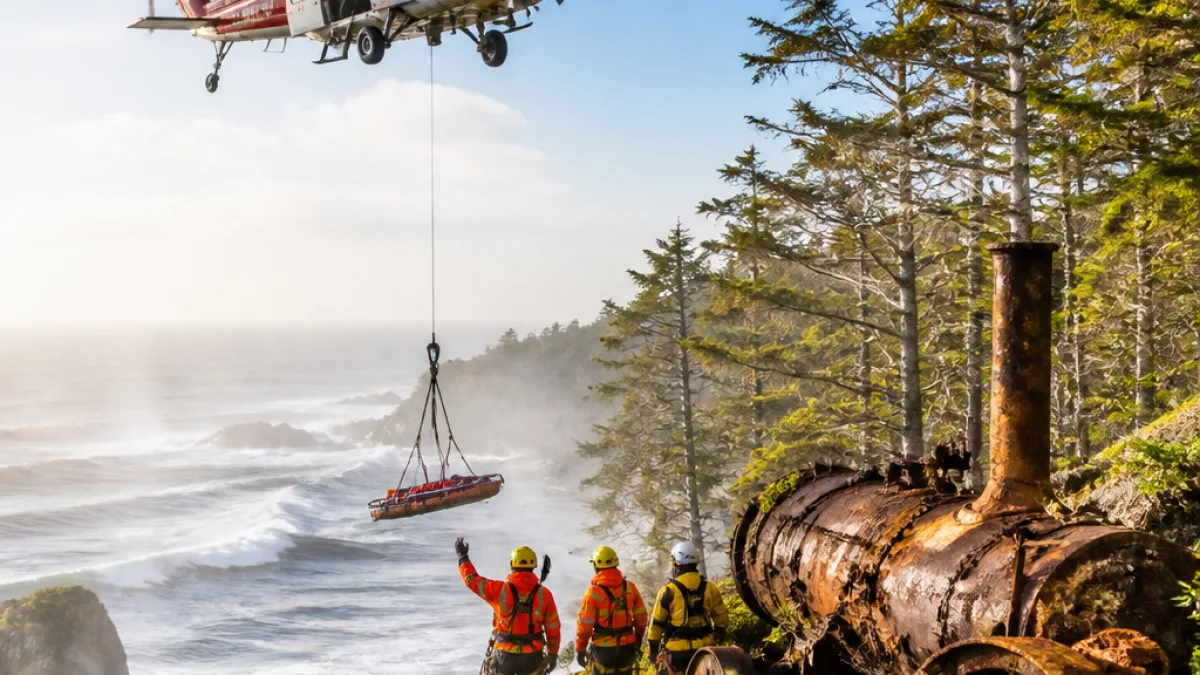
A hiker was airlifted from the West Coast Trail on Friday after suffering a suspected lower‑limb injury that made a standard stretcher carry impractical, park officials and rescue teams said.
Where and how the rescue unfolded
The incident occurred near kilometre 72 of the trail, in the area known as the Old Steam Donkey, within the boundaries of the Pacific Rim National Park Reserve. Visitor Safety staff from the park were the first responders on scene and stabilised the injured person before calling for additional support.
After assessing the situation, the park’s Visitor Safety Team determined that the terrain and the patient’s suspected lower‑limb injury required a specialised hoist rescue rather than a conventional stretcher evacuation. That prompted a co‑ordinated response involving multiple volunteer and commercial agencies.
Agencies involved and the patient's transfer
Juan de Fuca Search and Rescue was called in to assist on the ground, while Arrowsmith Search and Rescue and a helicopter crew from Ascent Helicopters were brought into the operation to carry out an aerial hoist. Once hoisted, the patient was transferred to B.C. Emergency Health Services and taken to a higher level of care.
“Different agencies. Different roles. One goal. Safe patient care.”
The statement, posted online by the cooperating organisations, summarised the multi‑agency nature of the operation and the priority placed on patient safety.
Who did what: quick reference
- Pacific Rim National Park Reserve Visitor Safety Team: initial response, patient stabilisation and assessment.
- Juan de Fuca Search and Rescue: ground assistance.
- Arrowsmith Search and Rescue: additional rescue support.
- Ascent Helicopters: aerial hoist extraction.
- B.C. Emergency Health Services: patient transfer to higher care.
| Agency | Role |
|---|---|
| Pacific Rim Visitor Safety Team | Initial stabilisation and assessment |
| Juan de Fuca SAR | Ground support |
| Arrowsmith SAR | Additional rescue personnel |
| Ascent Helicopters | Aerial hoist extraction |
Context for West Coast Trail hikers and visitors
The West Coast Trail, renowned for its rugged scenery and challenging terrain, runs along the outer west coast of Vancouver Island and attracts hikers from across Canada and abroad. Sections such as the Old Steam Donkey are remote and can be difficult to access by foot in the event of injury, which increases reliance on co‑ordinated rescue resources including volunteer search‑and‑rescue teams and helicopter services.
Park officials and rescue organisations did not provide additional details about the patient’s identity, age or current condition beyond confirming the transfer to emergency health services. The operation illustrates how quickly local teams can mobilize when hikers encounter serious injuries in remote coastal sections of the trail.
Safety takeaways
Rescue teams often remind hikers to prepare for extended response times and to carry appropriate safety gear. While authorities did not issue specific advisories related to this incident, practical precautions for anyone planning a West Coast Trail trip include:
- Carrying a fully charged satellite communication device or personal locator beacon where cell coverage is absent;
- Travelling in groups where possible and telling someone on the mainland your itinerary and expected return;
- Wearing supportive footwear and using trekking poles to reduce fall risk on steep or uneven sections;
- Being prepared for changes in weather and tide conditions that can complicate travel and rescues.
The quick multi‑agency response underscored the value of coordinated volunteer and commercial rescue capacity on Vancouver Island’s west coast. Local teams thanked all partners involved in carrying out the extraction and ensuring the patient was moved to a higher level of care.
Further updates would typically come from the Pacific Rim National Park Reserve, B.C. Emergency Health Services or the involved search‑and‑rescue teams when and if more information is made public.