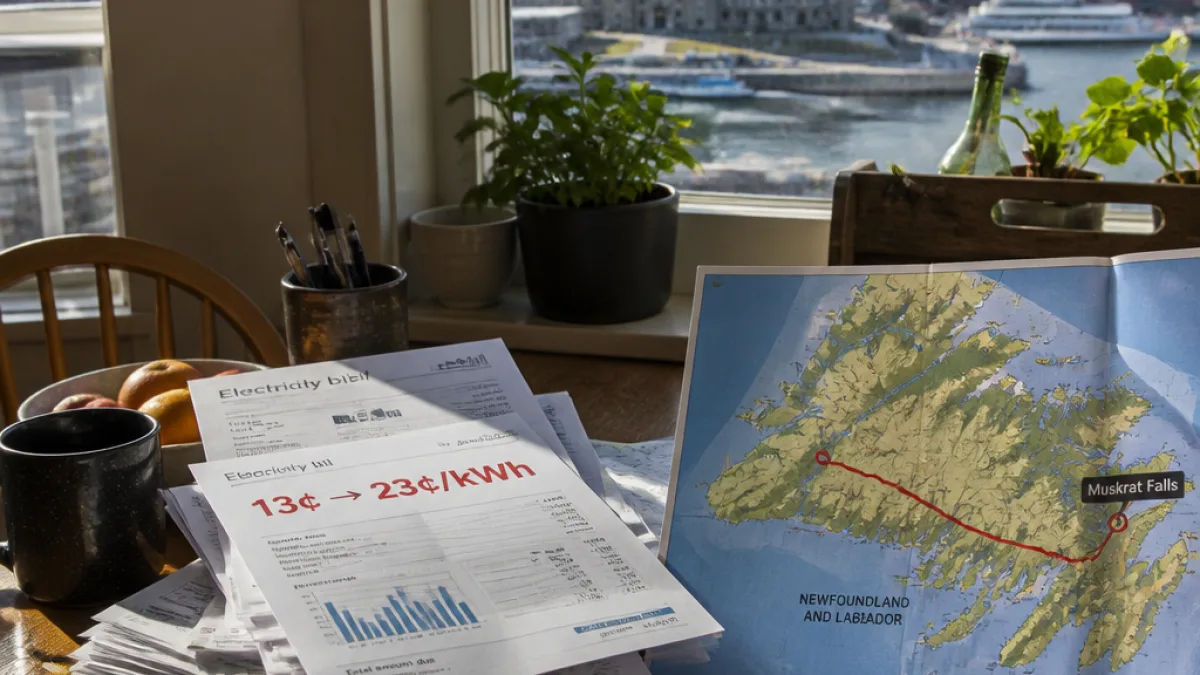
ST. JOHN'S — The interim Consumer Advocate for Newfoundland and Labrador is sounding the alarm that the province is facing a looming “cliff” in household electricity costs tied to the Muskrat Falls hydroelectric project, a warning that comes as the provincial finance minister says the government is not in discussions with Ottawa about further rate relief.
Advocate says costs could nearly double rates
Adrienne Ding, the interim Consumer Advocate, told media and stakeholders this week that experts she has consulted believe the unresolved portion of the Muskrat Falls bill could push residential electricity rates sharply higher by the end of the decade. Ding said those projections suggest rates could increase from the current roughly 13 cents per kilowatt-hour to around 23 cents per kilowatt-hour by 2030 unless a plan is put in place.
“The problem is I don't really have more clarity than anyone else, other than speaking to my experts and what they're saying, that this could double [rates],”
Ding called the present picture “an untenable situation,” emphasising the need for government action to protect consumers from the outstanding costs tied to the project.
Where the bill stands
The Muskrat Falls development, approved by the provincial government in late 2012, experienced major cost overruns. The debt associated with the project now sits at about $13.5-billion, with much of that burden borne by electricity customers in the province.
When the scale of the overruns became clear, provincial and federal officials negotiated a mitigation package to cushion the blow for ratepayers. That arrangement is currently valued at $5.2-billion, but Ding and others say that does not settle the long-term strain on household bills.
| Item | Figure |
|---|---|
| Muskrat Falls project cost (approx.) | $13.5-billion |
| Federal-provincial rate mitigation | $5.2-billion |
| Residential electricity rate (current) | ~13¢/kWh |
| Projected residential rate (by 2030, per experts) | ~23¢/kWh |
Government response — limited engagement with Ottawa
The province’s finance minister told reporters there are no active talks with the federal government about further mitigation of electricity rates — a statement that underlines the gap Ding says needs bridging.
Ratepayers and municipal leaders have repeatedly urged provincial officials to provide clarity on how outstanding liabilities tied to the hydro project will be managed. Ding’s warning adds fresh urgency to those calls as provincial lawmakers prepare to debate development along the Churchill River and the broader state of provincial revenues and utility finances.
What Ding wants
The interim advocate has signalled an intention to press for a structured conversation about options to address the outstanding Muskrat Falls costs. She says that conversation should include clear timelines, responsibilities for new and existing debt, and measures to shield vulnerable households from bill shock.
- Assess the residual debt and how it will be repaid
- Explore further mitigation or restructuring options with federal partners
- Protect low-income and fixed-income households from sharp rate increases
Local impact and the path ahead
For many households and businesses in Newfoundland and Labrador, electricity is a significant portion of monthly household expenses. A jump of the magnitude cited by experts would reverberate through household budgets, small business operating costs and the provincial economy.
With parliamentary debate scheduled this week on energy development on the Churchill River and the province’s finances, Ding’s intervention is likely to keep the Muskrat Falls legacy in the public eye. The key questions for consumers are how quickly elected officials can lay out a plan, whether further federal support will be sought or negotiated, and what protections will be put in place to prevent abrupt increases for vulnerable families.
The Muskrat Falls project remains one of the most consequential infrastructure and fiscal challenges the province has faced. For residents, clarity on next steps will determine whether the coming years are marked by manageable adjustment or by the sharp increase the consumer advocate warned against.
— Reporting from St. John's