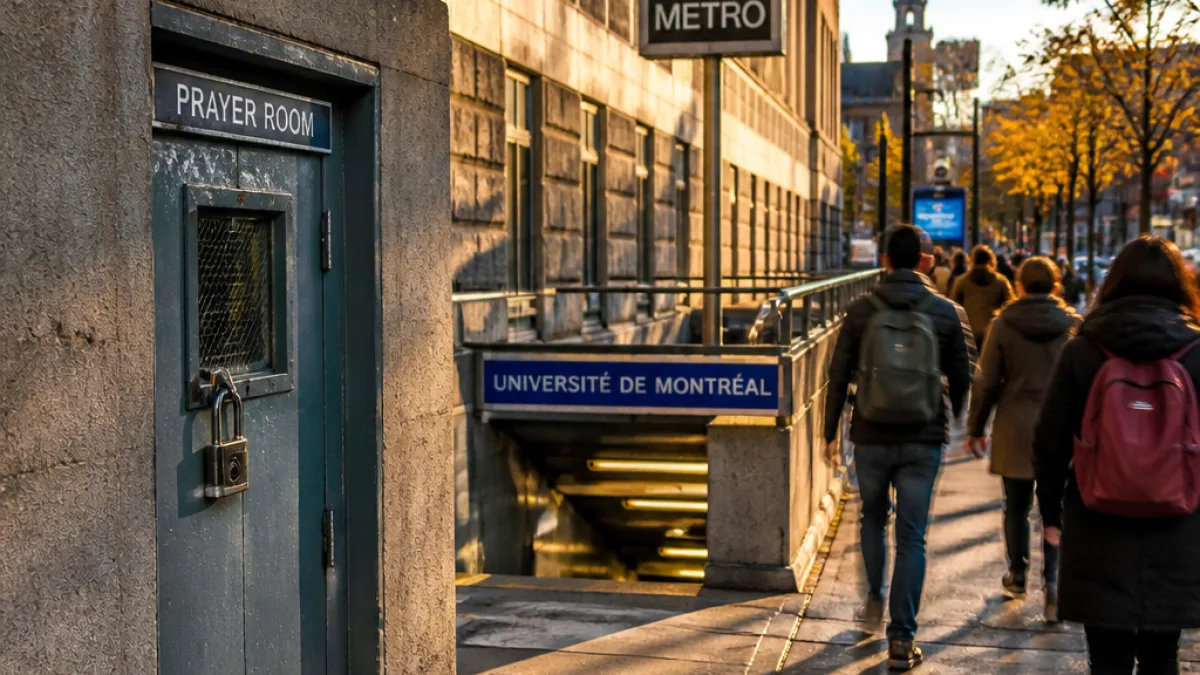
MONTREAL — Quebec’s controversial secularism law, adopted earlier this year, is now reshaping daily routines at public workplaces and on university campuses after new restrictions on prayer took effect on Sept. 1.
What changed on Sept. 1
The legislation, passed in April, bars prayer rooms in public institutions including universities, colleges and transit agencies, and prohibits collective religious practices on public roads and in public parks unless a municipality grants permission on a case‑by‑case basis. Institutions across Montreal are adjusting policies to comply.
- The Société de transport de Montréal (STM) says employees may no longer pray anywhere on STM property, including in four wellness rooms where prayer had been permitted alongside meditation and yoga.
- STM managers who witness religious practice will remind employees of the new rules; employees are permitted to leave STM property to pray during unpaid breaks.
- At the Université de Montréal, managers and security staff are being given guidance on how to implement the law; people who wish to pray will be asked to leave campus.
- The Université du Québec à Montréal (UQAM) said it did not have dedicated prayer spaces prior to the new rules and will comply with the law.
- Montreal police did not respond to questions about how they will enforce the restrictions.
Those measures mark an abrupt change for some who had access to designated quiet or wellness spaces in public institutions. The STM’s explicit removal of prayer from its wellness rooms illustrates how employers are interpreting a broad prohibition into concrete workplace rules.
How institutions are responding
Public organisations told reporters they are issuing guidance to staff and security personnel to ensure compliance. The STM framed its response in operational terms: managers will act as first responders to observed religious practice on its property and will remind employees of the new prohibition. The agency also confirmed its posture that employees may remove themselves from work property to pray during unpaid breaks.
Universities in Montreal are taking similar compliance-first approaches. The Université de Montréal said it is preparing staff so that those who seek to pray on campus will be asked to leave. UQAM noted it did not have official prayer rooms before Sept. 1 and will follow the law.
Practical effects for students and workers
For many, the practical implications are immediate: designated quiet rooms that once accommodated meditation and prayer can no longer be used for religious observance if they are part of a public institution. Workers who previously used a wellness room during a shift must either refrain from praying on site or leave the property entirely — and, under current practice, use unpaid time to do so.
The law also leaves room for municipal discretion. Collective religious activities on public roads and in parks are banned unless a municipality authorises them on a case‑by‑case basis, meaning local councils will be asked to weigh requests against public‑order and policy considerations.
| Institution | New practice |
|---|---|
| Société de transport de Montréal (STM) | Prayer prohibited anywhere on STM property; employees may leave to pray during unpaid breaks; four wellness rooms affected |
| Université de Montréal | Managers and security given guidance; persons wishing to pray will be asked to leave campus |
| UQAM | No dedicated prayer spaces before law; will comply with new restrictions |
Broader context and unanswered questions
The law’s implementation raises operational and legal questions for employers, universities and municipalities. How enforcement will work in practice — especially outside institutional settings — remains unclear. Montreal police did not answer requests for comment on how they will handle complaints or incidents tied to the new rules.
Municipal councils now hold limited power to permit collective religious practices in public parks and on roads in individual cases, which could create patchwork outcomes across Quebec’s cities and boroughs. Institutions must balance compliance with the law against staff, student and public expectations for accommodation and access to quiet spaces.
What this means going forward
For the immediate future, public‑sector employers and post‑secondary institutions in Montreal are moving to contain religious practice within the parameters set by the provincial law — often by removing prayer from spaces that had previously served mixed wellness purposes. Individuals affected by the changes will need to adapt by seeking private property for religious observance, requesting municipal permissions for collective activities or adjusting daily schedules to use unpaid time off for prayer outside institutional grounds.
The day‑to‑day consequences of the law will be shaped by how strictly institutions enforce the new rules and how municipalities respond to requests for permissions. For many Montrealers, those decisions will determine whether a short break for prayer remains feasible during a workday or study schedule.
Geneviève Tremblay is WE NEWS’s Quebec correspondent, reporting from Montreal.