
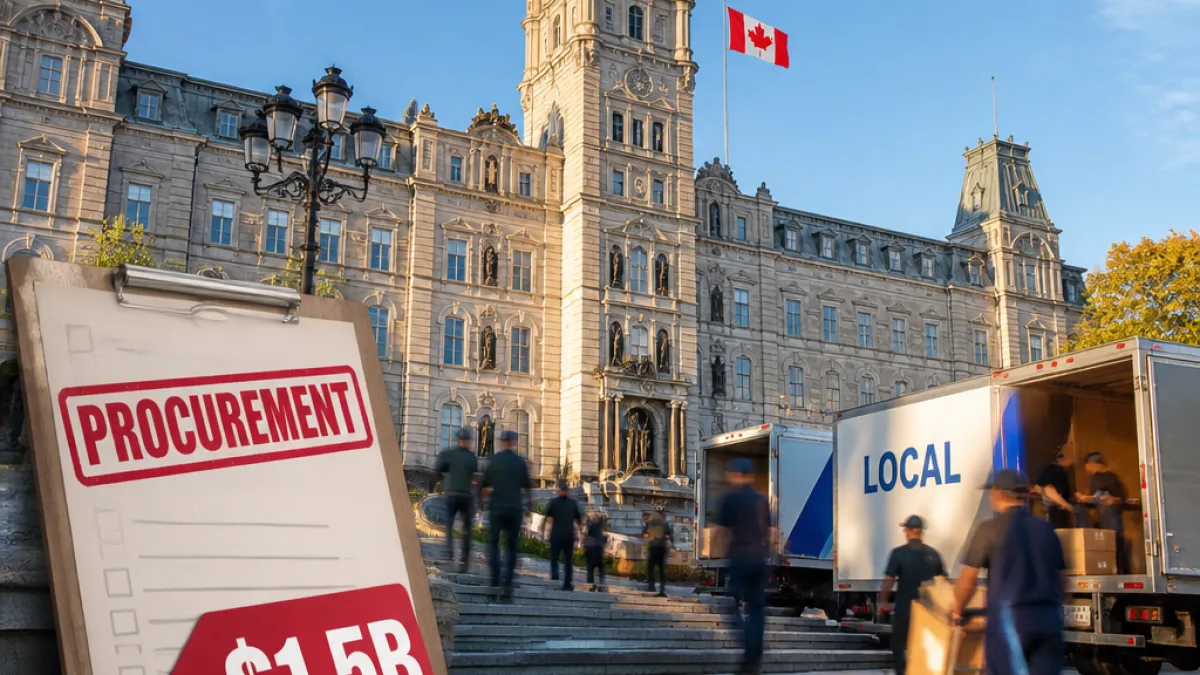
QUEBEC CITY — The provincial government announced a set of measures Tuesday intended to steer public purchasing toward Quebec and Canadian businesses as Ottawa and Washington escalate retaliatory tariffs. Premier Christine Fréchette told reporters the moves will channel roughly $1.5 billion into the Quebec economy in the next four months.
What the government ordered
Fréchette, flanked by Economy Minister Bernard Drainville and Municipal Affairs Minister Samuel Poulin, said the cabinet adopted an order‑in‑council directing the provincial administration to favour suppliers with a physical presence in Quebec or Canada when awarding public contracts.
The measures outlined by the premier include:
- Reserving certain public bids for companies with a place of business in Quebec and Canada;
- Potentially requiring goods to be produced and processed in the province;
- Applying a 15 per cent preferential margin based on Quebec or Canadian value added.
"Quebec is facing a bully and has the choice to either kneel down or to stand tall."
Fréchette said she briefly stepped away from the provincial election campaign to reconvene her cabinet and respond to the latest developments in the trade dispute with the United States. Federal retaliatory tariffs came into force on Monday after talks with the U.S. collapsed, a development she and her ministers framed as requiring an urgent provincial response.
Immediate and local effects
Officials estimated the combined measures would inject about $1.5 billion into Quebec’s economy over the coming four months. The government did not provide a line‑by‑line breakdown of that figure at the announcement, nor did it specify which contracts or sectors would be targeted first.
Officials said the order‑in‑council gives the province discretion to prioritise Quebec‑based suppliers when it comes to public procurement. That could affect a wide range of purchases from infrastructure projects to municipal goods and services, with implications for firms that rely on cross‑border supply chains.
Trade analysts and business groups warn that tighter procurement rules and domestic‑production requirements can help some local firms while complicating operations for others, particularly small businesses that depend on U.S. inputs. The government’s 15 per cent preferential margin is designed to tilt the evaluation of bids in favour of Quebec or Canadian value added, not to ban foreign suppliers outright.
Political backdrop
The announcement comes while Quebec is in the midst of a provincial election campaign, and Fréchette temporarily returned to her role as premier to chair the cabinet meeting. The decision to use public procurement as an economic lever is likely to resonate in next month’s campaign, where questions of jobs, manufacturing and the province’s economic resilience are front and centre.
Opposition parties have acknowledged the need to shield local firms but are expected to scrutinise the legal and budgetary implications of favouring domestic suppliers, and whether such measures comply with federal trade obligations or international commitments.
Details to watch
At this stage, several implementation questions remain unanswered. Observers and municipal partners will be looking for clarity on:
- Which categories of public contracts will be reserved or prioritised;
- How the government will verify claims of Quebec or Canadian value added;
- How small and medium‑sized enterprises reliant on U.S. inputs will be supported.
| Measure | Publicly stated detail |
|---|---|
| Priority in public bids | Reserve bids for firms with a place of business in Quebec/Canada |
| Local production | Possible requirement for goods to be produced/processed in province |
| Value‑added preference | 15% preferential margin based on Quebec/Canadian value added |
| Estimated short‑term economic effect | ~$1.5 billion over next four months |
Fréchette portrayed the measures as a defence of Quebec jobs and industry in a fraught bilateral dispute. The province’s approach mirrors a broader shift among governments seeking to use procurement to bolster domestic supply chains as trade tensions rise.
For businesses, the coming weeks will be crucial: the exact regulations and their administration will determine whether the steps provide timely relief for Quebec firms or create new hurdles for companies whose operations cross the border.
As Ottawa and Washington continue negotiations and countermeasures, Quebec’s move signals a readiness by the provincial government to deploy procurement policy as an economic and political tool in defence of local industry.