The Nova Scotia government introduced legislation Thursday that would broaden legal protections for people targeted by AI-generated or altered intimate images and reduce the legal burden on victims seeking court orders to have such material removed.
What the bill changes
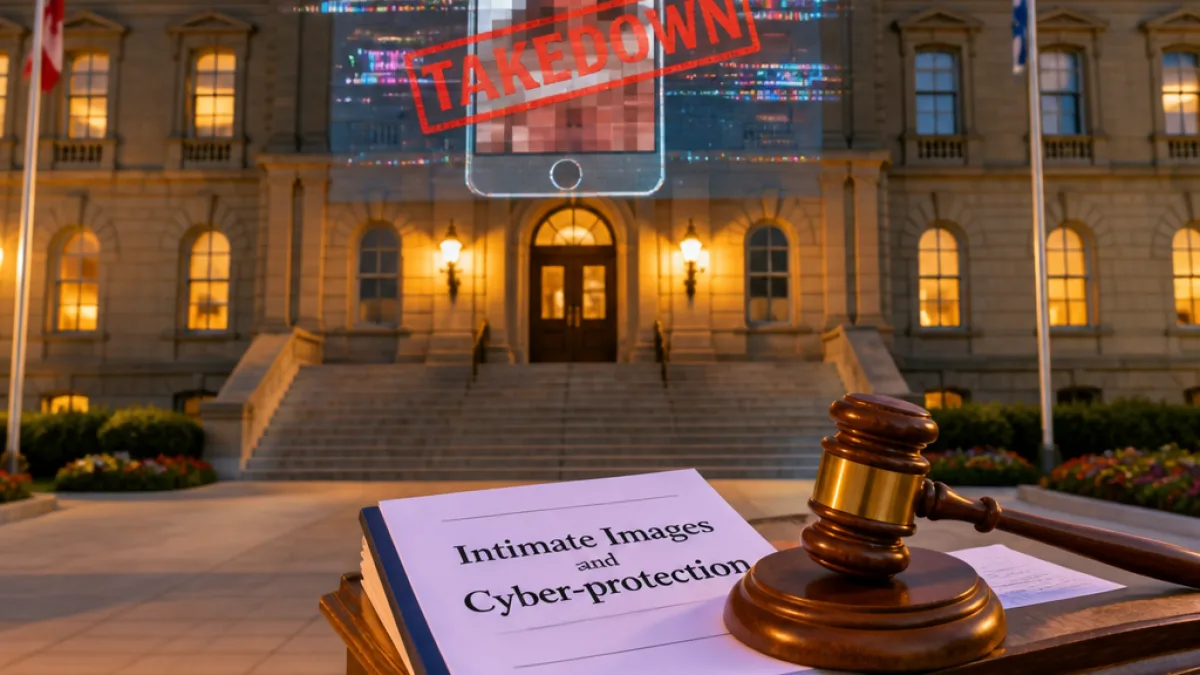
The proposed amendments revise the province's Intimate Images and Cyber-protection Act, expanding the definition of what counts as an intimate image to explicitly include images created or modified using artificial intelligence without the subject's consent. Justice Minister Scott Armstrong said the changes remove the need for victims to prove images were posted without permission when applying to courts for takedown orders.
“Prior to these changes … if someone uploaded an intimate image of a victim, it was on the victim to actually prove that they did not give consent,” Armstrong said. “That’s not trauma informed. The victim shouldn’t have to do the work here.”
Armstrong told The Canadian Press the amendments will also criminalize threats to distribute intimate images — language that brings the provincial law into alignment with amendments made to the Criminal Code in June that targeted threats to share sexual deepfakes and other non-consensual intimate material.
Other provisions in the bill
The package of changes is not limited to online harms. The government is proposing adjustments to the Safer Communities and Neighbourhoods Act that would grant the province broader authority to take control of properties suspected of hosting serious criminal activity. The province says that tool will be used, among other things, to combat human trafficking.
Officials also say the legislation contains measures aimed at modernizing 911 services and other public-safety improvements, though the government has not released detailed technical timelines for those elements.
- Expanded definition of intimate images to include AI-generated or altered images created without consent.
- Evidence burden reduced — victims will no longer be required to prove images were shared without consent to pursue court takedown orders.
- Threats outlawed — making it illegal to threaten to share intimate images, aligning with recent federal Criminal Code changes.
- Property-control powers bolstered under existing anti-occupancy law to address serious criminal activity, including human trafficking.
- 911 modernization and other public-safety amendments included.
Why it matters locally
Nova Scotia joins other jurisdictions grappling with the rapid rise of synthetic media — sometimes called deepfakes — and the novel harms they can cause. For victims, the ability to secure removal orders without proving lack of consent represents a shift toward reducing retraumatization within the justice process.
Legal experts and advocates have warned that AI makes it easier to produce realistic images that falsely depict someone in intimate situations. By broadening the legislative definition, the province aims to close a gap where older statutes could be interpreted as applying only to images actually produced by or captured of the subject.
How the changes relate to federal law
Federal Parliament amended the Criminal Code this past June to criminalize threats to share non-consensual intimate images, including sexual deepfakes. The Nova Scotia bill mirrors that approach at the provincial level for civil takedown and protection tools, creating a complementary legal framework for victims seeking recourse.
| Area | Change |
|---|---|
| Definition of intimate image | Expanded to include AI-generated/altered images |
| Legal burden | Victims need not prove lack of consent for takedown orders |
| Threats | Prohibited — aligns with Criminal Code update |
| Safer Communities Act | Increased provincial powers over suspected criminal properties |
Next steps and public impact
The bill was tabled this week and will proceed through the legislative process, including debate and committee review. If passed, it would alter how victims, courts and law enforcement approach cases involving AI-manipulated intimate material.
For residents concerned about non-consensual sharing of intimate images, the government says the changes are intended to speed access to remedies and reduce the emotional and evidentiary strain on victims. The addition of property-control measures signals a broader public-safety strategy that ties online harms to on-the-ground enforcement tools.
As technology evolves, Nova Scotia's move reflects a growing recognition among policymakers that statutes must be updated to address harms enabled by artificial intelligence while coordinating with federal criminal law.
Reporting from Halifax.