The Nova Scotia government has amended its income-assistance regulations to exclude people living in tents from eligibility for an enhanced rate of benefits, a change that legal advocates say effectively reverses a recent Court of Appeal decision.
What changed
The provincial government filed an order-in-council on Aug. 25 that substitutes the word “accommodation” in the income-assistance rules with the phrase “lives in a home.” It also repeals the previous definition of “home” and replaces it with a new definition that requires a primary residence to be a self-contained unit someone rents or owns, a room in a municipally approved or licensed lodging house, or a single-occupancy room in an approved supportive housing building.
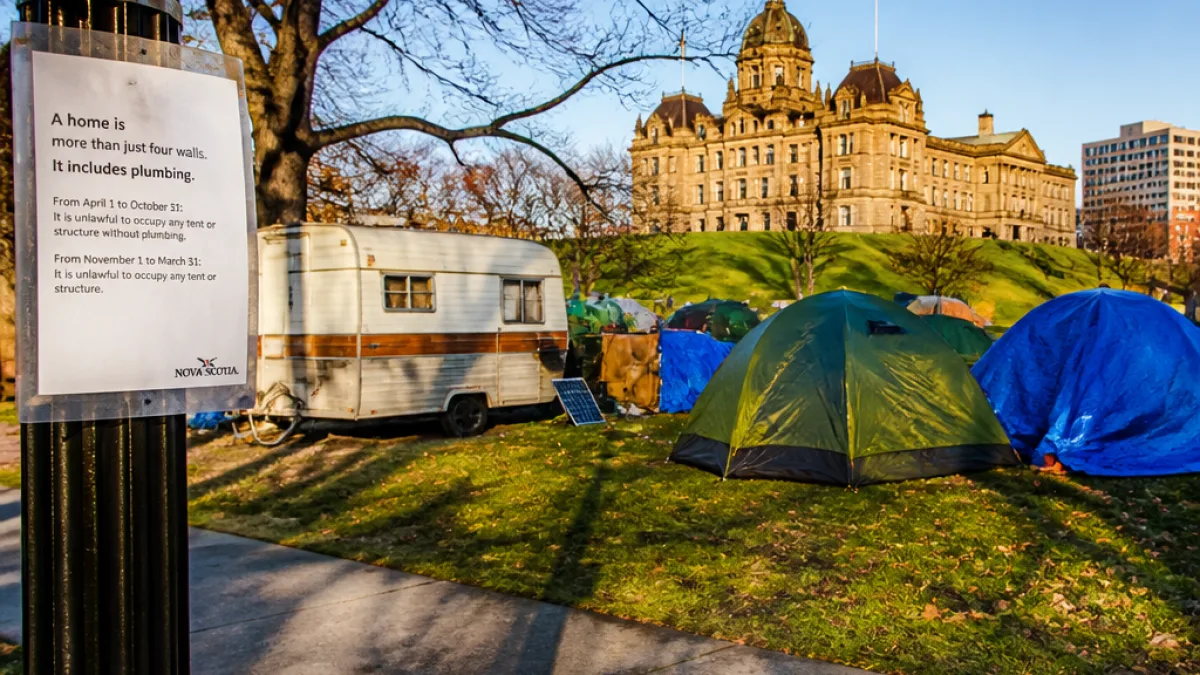
The definition of a self-contained unit now explicitly requires private living, kitchen and bathroom facilities, including a plumbed water supply and sanitary sewer disposal — a change that advocates say will exclude tents, cars, trailers and many other non-plumbed living situations.
Rates and eligibility
Under the province’s income-assistance structure, rates vary depending on whether a recipient is deemed to have a home and whether they meet additional criteria such as disability or age. The government says the amendments were made to provide clarity after the Court of Appeal’s ruling in August that had interpreted the previous wording to include a tent as accommodation.
| Recipient situation | Monthly rate (illustrative) |
|---|---|
| Single person without a home | $410 |
| Single person with a home | $738 |
| Person with a home and disability or 55+ | $1,022 |
These figures reflect the structure the province uses to calculate enhanced and basic income-assistance rates; the regulatory language now clarifies what living situations are counted toward those higher payments.
Response from the legal advocate
“It’s a very cruel policy decision by the province, and I think Nova Scotians will judge them accordingly,”
The comment from Halifax lawyer Vince Calderhead, who represented the late Bradley Lowe’s estate, underscores the criticism aimed at the government. Calderhead argued the new language was drafted specifically to overturn the Court of Appeal’s interpretation that Lowe’s tent amounted to his accommodation.
Lowe died in December 2023 after an overdose while living in a tent; two months earlier he had applied to move from a basic monthly benefit to the enhanced rate, arguing he owned and lived in his tent. A lower court had previously found he did not meet eligibility, but the Court of Appeal in August concluded the tent could qualify as accommodation under the prior wording.
Government rationale
The Department of Community Services told The Canadian Press the August court decision had called for clearer regulatory language. Officials said the amendments are intended to give program administrators firmer direction on how different living situations are assessed when determining eligibility for income-assistance rates, and to ensure consistent application of the program.
The regulatory change was filed on the recommendation of Susan Corkum-Greek, minister of opportunities and social development, and took effect the day it was filed.
Local impact and broader concerns
Advocates and lawyers say the practical effect will be to deny higher-income-assistance rates to people living outside plumbed, conventional housing, including those in tents, cars and many trailers. Critics frame the move as a policy choice that will push some of the province’s poorest residents into deeper precarity rather than finding ways to extend supports.
- Legal advocates: say the amendment nullifies the Court of Appeal’s reading that broadened eligibility.
- Province: argues the change clarifies how assistance is administered and ensures consistency.
- People affected: those living in non-plumbed shelters may remain eligible for basic benefits but will likely be excluded from the enhanced rate tied to having a defined “home.”
Questions remain about how the amendment will be applied in borderline cases — for instance, people living in vehicles or certain types of trailers — and whether there will be legal challenges to the regulation change itself. Calderhead has previously suggested that people living in cars may have qualified under the Court of Appeal’s interpretation; the new plumbing requirement appears aimed at narrowing that scope.
The regulatory amendment raises broader policy questions in a province where housing affordability and homelessness have been persistent issues. By tightening the definition of who counts as having a home for assistance purposes, the government has signalled a clearer line between those it considers housed and unhoused — a line that will now be measured in part by access to running water and sewer connections.
As the new rule takes effect, advocacy groups, legal counsel and people with lived experience will be watching closely to see how the government implements the change and whether further legislative or judicial steps follow.