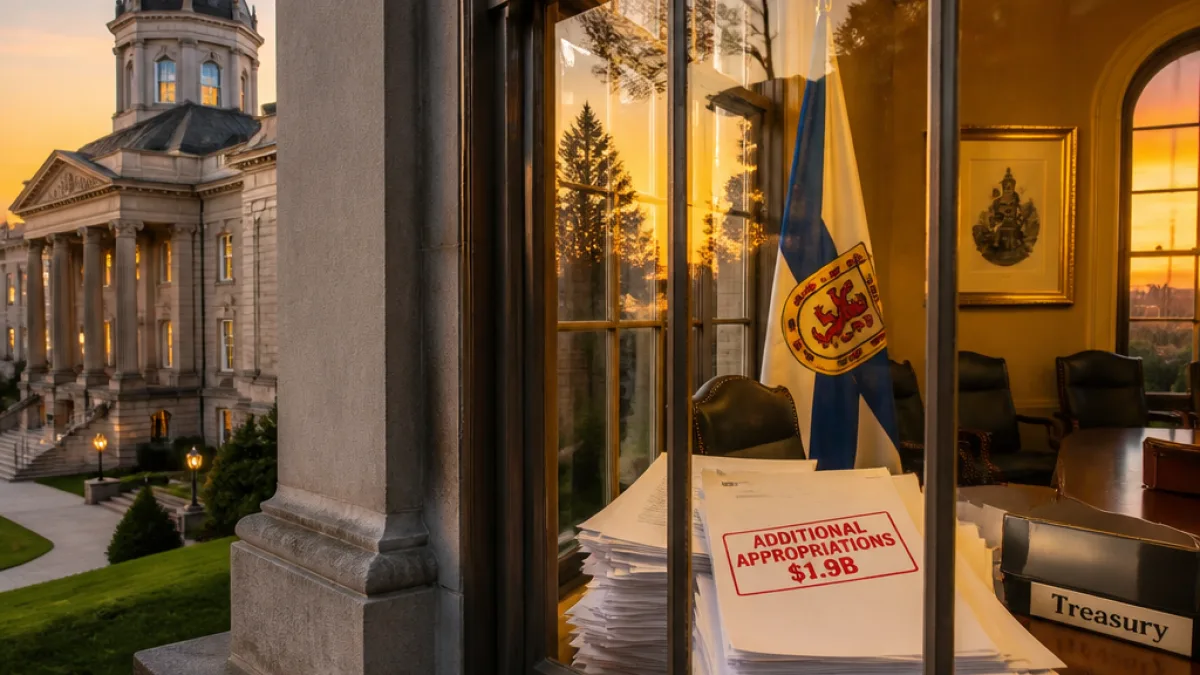
The Nova Scotia government says it spent a record $1.9 billion more than what the legislature approved for the 2025–26 fiscal year, prompting renewed scrutiny of how additional appropriations are used and the province’s approach to fiscal oversight.
Finance Minister John Lohr outlined the figure at a news conference Thursday, describing the excess spending as the result of “additional appropriations” — funds not included in the budget that are approved by cabinet rather than through a vote in the legislature.
“We need to be flexible as a government, and we will continue to do that,” Mr. Lohr said.
The province closed the 2025–26 year with a record-high deficit of $1.4 billion. Revenues were reported at just under $18 billion, but were outpaced by spending of about $19.4 billion, the finance department said. Net debt ended the year at $24.1 billion.
How the extra spending was used
Mr. Lohr said much of the additional money went to health-care services and programs for seniors. The government also identified specific items covered by the additional appropriations, including:
- $40.4 million for public works projects;
- $13.8 million for emergency management expenses related to the 2025 wildfire season;
- $420 million listed as funds set aside for anticipated commitments that have not yet been finalised and therefore could not be publicly detailed.
Officials would not confirm whether the $420-million reserve related to potential costs tied to a previously legislated wage restriction. A 2015 bill — Bill 148 — that limited pay increases was later ruled unconstitutional by a Supreme Court judge earlier this year, and the province faces potential settlement obligations. Mr. Lohr said the government has until February of next year to reach a settlement and that the matter remains before the courts; he declined to say how much any settlement might cost.
Auditor general’s concerns and legislative oversight
The auditor general has repeatedly called for stronger oversight of government spending that falls outside the formal budget process. Additional appropriations are a long-standing mechanism that allows the executive branch to move money without returning to the legislature for a vote, a practice critics say undermines parliamentary scrutiny.
Opposition parties have seized on the new numbers to question transparency and fiscal management. The details released by the Department of Finance do not fully explain the nature of the $420 million in reserved funds, leaving unanswered questions about future obligations and program commitments.
Context and potential implications
Nova Scotia’s fiscal picture for 2025–26 shows revenue slightly higher than planned but spending that exceeded expectations by a wide margin. A record additional appropriation total and a sizeable deficit increase pressure on the government to explain its fiscal discipline and priorities amid growing demands on health and senior services.
For residents, the practical consequences may include constrained capacity for new program spending or taxes and service trade-offs in future budgets as the province works to manage its debt. The government’s approach to additional appropriations will likely animate debate at public accounts committees and in the legislature as parties push for clearer rules around off-budget spending.
| Metric | 2025–26 figure |
|---|---|
| Revenue | Just under $18 billion |
| Total spending | $19.4 billion |
| Additional appropriations | $1.9 billion |
| Deficit | $1.4 billion |
| Net debt | $24.1 billion |
Government spokespeople defended the practice as necessary flexibility to respond to unanticipated needs, including urgent health-care costs and emergency responses. But the lack of detailed public accounting for large reserved amounts such as the $420 million has added urgency to calls for reform.
As the province moves into the 2026–27 fiscal year — when it expects another significant deficit — Nova Scotians and their elected representatives will be watching for clearer explanations of how additional appropriations are justified and spent, and whether new measures will be introduced to strengthen legislative oversight.
Reporting for this story relied on statements from the Department of Finance and public comments made by Finance Minister John Lohr during the September briefing. Questions about the exact nature of some reserved funds remain unresolved and are likely to be pursued by the legislature and the auditor general in coming months.