
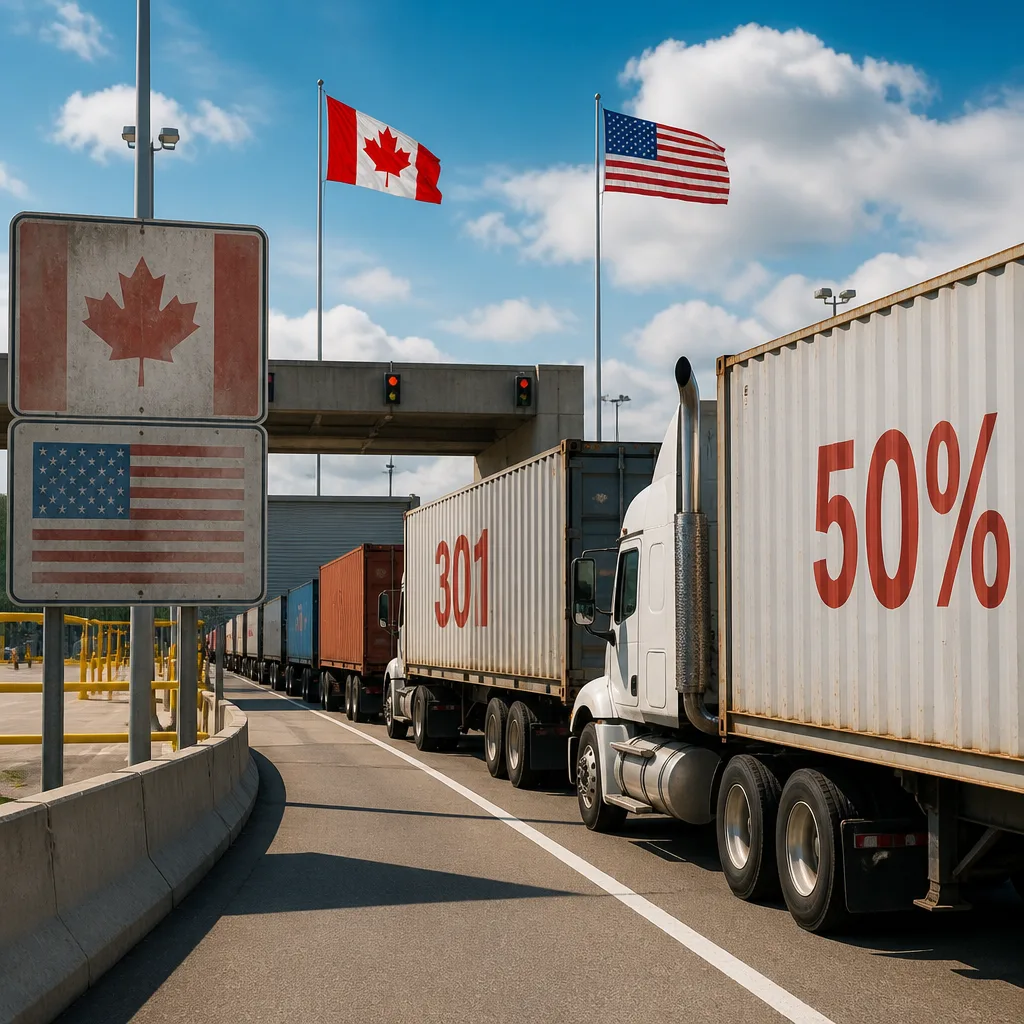
Washington’s recent tariff actions against Canada and other trading partners are being read in Ottawa and global markets as a signal that the United States may no longer reliably uphold treaty commitments — with potential consequences for investment and supply chains.
What happened
In July, the U.S. administration imposed a new set of duties that included a 50 per cent tariff on some Canadian goods. Those measures came just days before the U.S. Trade Representative, Jamieson Greer, announced fresh Section 301 tariffs covering trading partners that represent nearly 99 per cent of American trade. The moves followed a separate set of measures that had relied on emergency authority under the International Emergency Economic Powers Act. The latter IEEPA-based tariffs were subsequently struck down by the U.S. Supreme Court.
Throughout the recent rounds of measures, the administration has allowed exemptions for goods that comply with the USMCA — the trilateral trade pact among Canada, the United States and Mexico — but other authorities have been used to impose sector-specific duties. Since early 2025, Washington has applied Section 232 powers to levy tariffs on Canadian steel, aluminium, autos and lumber. Ottawa has responded with its own sectoral counter-tariffs.
“do not retaliate.”
That message — reported as an intended Washington signal when the administration introduced the measures — has in practice been interpreted differently abroad, according to analysts writing in commentary reproduced in Real Clear World. Rather than projecting control, the actions are being read as evidence of unpredictability.
Why it matters to Canada and investors
Trade lawyers, economists and business groups say the overriding concern is what this pattern communicates about the sanctity of trade agreements. The U.S. previously ratified the USMCA with Congressional approval and presidential assent; critics argue that new unilateral tariffing under different authorities undermines the value of such approvals.
That erosion of certainty can translate quickly into economic costs:
- Direct export losses for affected Canadian sectors already facing duties, such as steel, aluminium and lumber.
- Higher compliance and transaction costs for firms trying to navigate overlapping exemptions and authorities.
- Broader investor hesitancy as multinational firms reassess supply chains that cross the Canada–U.S. border.
The commentary notes that the U.S. administration has complained only two countries retaliated against earlier 2025 American tariffs: China and Canada. In response to U.S. sectoral tariffs, Ottawa enacted its own targeted countermeasures — a predictable trade-retaliation pattern that Washington appears to have intended to deter.
Legal and political consequences
There are also constitutional and legal dimensions. After the Supreme Court struck down IEEPA-based tariffs, observers point to the Court’s suggestion that long-term tariff policy should rest with Congress. The recent Section 301 and 232 manoeuvres highlight competing executive authorities to impose trade restrictions, but the Court’s decision signals potential judicial limits on emergency powers used for trade policy.
That legal uncertainty creates avenues for U.S. businesses seeking relief; it could also lead to new litigation if companies or foreign governments challenge the latest tariffs. The resulting court fights would prolong uncertainty for exporters and importers alike.
What to watch next
Key items to monitor in the coming months include whether Ottawa expands or adjusts its counter-tariffs, whether U.S. courts or Congress intervene to curb executive tariff powers, and how global investors recalibrate risk assessments for North American supply chains.
| Measure | Authority | Notable element |
|---|---|---|
| July tariffs on some Canadian goods | Executive proclamation | 50% duties on specified items |
| Section 301 tariffs | USTR announcement | Targets partners covering ~99% of U.S. trade |
| Section 232 sectoral tariffs | Since early 2025 | Steel, aluminium, autos and lumber |
For Canadians, the larger story is less about any single duty and more about the precedent it sets. If a trading partner that helped negotiate and ratify a continental trade agreement can be subject to sweeping unilateral tariffs, governments and firms alike will need to decide how to protect jobs, maintain market access and encourage investment in an era of renewed trade volatility.