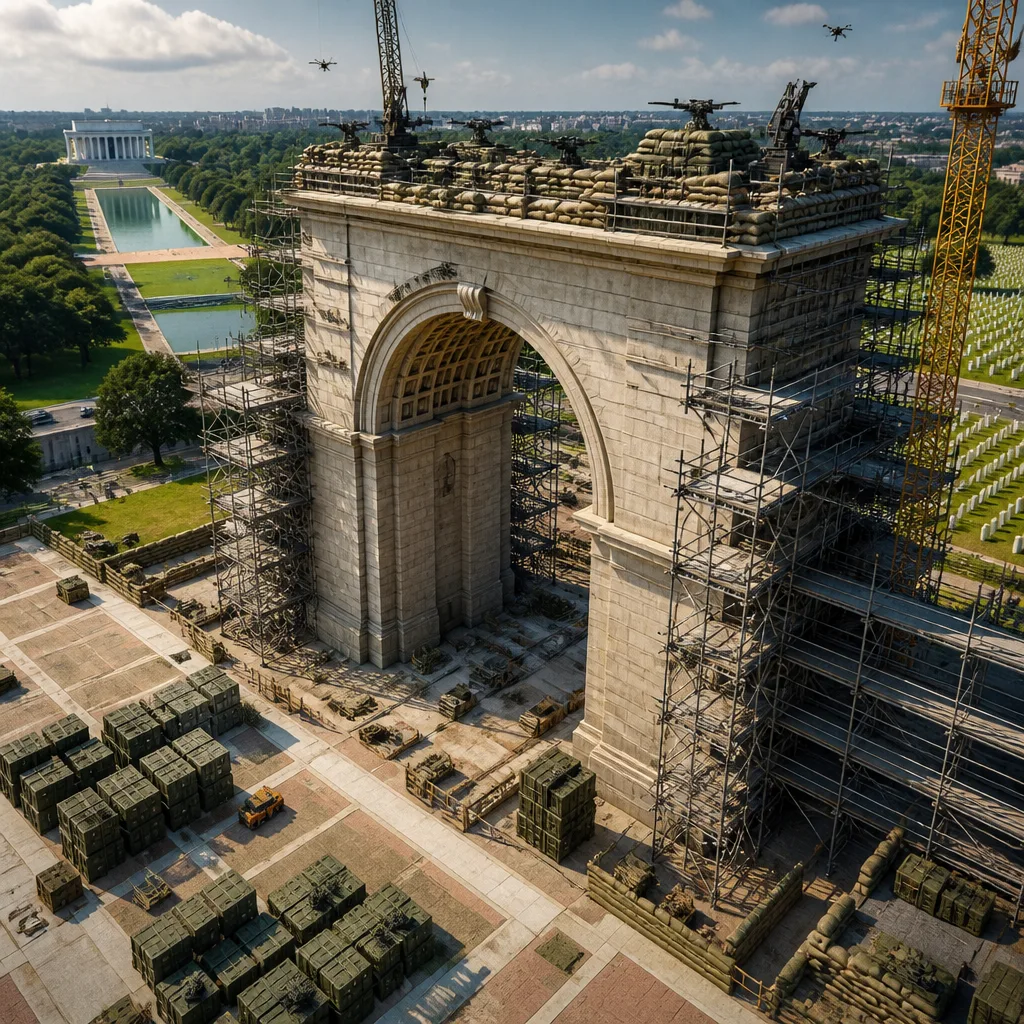
President Donald Trump said the massive arch he plans to build between the Lincoln Memorial and Arlington National Cemetery would be converted into a "top grade military complex" able to host drones, accommodate snipers on roofs and plazas, and store large quantities of sniper ammunition.
What the president announced
In a social media post, Mr. Trump said he had agreed, at the "strong request" of the military, to adapt the proposed memorial arch — planned as a 250-foot-tall (76-metre) structure — for defensive and force-projection functions. The Pentagon said it had no information beyond the president's statement.
"...into a top grade Military Complex/Triumphal Arch, to house, store, and have the rapid ability to use large numbers of drones, plus Snipers, on both the roof and plaza areas..."
Where the arch is proposed and why it matters
The arch is proposed for a traffic circle adjacent to the Memorial Bridge, one of a handful of crossings that link the capital to northern Virginia. The site is within a heavily trafficked area and sits in a nationally sensitive landscape that includes the Lincoln Memorial and Arlington National Cemetery.
The project is among several high-profile initiatives Mr. Trump has pursued to reshape Washington. Other efforts include renovations at the White House, plans affecting the Kennedy Centre and changes to the Lincoln Memorial reflecting pool. All have drawn attention for their scale and their potential to alter well-known civic spaces.
Legal and procedural hurdles
Although the U.S. Commission of Fine Arts has given early approval to the arch — its members were appointed by Mr. Trump — a group of three veterans and an architectural historian have launched a lawsuit arguing that the project requires congressional approval. That litigation puts the proposal on uncertain legal footing and could delay or block construction depending on how courts interpret statutory authority over memorials and use of federal land.
Mr. Trump's framing of the arch as a military facility introduces additional questions about the scope of executive control over public monuments and the role of the armed forces in civilian spaces. The Pentagon's statement that it had no further information underscores that, as of now, no formal defence plan or military authorizations have been publicly disclosed.
Broader implications
The president has used similar language about other projects, describing a new White House ballroom as a "military complex" and defending large-scale aesthetic changes on national-security grounds. Those assertions raise policy and oversight issues:
- How civilian memorials and public spaces can be repurposed for defence activities.
- Which federal bodies have authority to approve military uses of monuments or federal land.
- Potential safety and access impacts for residents, visitors, and commuters in high-traffic areas near federal sites.
| Project | Status |
|---|---|
| Proposed 250-foot arch | Early approval by U.S. Commission of Fine Arts; facing lawsuit |
| White House ballroom | Described by president as serving defensive purposes |
| Lincoln Memorial reflecting pool | Planned refurbishment |
Legal challenges and the absence of confirmed Pentagon involvement mean the proposal remains contested. If the courts find congressional approval is required, the arch could be delayed substantially or altered in scope. Conversely, if the executive branch and appointed agencies retain the authority to approve and modify memorial designs, the president's vision may proceed more quickly.
Beyond legal outcomes, the president's characterization of memorial projects as defensive installations could set a precedent for future administrations. It raises policy questions about the separation of commemorative functions from tactical military use — questions that will likely be aired in court filings and public debate as the project advances.
The combination of high symbolic value, heavy public use of the proposed site, and the president's assertive framing ensures the arch will remain a focal point for legal, political and civic scrutiny in the months ahead.