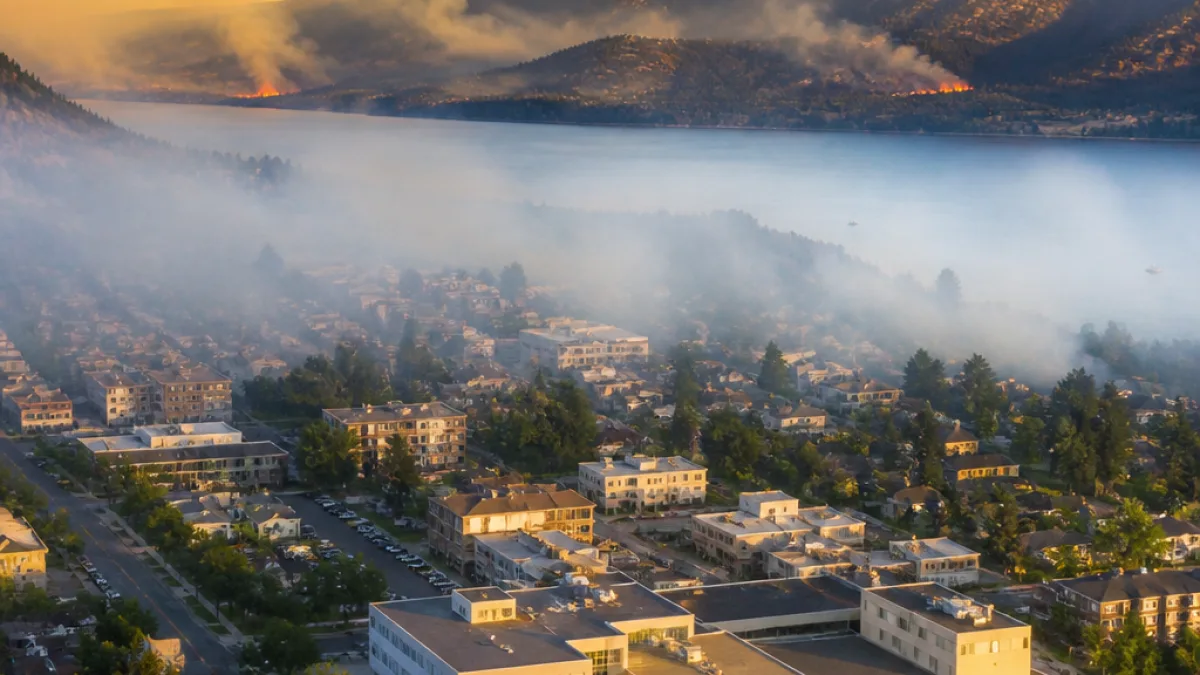
PENTICTON — A heavy blanket of smoke has settled over parts of the B.C. Interior, cutting air quality in cities such as Penticton even as the same haze is moderating flame behaviour on a number of active blazes.
Smoke a mixed blessing for crews
Cliff Chapman of the B.C. Wildfire Service said smoke has pooled in valley bottoms and created a layer that reduces the supply of clean oxygen to flames, helping to slow fire spread in some locations.
"The smoke has settled in valley bottoms and helps to suppress the flames by preventing the fires from getting clean oxygen," Chapman said.
At the same time, Chapman cautioned that the situation is volatile. A shift in weather that clears the smoke could allow winds and fresh air to reach hot spots, increasing the potential for fire growth.
Scale and behaviour of the season's fires
Provincial figures provided by the Wildfire Service show about 100 fires are burning across British Columbia, with roughly half described as out of control. Officials report that several fires have exhibited growth in recent days despite tempered wind conditions, a sign that underlying dryness and prolonged drought are sustaining fire intensity.
Those dryness factors mean crews face a double challenge: they are fighting flames while anticipating rapid changes if smoke layers dissipate or weather shifts.
Local impacts: evacuations, air quality and services
The Bald Range fire near Summerland forced thousands of people to evacuate the weekend before, and smoke from that blaze has been a major contributor to the hazy skies observed in Penticton and surrounding communities.
Health authorities routinely advise people in affected areas to limit outdoor activity, particularly children, older adults and those with respiratory or cardiac conditions. Individuals concerned about air quality should consult local public-health bulletins and use official air quality indices to decide whether to reduce exertion or stay indoors.
- Where smoke is worst: valley bottoms and low-lying areas are experiencing the heaviest accumulation.
- Who is most at risk: people with asthma, COPD, heart disease, older adults and infants.
- Practical precautions: reduce strenuous outdoor activity, keep windows closed when smoke levels are high and seek cleaner-air spaces if symptoms worsen.
Support for communities and infrastructure
Telecommunications company Telus announced a $2 million commitment to communities affected by the wildfires. The funding, the company said, will be directed toward maintaining network connectivity, providing data top-ups and issuing bill credits for customers in impacted areas.
Maintaining communications is a critical piece of response and recovery. With large numbers of residents displaced in regions such as the South Okanagan, stable cellular and internet access helps families coordinate, access emergency information and receive support.
| Metric | Detail |
|---|---|
| Active fires in B.C. | About 100 |
| Out-of-control fires | Roughly half of active fires |
| Corporate support | Telus: $2 million for connectivity and customer relief |
What comes next
Fire behaviour remains highly dependent on short-term weather patterns. Officials said that while smoke accumulation can temporarily reduce fire spread, any clearing winds or increased ventilation can reverse that effect quickly. Residents should follow evacuation orders and regional updates from the B.C. Wildfire Service and local emergency-management offices.
As crews work to contain blazes, authorities continue to monitor fuel conditions across the landscape. The persistence of drought and low humidity in southern B.C. means the province could see active and unpredictable fire behaviour until substantive rains or cooler, wetter weather arrive.
For now, the people of the South Okanagan face poor air quality and disrupted lives, even as that same smoke provides a partial shield against the most aggressive fire behaviour. The coming days will test whether that temporary equilibrium holds or whether a change in the elements will demand a renewed surge in firefighting effort.
Reporting from the South Okanagan. Updates will follow as provincial authorities release new information.