
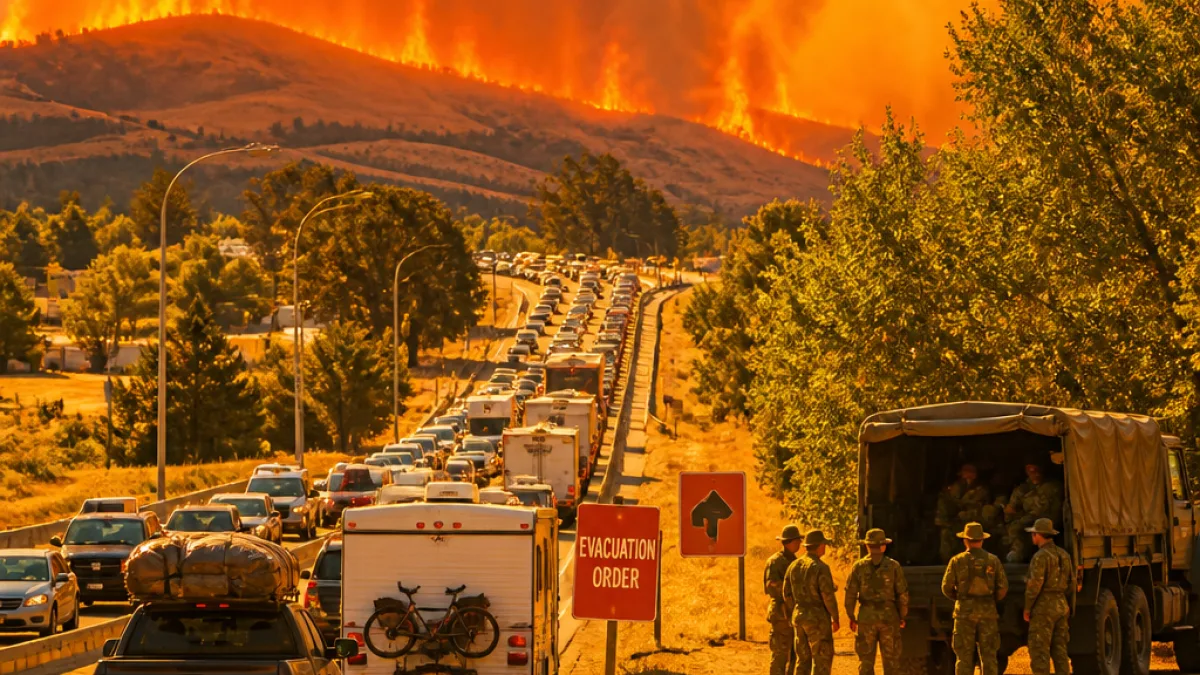
Federal forces prepared to assist as blazes threaten communities
Canadian military units have been placed on standby to support provincial authorities as a wave of wildfires sweeps across British Columbia, forcing tens of thousands of people from their homes and causing at least one fatality, officials say.
The federal Defence Minister has confirmed that the Armed Forces are in contact with provincial representatives and are ready to deploy should British Columbia formally request help. The move comes as dozens of fires ignited over several days, with nearly half described as out of control because of a combination of heat, strong winds and prolonged drought conditions.
Evacuations and human toll
Authorities evacuated entire communities in the Okanagan and surrounding regions after aggressive fire behaviour threatened populated areas. Summerland, a town of about 12,000 residents, and neighbouring Peachland were among the areas ordered to clear out. Police and emergency officials say thousands remain displaced, and further evacuation orders are possible.
| Metric | Reported figure |
|---|---|
| People displaced | About 20,000 |
| Homes under evacuation order (preliminary) | ~10,000 |
| Additional homes that could be ordered out | 3,200 |
| Reported fatalities | 1 confirmed (an 80-year-old woman) |
The Royal Canadian Mounted Police reported that an 80-year-old woman died while attempting to leave the area near Summerland. Federal leaders, including the prime minister, expressed sorrow over the loss and pledged continued support to the province as it contends with the emergency.
Fires too intense for ready suppression in some areas
Officials described several blazes as exhibiting extreme behaviour; one of the more dangerous fires, burning in the Bald Range, has expanded rapidly and covers roughly 155 square kilometres. Dozens of helicopters have been assigned to water-bombing and support roles, but crews say the intensity and speed of the fires have made containment difficult.
“We could put another thousand helicopters and a thousand people on the ground, but it would not change anything.”
The blunt assessment reflects the scale of the challenge facing firefighters contending with high fuel loads, limited moisture and gusting winds.
Federal response and what standby means
When the Canadian Armed Forces are put on standby, military units prepare logistical, transportation and personnel resources so they can be mobilized quickly if requested by provincial authorities. The specific nature of assistance — whether it will involve search and rescue, evacuation assistance, supply distribution, or specialised aerial firefighting capacity — depends on the province’s needs and an official request for federal support.
- Standby posture: Forces ready to deploy pending a formal request from B.C.
- Local impacts: Mass evacuations, road closures and disruptions to power and services
- Firefighting assets: Multiple helicopters assigned; ground crews deployed where safe
Community concerns and next steps
Mayors and local emergency planners have cautioned residents that there is no immediate timeline for returning to evacuated areas. Officials say infrastructure assessments — including checks of damaged power lines and the safety of buildings — must take place before displaced people can be allowed back.
Emergency shelters and reception centres are being established. Residents under evacuation orders are urged to follow official directions from local authorities and to register with emergency services to help families reconnect and to assist with relief planning.
As the province weighs requests for outside help, federal and provincial officials continue to monitor fire behaviour closely. Forecasts for temperatures, wind and precipitation will be critical in determining how quickly crews can get the blazes under control and when evacuees might safely return.
This evolving situation has significant implications for communities in the Interior and surrounding areas. Officials have stressed that conditions remain dangerous and unpredictable — and that public safety decisions will be guided by on-the-ground assessments.
Further updates are expected from provincial emergency management and federal authorities as requests for assistance are clarified and additional resources are mobilized.














