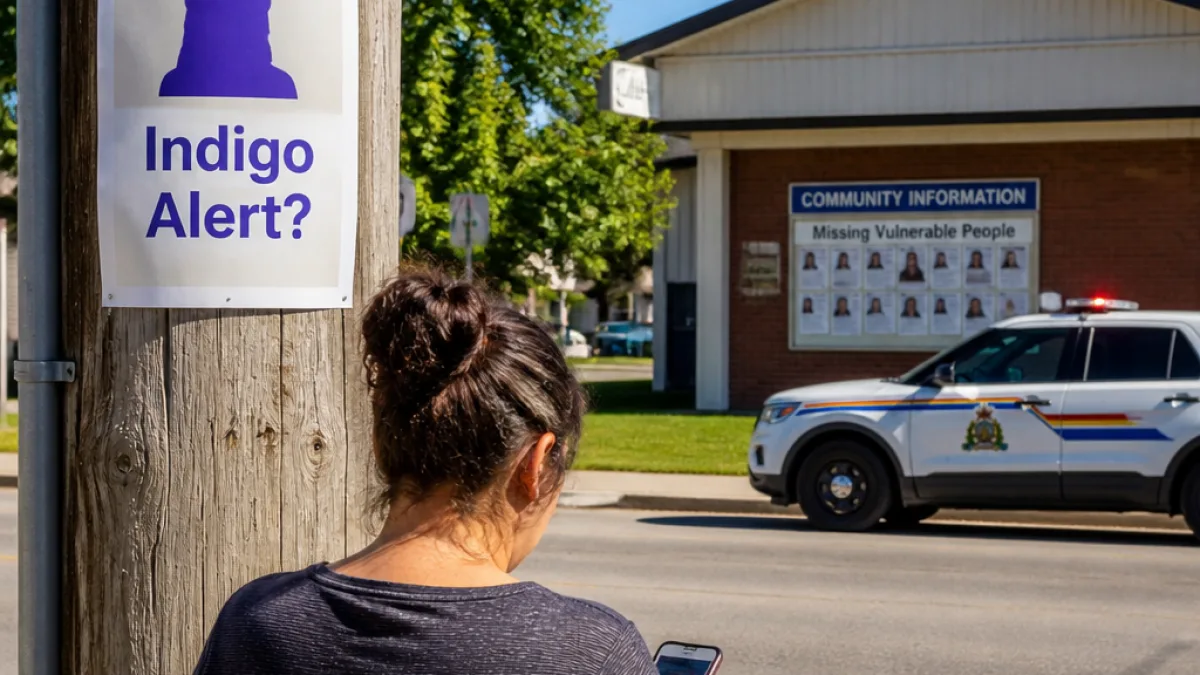
A Saskatchewan mother is calling on provincial and municipal authorities to adopt an Indigo Alert system that would target searches for missing people with cognitive or communication disabilities, arguing existing public-notification systems such as the Amber Alert are too restrictive to protect the most vulnerable.
Why an Indigo Alert?
The mother, who asked to speak about her family’s experience and was interviewed in a wide-ranging conversation with local media, says her eldest daughter is medically complex — diagnosed with level-three autism and uncontrolled epilepsy — and may not understand everyday dangers or instructions from strangers.
“We’re thinking about the 11-year-old boy in Calgary back in July… and the intense search that we saw and we’re all scratching our heads thinking, ‘well, where is this boy?’”
She described how families caring for people with conditions such as advanced autism, dementia or other neurological disorders need an alert system tailored to those individuals’ behaviours and needs. An Indigo Alert, she said, could include warnings like “do not approach” and locality-specific details so the public knows how best to respond if they see the missing person.
How it would differ from Amber Alerts
The mother explained that Amber Alerts are designed primarily for suspected abductions and require strict criteria to be met before authorities issue them. That threshold, she says, can mean delays or no alert at all when someone with a cognitive impairment wanders and is unable to find their way home.
She pointed to a recent Calgary case in July, where an 11-year-old boy with autism went missing and was found dead after an intensive search. The family’s request that people who spotted him not approach but instead notify authorities was, she argued, illustrative of how different responses are required for vulnerable missing people.
What advocates propose
Although discussions about an Indigo Alert system are ongoing, advocates want a public-notification tool with features that could include:
- Local-area targeting so alerts are sent to residents nearest the disappearance;
- Behavioural guidance for the public (for example, "do not approach");
- Information tailored to non-verbal or easily frightened individuals;
- Rapid deployment even when criteria for Amber Alerts are not met.
Comparing alert systems
| Feature | Amber Alert | Indigo Alert (proposed) |
|---|---|---|
| Main purpose | Suspected abduction of a child | Locate missing vulnerable people (autism, dementia, non-verbal) |
| Criteria | Strict; requires evidence of abduction and imminent danger | Broader; based on vulnerability and risk factors |
| Public guidance | General tips (vehicle descriptions, last seen) | Behaviour-specific instructions (do not approach, call authorities) |
Local impact and practical concerns
Families caring for people with advanced autism, memory loss or other cognitive impairments say lost-time is critical. They want quicker public awareness tools and clearer guidance for citizens who may encounter a missing person who does not respond to normal social cues.
At the same time, officials must weigh privacy, the potential for alert overuse and the operational burden on emergency services. There is also a need for public education so recipients of an Indigo Alert understand how to act safely and effectively.
Voices from the community
In the interview, the mother recalled the pain and fear families endure when a vulnerable person leaves home. She said the psychological burden shapes daily life: constant supervision, contingency planning and the knowledge that a momentary lapse can lead to danger.
She urged provincial and municipal leaders to move from discussion to action so that other families do not face the same uncertainty and loss.
Next steps
Conversations about an Indigo Alert remain preliminary. Advocates hope that law enforcement, emergency-management officials and disability-rights groups will work together to develop clear criteria and operational guidelines for an alert system tailored to vulnerable people.
Until then, families and caregivers say they will continue pressing governments to adapt public-notification tools to the realities of those who cannot reliably follow directions or communicate their needs.
Contact and support: Families seeking more information about local services for vulnerable persons should consult municipal emergency-management offices, local police non-emergency lines and community health organisations for guidance and resources.