
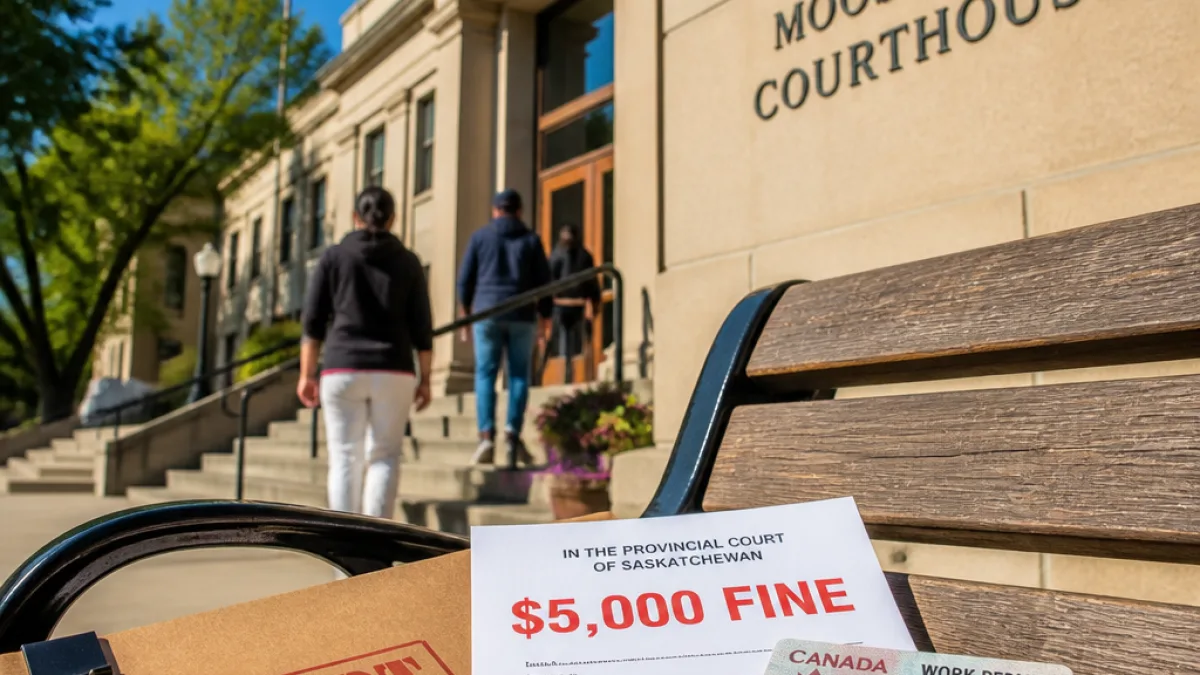
A Saskatchewan employer has been fined after pleading guilty to demanding money from a worker as a condition of maintaining his Canadian work permit, in what officials describe as one of the first convictions flowing from a provincial crackdown on foreign worker exploitation.
Fine follows admission of extortionate demand
Representatives of Dyan Jeny Enterprises admitted in court that they demanded $12,000 from an employee as a condition of keeping his Canadian work permit. The company was hit with a $5,000 fine after the guilty plea, according to court reporting.
The case was heard in provincial court in Moose Jaw, where the conviction was recorded. Provincial authorities have framed the outcome as an early success in enforcing tougher rules aimed at protecting temporary foreign workers from coercive practices.
Why the case matters
Advocates and labour-watchers have increasingly flagged situations where migrant workers face pressure, fees or other demands that jeopardize their employment and legal status. While prosecutions have historically been rare, this recent case shows provincial prosecutors are willing to pursue charges where employers allegedly exploit an asymmetry of power.
For workers who depend on an employer to hold a permit or to sponsor status in Canada, an extortionate demand can be especially coercive. The fine and guilty plea in this instance underline the legal consequences employers face if they seek payment in exchange for maintaining a worker’s immigration-related documentation.
What the province says
Officials have described the conviction as one of the first concrete results from a program designed to crack down on the exploitation of foreign workers. The provincial initiative aims to identify and prosecute employers who take advantage of the precarious position occupied by many temporary workers.
While details of the broader enforcement program and its timeline were not included in the court reporting, the conviction signals a shift toward more active policing of employer behaviour where it intersects with immigration status.
Practical implications for employers and workers
The ruling carries immediate implications for both employers and migrant employees in Saskatchewan:
- Employers should review hiring and retention practices to ensure no fees or payments are demanded in connection with immigration documents.
- Workers who face threats, demands for money, or conditions tied to their permits should seek advice from legal clinics, advocacy groups or government resources available for temporary foreign workers.
These steps are particularly important in industries where temporary foreign workers are common, and where language barriers or fear of reprisals can deter reporting.
Case record at a glance
| Item | Detail |
|---|---|
| Employer | Dyan Jeny Enterprises |
| Allegation | Demanded $12,000 from employee to maintain Canadian work permit |
| Outcome | Guilty plea; $5,000 fine |
| Court | Provincial court, Moose Jaw |
What’s next
Observers will be watching whether this conviction is followed by additional charges and enforcement actions, and how aggressively the province uses existing tools to deter exploitative behaviour. For workers and community groups, the ruling may provide greater confidence to report abuses knowing prosecutions are possible.
Meanwhile, employers who rely on temporary foreign labour would be wise to ensure their practices comply with provincial and federal requirements, and to document any fees or deductions to avoid allegations of coercion or improper demands.
The conviction offers an early benchmark for the province’s anti‑exploitation campaign, and a reminder that demands tied to a worker’s immigration status can carry criminal and financial penalties.