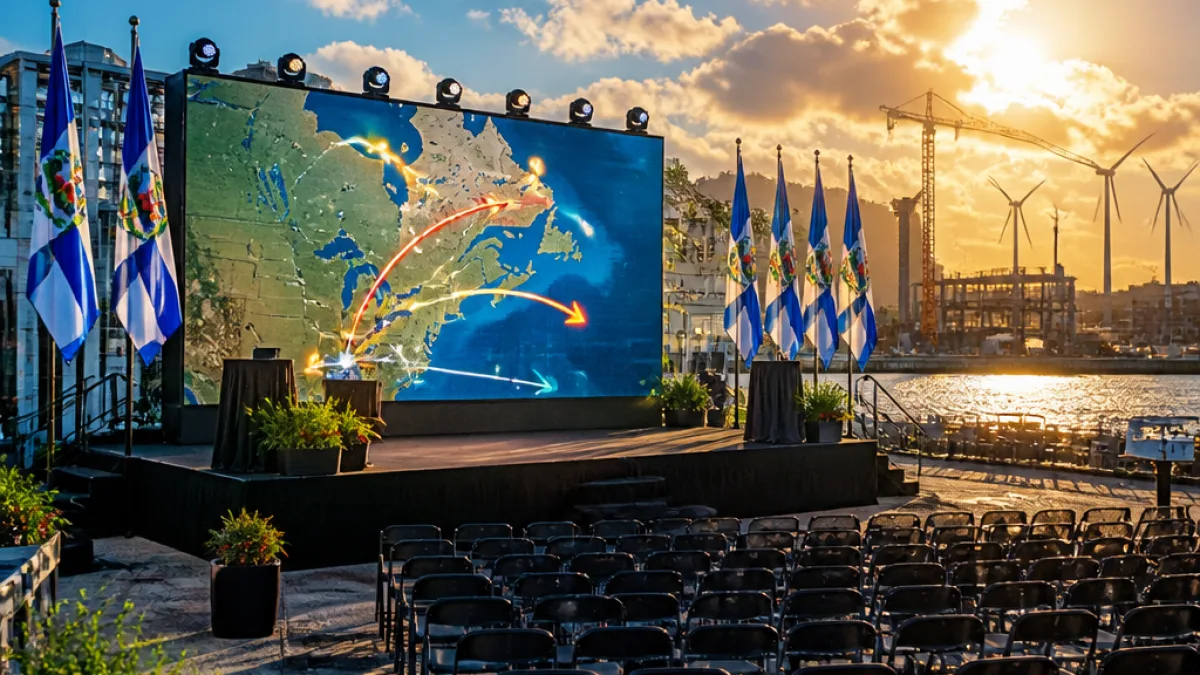
ST. JOHN’S — Federal and provincial officials on Monday unveiled a sweeping, non-binding agreement that, if finalized, would unlock more than $50 billion in hydro and wind developments in Labrador and redraw decades-old electricity links between Newfoundland and Labrador and Quebec.
Big build in Labrador, transmission through Quebec
The framework outlines plans for Hydro-Québec and Newfoundland and Labrador Hydro to share power generated on the Churchill River and to pursue a new portfolio of hydro, wind and transmission projects. Negotiators say the work could bring up to 14,000 megawatts of new and existing producing capacity into play and make available as much as 985 megawatts for transmission through Quebec to markets in the United States.
Prime Minister Mark Carney joined Newfoundland and Labrador Premier Tony Wakeham and Quebec Premier Christine Fréchette in St. John’s for the announcement. Officials described the arrangement as a tentative cooperation and implementation agreement, underwritten in part by the federal government.
What’s in the draft plan
- Construction of a 2.7 GW hydropower complex at Gull Island.
- Expansion of the existing Churchill Falls plant by 1.275 GW.
- Development of a 2 GW wind complex in the Churchill Falls area.
- Creation of the Labrador Western Transmission Line to link projects to the Quebec grid and beyond.
Negotiators said Hydro-Québec would purchase about two-thirds of the additional output, while Newfoundland and Labrador would retain the remainder to spur low-carbon industrial development in the province.
| Project element | Proposed capacity |
|---|---|
| Gull Island hydropower complex | 2.7 GW |
| Churchill Falls expansion | 1.275 GW |
| Wind complex near Churchill Falls | 2 GW |
| Available through-quebec transmission to U.S. | Up to 985 MW |
Historical context and political sensitivities
The accord seeks to resolve a contentious chapter in eastern Canada’s energy history. Since 1969, Hydro-Québec has purchased the majority of Churchill Falls’ output under a contract many in Newfoundland and Labrador regard as deeply unfavourable. That agreement runs until 2041 and has long been the subject of provincial efforts to achieve better returns and transmission access.
Newfoundland and Labrador’s Progressive Conservative government under Premier Wakeham had already re-opened the conversation after taking office. Wakeham said he had pushed for more power, greater value and clearer transmission rights through Quebec when he sent the 2024 memorandum of understanding back to negotiators for revision.
“I think this is a win‑win‑win situation,” Wakeham said about the draft agreement.
Federal role and technical scale
Officials likened the scale of the proposed developments to earlier large hydro projects in Quebec. Prime Minister Carney invoked the 1970s James Bay megaproject when describing the ambition and the technical challenges ahead.
“The technical challenges are immense and at scales unprecedented,” Carney said, adding the work would “build on that greatness to power tomorrow’s economy.”
Negotiators hope to conclude a final deal by year-end, but acknowledged timing risks. Quebec’s premier must call a provincial election by Oct. 5, and the political transition could affect negotiations and the eventual implementation of any agreement.
Local implications and next steps
For Newfoundland and Labrador the tentative deal offers potential new revenue streams and capacity to power low‑carbon industry on the island and in Labrador. For Quebec it promises long-term access to reliable supply and a role as the transmission corridor to continental markets.
Officials described the agreement as non-binding at this stage. Negotiators will now work on the detailed legal and commercial steps needed to finalize the pact before the end of the year, while communities, labour groups and stakeholders await specifics about timelines, jobs and environmental reviews.
Whether the arrangement ultimately secures final approval, and how it will be phased in across Labrador’s landscapes and watersheds, will be questions that shape the province’s economic outlook for decades.