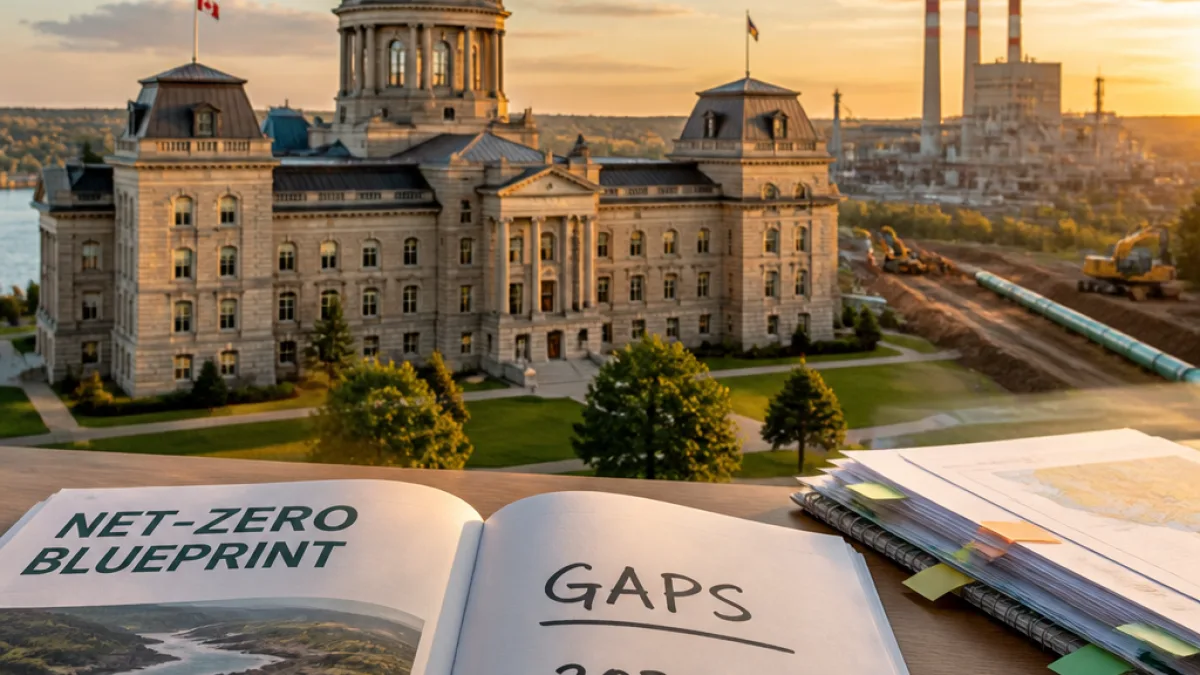
New Brunswick’s government has acknowledged its updated net-zero blueprint shows the province is not currently on course to reach net-zero greenhouse gas emissions by 2050, even as officials pursue projects and reviews that expand the role of natural gas in the province’s energy mix.
Blueprint published without fanfare
The new net-zero blueprint was posted online on Aug. 21 with no news release. The document states the province is “expected to reach our 2030 emissions target but is not currently on track to achieve net zero emissions by 2050.” It also identifies policy gaps in four of seven sectors and the possibility of gaps in a fifth.
Environment Minister Gilles LePage has signalled confidence in future technological advances to help New Brunswick meet its long-term goals.
“New Brunswick is expected to reach our 2030 emissions target but is not currently on track to achieve net zero emissions by 2050.”
Natural gas developments raise questions
The admission comes as the Holt government quietly launched a review of the provincial moratorium on shale gas development. Within days of that announcement, the province granted conditional environmental approval for a proposed natural gas-fired power plant in the Tantramar region and sought public input on a proposed policy framework for data centres — an area where natural gas may play a role in power and cooling.
Conservation and climate groups say the timing and direction are troubling.
“It’s surprising that they actually admit that, but it’s true,” said Beverly Gingras, executive director of the Conservation Council of New Brunswick, responding to the blueprint’s findings.
What the blueprint says — and what it doesn’t
The blueprint outlines the province’s pathway to reduce emissions across multiple sectors but flags several areas where current policy falls short. It does not, however, provide a firm plan to close the identified gaps; instead it notes that additional policy action will be required.
Officials have not tied the moratorium review or the Tantramar decision directly to specific measures in the blueprint, and the government published the document without a public release or detailed explanation of next steps.
- 2030 target: Province says it is expected to be met.
- 2050 net-zero: Not currently on track; policy gaps in multiple sectors.
- Recent actions: Moratorium review launched; conditional approval for Tantramar natural gas power plant; public consultation on data-centre policy.
Local advocacy and political implications
Environmental advocates argue that expanding natural gas infrastructure is inconsistent with the trajectory required to reach net-zero by mid-century. They say any short-term economic or reliability gains must be weighed against the long-term emissions consequences.
For the Holt government, the juxtaposition of an admission that the 2050 goal is in doubt and the advancement of gas-related projects presents a communications and policy challenge. Officials have to demonstrate how proposed developments and technology commitments fit within — or adjust — the province’s climate ambitions.
Table: Key dates and developments
| Item | Status / Date |
|---|---|
| Net-zero blueprint posted | Aug. 21 — published online without news release |
| Province’s 2030 target | Expected to be reached |
| Province’s 2050 net-zero target | Not currently on track — policy gaps flagged |
| Shale gas moratorium review | Launched days after blueprint publication |
| Natural gas power plant in Tantramar | Given conditional environmental approval |
Next steps and what to watch
The blueprint says additional policy is required but stops short of specifying firm timelines for closing the identified gaps. Observers will be watching for:
- Detailed government responses that set out measures and timelines to address the gaps identified in the blueprint;
- Final decisions and conditions tied to the Tantramar approval and any subsequent natural gas projects;
- Public consultations and outcomes from the review of the shale gas moratorium;
- How technological solutions invoked by government officials will be assessed for feasibility and emissions impact.
As New Brunswick navigates competing demands for reliable electricity, economic development and climate obligations, the province faces a narrow path to reconcile short-term decisions with long-term emissions commitments. The blueprint’s frank assessment — quietly released — may intensify scrutiny over how the Holt government intends to move from aspiration to action.