
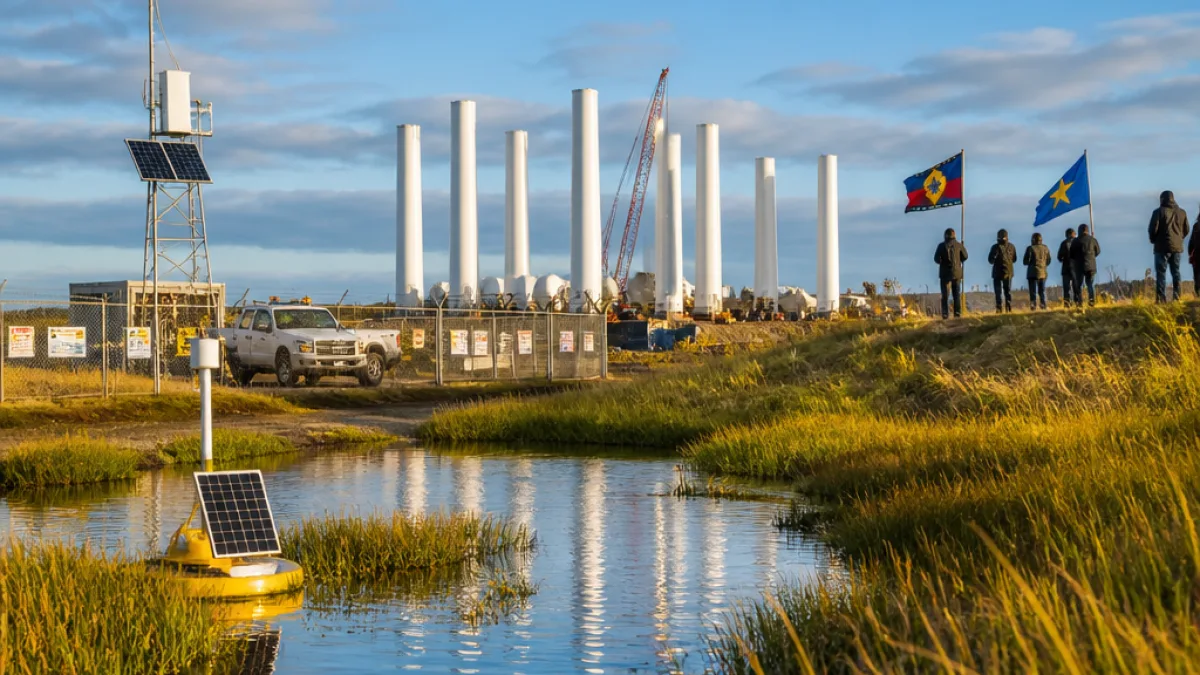
The New Brunswick government has given conditional approval for a 500‑megawatt natural gas and diesel generating station proposed for the Tantramar area in the province’s southeast, the Environment Department announced Friday.
Approval tied to conditions and monitoring
Provincial officials say the decision follows an environmental impact assessment and is contingent on a set of measures the proponent must meet before and after construction. NB Power — which contracted the project — described the approval as contingent on a series of 45 conditions. CBC News reported the department attached a nine‑page list of requirements.
The company chosen to build and operate the plant, U.S.‑based ProEnergy, would install 10 refurbished jet‑engine turbines in Centre Village, giving the facility the ability to produce up to 500 megawatts of electricity on short notice. NB Power has a 25‑year agreement with ProEnergy for the project.
Role in the province’s electricity system
NB Power says the generating station is needed as a backstop to cover a sharp rise in demand expected by 2028 and to provide reliable capacity when weather‑dependent renewables are not producing. Nova Scotia’s transmission operator has signed a 10‑year agreement to purchase 100 megawatts from the future plant.
| Item | Detail |
|---|---|
| Capacity | 500 MW (up to) |
| Turbines | 10 refurbished jet‑engine units |
| Fuel | Natural gas (when available) and on‑site diesel |
| Operator | ProEnergy (U.S.) under 25‑year contract with NB Power |
| Offtake | Nova Scotia: 100 MW for 10 years |
| Target in‑service | 2028 |
Conditions address local and environmental concerns
Among the measures reported by the Environment Department and in company documents are requirements for regular air and water‑quality monitoring, an emergency management plan developed with local officials and information sharing with Elsipogtog First Nation about potential impacts on plants and wildlife. ProEnergy’s project documents specify the turbines would burn natural gas from the Maritimes and Northeast Pipeline when available, and diesel fuel stored on site when gas is not accessible.
- Emergency management planning with local authorities
- Ongoing air and water monitoring
- Engagement and information sharing with Indigenous communities
- Controls on construction and operation to protect local ecosystems
Local reaction and outstanding concerns
The project has faced criticism from opposition politicians and environmental groups since it was first announced in July 2025. Residents and local stakeholders have raised concerns about potential effects on air quality, water use and discharges from the plant’s water treatment systems, as well as broader impacts on the regional ecosystem.
Shortly after the proposal was made public, community members questioned whether local water resources would be sufficient for the site’s needs and how treated effluent would be managed and monitored. The requirement for ongoing water‑quality monitoring is intended to address some of those concerns, though critics say monitoring alone does not eliminate potential risks.
Next steps and timeline
If ProEnergy meets the conditions set by the provincial Environment Department and secures required permits, construction would proceed with the aim of having the facility operational by 2028. NB Power describes the plant as a reliability resource to be deployed when intermittent renewable generation is insufficient.
The government’s conditional approval leaves space for further regulatory oversight during permitting, construction and operation. Local officials, affected residents and Indigenous neighbours remain engaged and likely to scrutinize compliance with the conditions as the project advances.
As New Brunswick balances growing electricity needs with climate and community concerns, the Tantramar project highlights the tensions that accompany large‑scale energy infrastructure decisions in the region.