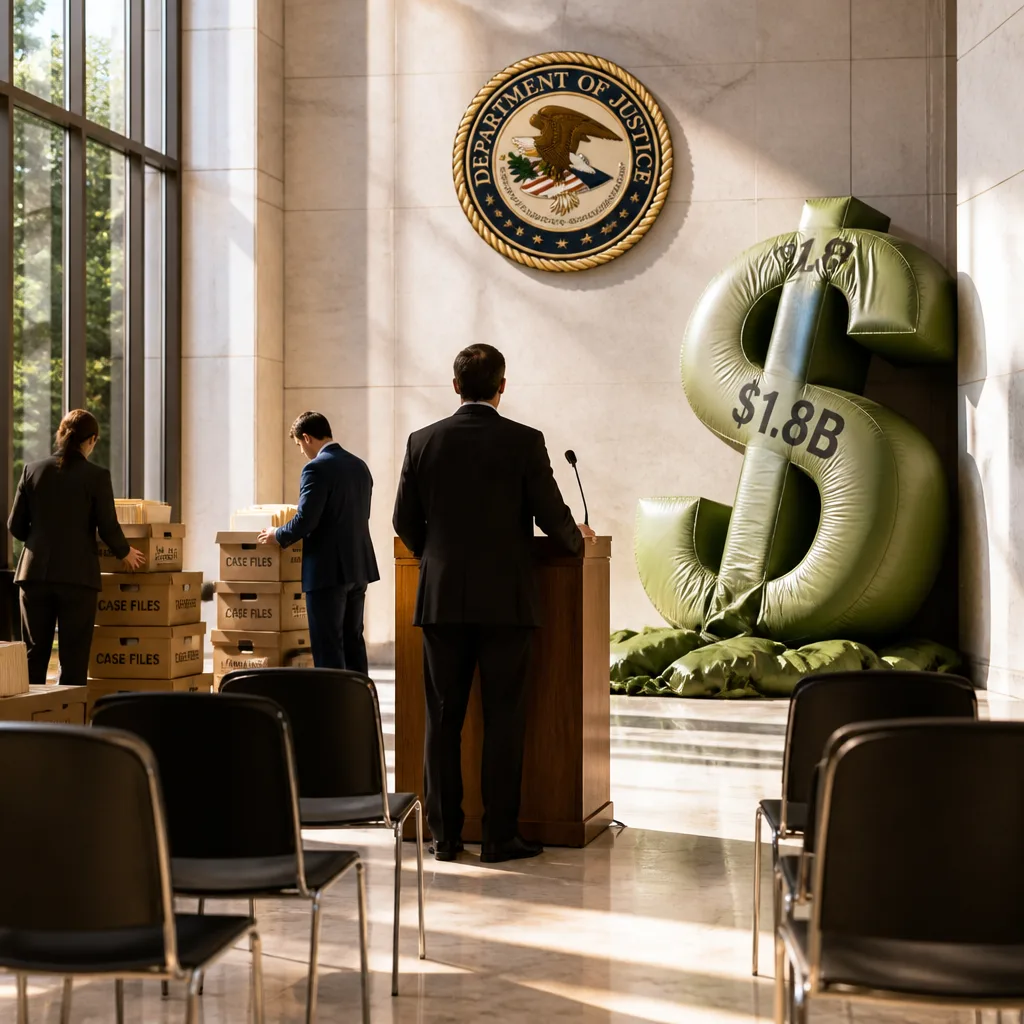
WASHINGTON — In his first remarks to Justice Department personnel since being sworn in this week, Attorney General Todd Blanche promised to steer the department with integrity and to apply the rule of law “fairly and impartially,” even as the agency grapples with criticism, staffing losses and the collapse of a high‑profile compensation plan.
Blanche used a roughly 20‑minute speech to underscore the department’s operational achievements and to urge staff to set aside politics to pursue common goals. He singled out recent enforcement results — including the seizure of thousands of pounds of fentanyl, the capture of the majority of the FBI’s 10 most wanted fugitives and the arrest of what he described as “tens of thousands of violent offenders” involved in drug and human trafficking — as demonstrations of the department’s impact.
“It’s easy to focus on the negative or the news story that is critical of something that we’re doing or something that we’ve done ... but do not forget that we have accomplished a tremendous amount of good, positive work in the past year and a half.”
Those accomplishments were presented alongside frank acknowledgement of turbulence inside the department. According to reporting cited in his speech, the Justice Department suffered the loss of about 3,000 attorneys and staff between January 2025 and early 2026 through buyouts, firings, resignations and retirements — a figure that has raised questions about capacity and institutional stability.
Rescinded fund and confirmation path
Blanche also addressed a recent controversy tied to an initiative he negotiated in May: an $1.8‑billion “Anti‑Weaponization Fund” intended to compensate people who said they had been targeted by a politically weaponized government. He has formally rescinded the order establishing that fund to secure confirmation as attorney general, and he told staff that the fund is now “dead.”
That move came amid public scrutiny of whether the Justice Department had been used for partisan ends during the previous presidential term. Critics accused senior officials of pursuing retribution against perceived political opponents and abandoning the department’s norm of non‑partisan investigations and prosecutions.
Calls for unity and vigorous defence of the Constitution
In his remarks Blanche urged employees to engage in "healthy disagreement" but to coalesce around a single operational plan. "One team, one mission, one goal," he told staff, framing the department’s past record as grounded in a shared sense of purpose that transcends politics.
He also vowed to mount vigorous legal defences of the Constitution in court — a signal of intent about the department’s priorities in litigation and its posture toward potential executive or legislative conflicts going forward.
- Operational claims: thousands of pounds of fentanyl seized; most of FBI’s 10 most wanted apprehended; tens of thousands of violent offenders arrested.
- Institutional strain: roughly 3,000 attorneys and staff lost from Jan. 2025–early 2026.
- Policy move: $1.8‑billion Anti‑Weaponization Fund rescinded and declared dead as part of confirmation process.
| Issue | Detail |
|---|---|
| Staff departures | ~3,000 attorneys and staff lost (Jan. 2025–early 2026) |
| Compensation fund | $1.8 billion rescinded |
| Enforcement highlights | Thousands of pounds of fentanyl seized; most of FBI’s 10 most wanted captured; tens of thousands of violent offenders arrested |
The questions now facing the Justice Department are concrete: how to rebuild internal capacity after mass departures, how the department will insulate operations from partisan influence, and how it will prioritise cases in court and in the field. Blanche’s public appeal for institutional cohesion aims to address those risks, but the department’s critics and many career staff will watch whether actions match rhetoric.
Blanche’s opening message is likely to be tested quickly. The department will continue to handle prosecutions and investigations that touch on politically sensitive terrain and litigate constitutional questions that could reach federal appeals courts. How Blanche manages those matters — while addressing morale, retention and public trust — will shape the department’s capacity to operate as the nation’s impartial law‑enforcement and prosecutorial authority.
For now, the attorney general’s pledge to defend the Constitution and to work "as one team" sets the rhetorical baseline. The coming months will determine whether that pledge translates into measurable change within the Justice Department.