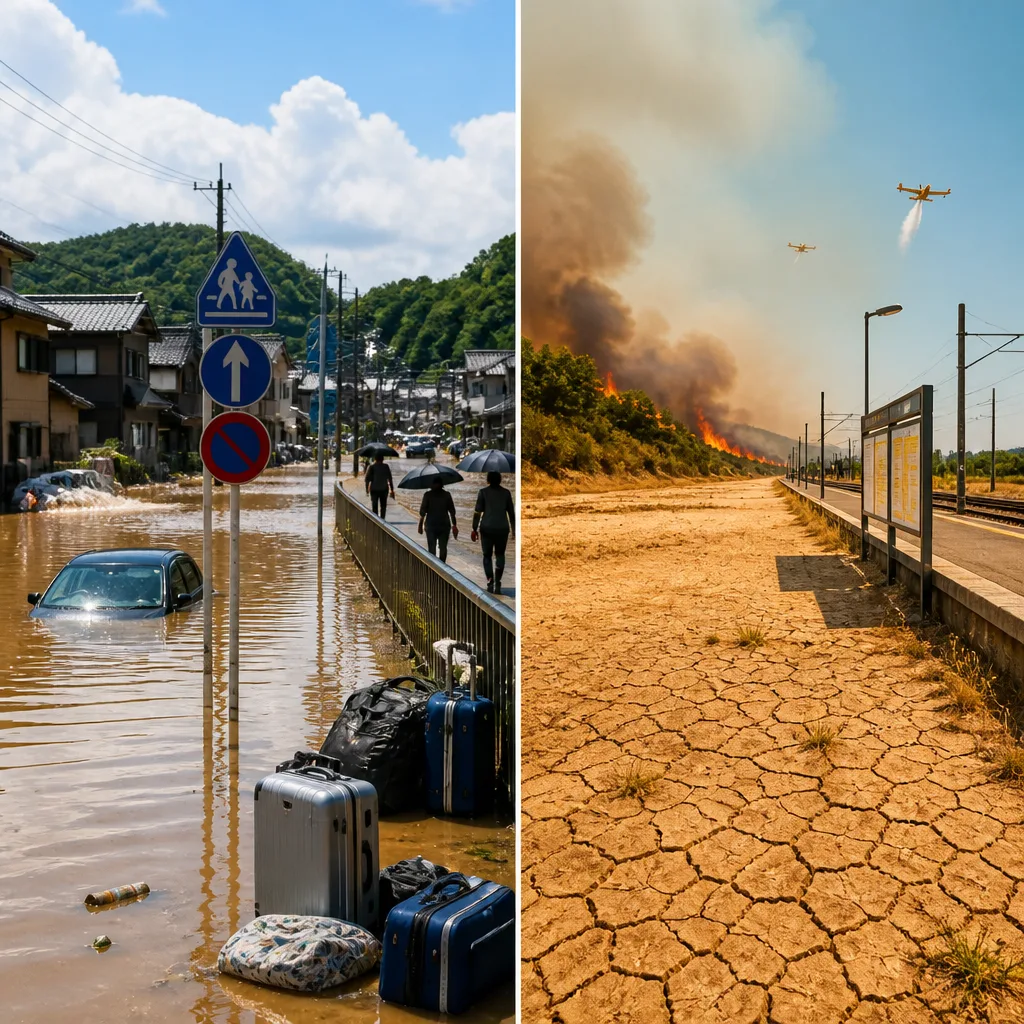
At least eight people have died after torrential rains caused severe flooding and landslides in areas east of Tokyo, Japanese media reported, as parts of Europe endure an extended heatwave that has affected roughly 300 million people.
Flash flooding during busy holiday travel
Heavy overnight rain pummeled prefectures surrounding Tokyo, prompting the Japan Meteorological Agency to issue its highest heavy-rain warning for the region for the first time. Local authorities reported that some areas of Chiba prefecture received, in half a day, roughly three times the rainfall typically expected for the entire month of August.
Evacuation instructions were issued to more than 100,000 residents, and officials said about 40 per cent of affected prefectures, cities and towns experienced flooding. More than 20,000 households lost electrical power as a result of the storms.
Several victims were discovered in submerged vehicles on flooded roads, according to Kyodo News. Transportation infrastructure was severely disrupted: trains and major highways were suspended and thousands of travellers were stranded at Tokyo’s Narita International Airport, which handles significant domestic and international traffic during the Obon holiday period.
Heatwave grips Europe for the fifth time this summer
Simultaneously, Europe is contending with an intense heatwave — the fifth such event of the summer — that officials say is affecting more than half the continent’s population. Authorities have reported prolonged, widespread high temperatures, with the current episode described as lasting longer than the lethal 2003 event that caused tens of thousands of fatalities, primarily among older people.
Fire services across Britain, France and Croatia have been stretched as crews battle blazes ignited or exacerbated by the extreme heat. In parts of Germany, waterways have fallen to historically low levels, exposing features such as islands in normally navigable rivers and prompting debate among government ministers about long-term river management.
Compounding risks and the human cost
These simultaneous extremes illustrate the complex and overlapping hazards that authorities must manage: floods, landslides and infrastructure failures in one region while heat, dehydration risks and wildfire spread in another. The timing in Japan has particularly acute social impacts because it coincides with Obon, a major holiday when millions travel and family gatherings are customary.
Disruption to transit networks during such a period has cascading effects: stranded travellers, delayed cargo movement and pressure on emergency services already responding to flooded neighbourhoods and power outages.
- Deaths in Japan: at least 8
- Evacuation orders: more than 100,000 residents
- Power outages: over 20,000 households
- People affected in Europe by the heatwave: roughly 300 million
| Location | Noted impact |
|---|---|
| Eastern Japan (Chiba area) | Record rainfall, widescale flooding, landslides, transport shutdowns |
| Europe | Extended heatwave, wildfires, low river levels, affects ~300 million people |
Emergency responders in affected areas face difficult decisions about rescue, evacuation and restoring basic services such as power and transport. In Japan, authorities have warned residents to remain vigilant for rising water and further landslide risk in upland areas where soil saturation is high.
European governments are balancing immediate firefighting and public health responses with longer-term questions about adapting infrastructure and waterways to changing climatic patterns. Low river levels are disrupting inland shipping and exposing cultural and environmental sites normally underwater, while the heat adds strain to health systems and vulnerable populations.
As authorities continue to assess damage and respond to ongoing hazards, the twin episodes underscore the growing challenge for national and local planners: preparing for weather extremes that can occur simultaneously across the globe, producing both acute emergencies and longer-term economic and environmental consequences.