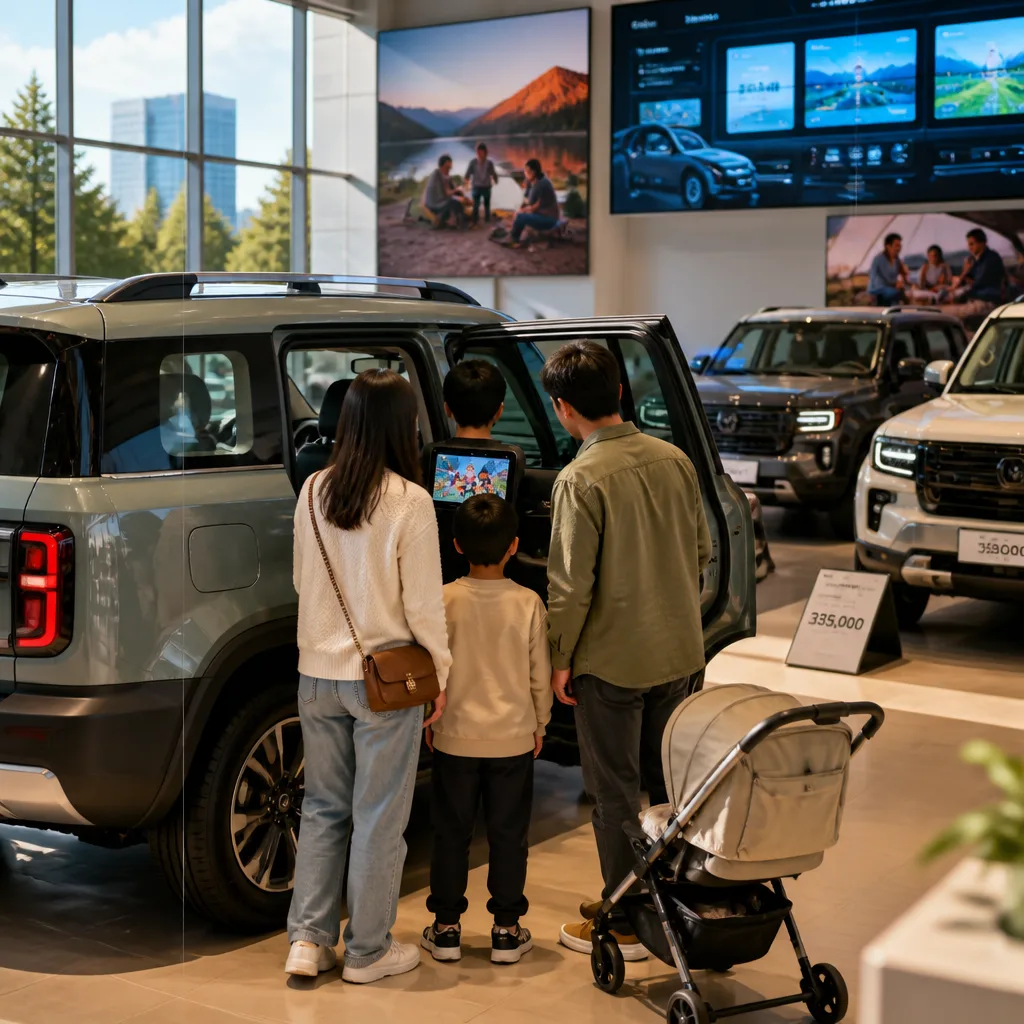
Annual sales of boxy SUVs in China have leapt from roughly 100,000 units five years ago to about 1.5 million today, reflecting a rapid repositioning of the segment from niche off-road machines to mainstream lifestyle vehicles.
From trail-ready to town-friendly
The market that once emphasised rugged capability is now being reshaped by customers who want intelligible in-car tech, comfort and family-oriented layouts. Industry reporting shows the segment has broadened, with more than 40 models competing across a range of price points and drivetrains — from gasoline to battery electric and range-extended systems.
Winners, losers and new competitors
That repositioning has upended fortunes for some brands. Tank, the off-road focused marque from Great Wall Motor, recorded a 10.6 per cent decline in first-half sales year-over-year, illustrating the risk of clinging too tightly to a hardcore identity as consumer priorities change.
By contrast, newer lifestyle-focused sub-brands are thriving. BYD’s Fangchengbao — which presents boxy designs with family-friendly features — has seen one of its models, the Tai 7, achieve monthly sales exceeding 20,000 units. That performance highlights how emphasizing comfort, interior space and everyday usability can translate into strong volume.
How the segment is stratifying
Analysts describe the market as splitting into three distinct tiers:
- Professional off-road — vehicles that retain serious capability for rough terrain.
- Lifestyle — models optimised for city and family use, with an emphasis on comfort and tech.
- Appearance-driven volume — more affordable options that capitalise on the boxy aesthetic without advanced off-road systems.
The result is a crowded field where look, interior packaging and digital features increasingly determine purchase decisions rather than maximum wheel articulation or approach angles.
Tech firms and the next phase
Another force accelerating change is the entry of consumer technology companies into the motoring space. Names such as Huawei and Xiaomi are moving into vehicle ecosystems, bringing priorities such as connected services, smart interfaces and seamless integration with other household devices. That focus is expected to push competition further toward in-car experience rather than off-road credentials.
| Metric | Figure |
|---|---|
| Annual boxy SUV sales (five years ago) | ~100,000 |
| Annual boxy SUV sales (current) | ~1.5 million |
| Number of competing models | 40+ |
| Tai 7 monthly sales | >20,000 |
What buyers can expect
For consumers, the shift means more choice targeted at everyday life: roomier cabins, simplified off-road capability kept as a reserve feature, and richer digital ecosystems. The upcoming Chengdu Auto Show is set to display that variety, with new boxy models from established automakers and newcomers spanning a wide price range — roughly the equivalent of 100,000 to 500,000 yuan (about $14,835 to $74,176), depending on powertrain and specification.
For Canadian buyers watching global automotive trends, the change underscores a broader industry pivot: design cues and tech that once signalled ruggedness are being repurposed into family-friendly, urban-orientated packages. That may influence what arrives in showrooms here as manufacturers tailor global models for local tastes.
As the segment matures, expect the marketing language to shift further away from talk of trails and into narratives about lifestyle, comfort and connected living — a transition that could make boxy SUVs even more ubiquitous in city traffic than they are on dusty tracks.