
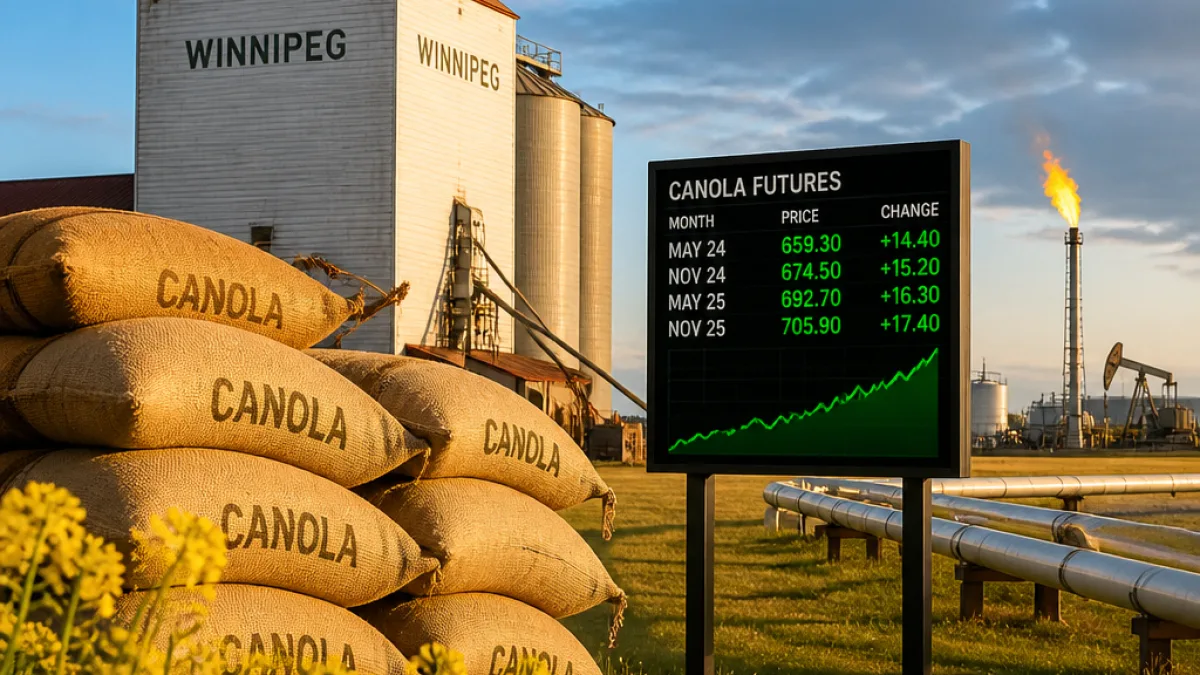
WINNIPEG — Canola futures climbed Monday morning as a spike in crude oil prices rippled through global oilseed markets, lifting values for canola, European rapeseed and other vegetable oils.
Global geopolitics pushes local grain values
Traders in the Intercontinental Exchange session opened the week with stronger bids for canola, reflecting a broader commodity response after recent disruptions to oil infrastructure in the Middle East. That surge in energy prices can translate into firmer demand expectations for vegetable oils, which are used both in food and biofuel production, and underpinned the early movement in canola contracts.
Production outlooks remain mixed
On the supply side, the U.S. Department of Agriculture maintained its projection for the 2026-27 Canadian canola crop at 22.5 million tonnes. That figure contrasts with Agriculture and Agri-Food Canada’s earlier estimate of 21.6 million tonnes, reflecting the uncertainty that remains ahead of Statistics Canada’s initial production report for 2026-27, scheduled later this week.
In western Canada, harvest activity is at an early stage. Alberta reported last week that just over 2 per cent of its canola had been combined, with early yields averaging about 37 bushels per acre. These early provincial figures will be watched closely in Manitoba as harvest progresses across the Prairies.
Export trends and domestic processing
Canada’s export pace showed improvement in early September. The Canadian Grain Commission’s weekly update recorded canola shipments of nearly 94,000 tonnes for the week ended Sept. 6, bringing the season-to-date export tally to about 704,600 tonnes, up from 529,500 tonnes a year earlier. Those flows are an important indicator of global demand and logistics performance for Prairie grain handlers.
Crush margins in Canada eased from recent highs, slipping by about C$4.10 to a reported C$4.55 per tonne for the November positions, a move that reflects changing spreads between seed values and processed oil and meal prices.
Market data — morning session
| Contract | Price | Change |
|---|---|---|
| ICE Canola Nov | C$825.50 | +8.30 |
| ICE Canola Jan | C$835.20 | +8.10 |
| ICE Canola Mar | C$843.80 | +8.60 |
| ICE Canola May | C$848.00 | +8.10 |
Wider grain complex and currency note
Monday’s session saw spillover gains across the grain complex. Chicago soybeans and European vegetable oils rose alongside canola as risk premia widened after the pipeline incident. At the same time, the Canadian dollar weakened early in the day, trading around 71.83 U.S. cents, down from a Friday close near 72.12 U.S. cents. A softer loonie can make Canadian oilseeds more competitive for foreign buyers, potentially supporting export demand if the trend persists.
What Prairie farmers should watch this week
- Statistics Canada’s first production report for 2026-27, due midweek, for updated national acreage and yield estimates.
- Further movement in crude oil markets if geopolitical developments continue to unfold, which could sustain pressure on vegetable oil prices.
- Weekly Canadian Grain Commission export updates and provincial harvest progress reports for a clearer picture of supply flows.
For Manitoba producers, the combination of higher nearby cash values, early export momentum and a softer Canadian dollar are immediate factors that could influence delivery decisions and pricing strategies as harvest accelerates. Market participants will be watching domestic and international data closely this week for signs that the recent price lift is sustainable.
This report summarises market releases and government estimates as they were reported in the morning trading session.