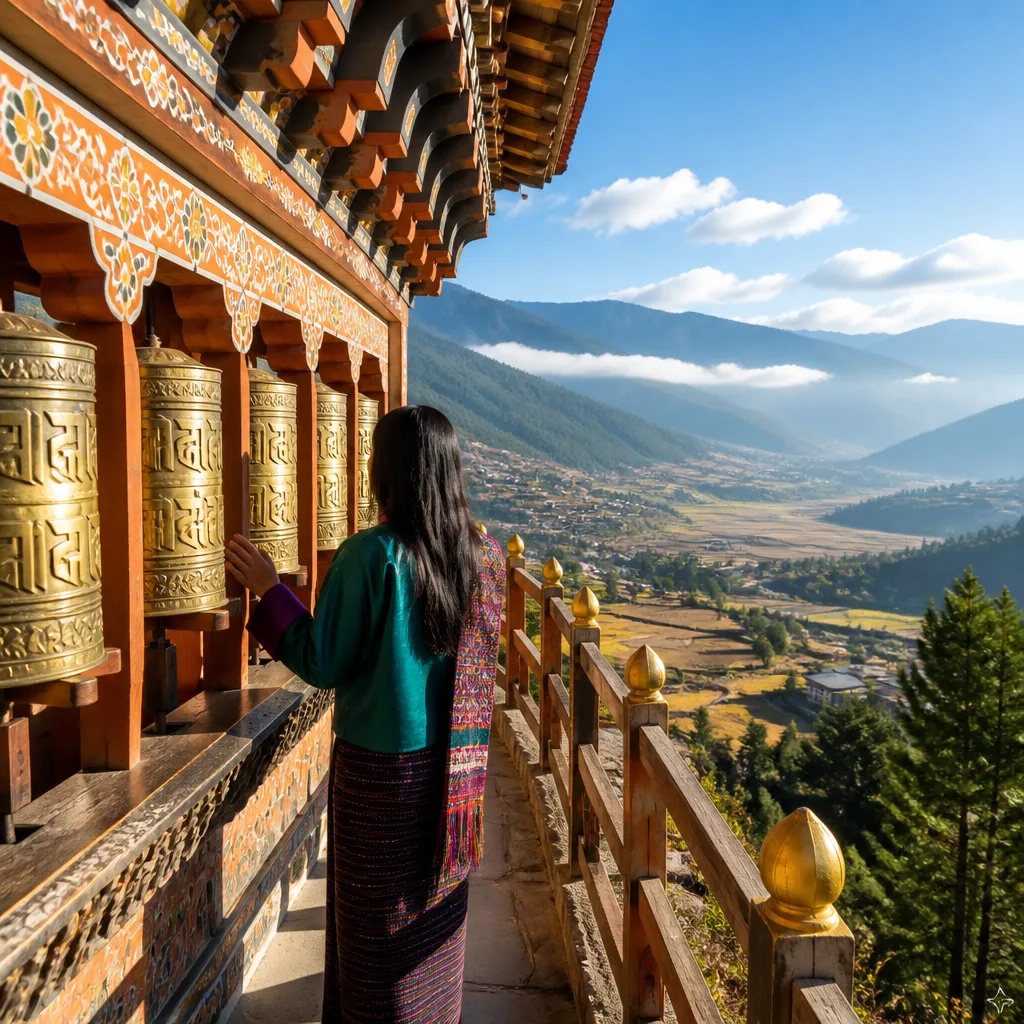
Bhutan Spirit Sanctuary, a hillside wellness retreat overlooking Paro’s Nephyu Valley, positions itself as the world’s only centre solely devoted to traditional Bhutanese medicine. For international travellers seeking a wellness experience that blends cultural ritual and clinical care, the property offers an uncommon alternative to mainstream spa escapes.
First impressions and cultural arrival
The moment visitors land at Paro — home to Bhutan’s only international airport — the tone of the visit shifts from transit to something more ceremonial. The airport’s carved timber façades and mountain backdrop frame an arrival that feels curated and national in scope. As the sanctuary’s approach begins, guests encounter prayer wheels and a bridged entrance where staff invite them to symbolically leave stress behind.
That sense of deliberate calm is in keeping with Bhutan’s broader national philosophy. The kingdom measures success using Gross National Happiness rather than gross domestic product, a policy grounded in the collective wellbeing of its population of about 805,000. For many visitors, that ethos is immediately perceptible in mood and manner.
A retreat built on traditional practice
Bhutan Spirit Sanctuary frames the guest journey around traditional healing rather than typical resort thrall. Treatments and services are based on local medical heritage; the stay begins with a ritual transformation rooted in Buddhist practice rather than a standard check-in process. Staff guide guests across sunlit prayer wheels and through a ritualised welcome, signalling the retreat’s intention: this is a pilgrimage of health and presence as much as a holiday.
The property’s medical focus is one of its defining features. Guests are introduced to practitioners steeped in Bhutanese approaches that fuse spiritual and physiological diagnosis and care. That orientation makes the sanctuary particularly appealing to travellers who want health interventions integrated with cultural context rather than exported wellness trends.
“Your heart is trembling,”
The sensory tone of the sanctuary is intimate and reflective. One visiting journalist was told by a practitioner,
“Your heart is trembling,”a moment that underlines how the retreat’s assessments can be personal and poetic as much as diagnostic.
Why this matters to travellers
For Canadians weighing long-haul wellness travel, Bhutan Spirit Sanctuary represents several meaningful departures from mainstream luxury travel:
- Authenticity: The experience is anchored in local healing traditions rather than transplanted spa trends.
- Ritualised hospitality: Arrival and treatment sequences emphasise ceremony and reflection over checklists and amenities.
- National identity: The retreat is integrated with Bhutan’s broader cultural approach to wellbeing, including the country’s Gross National Happiness philosophy.
These differences matter for travellers seeking restorative travel that is immersive and educational, not merely indulgent.
Practical considerations
The sanctuary’s location above Paro enhances its appeal but also adds logistical complexity: international arrival comes through one gateway, and access to remote wellness rituals requires planning. The retreat’s settings — prayer wheels, carved woodwork, and mountain vistas — are part of the draw, and travellers should account for travel time, altitude and seasonal conditions when assembling an itinerary.
| Feature | Detail |
|---|---|
| Population context | ~805,000 |
| International access | Paro — the country’s only international airport |
| Speciality | Exclusive focus on traditional Bhutanese medicine |
For lifestyle-minded readers, the retreat prompts a broader question about what wellbeing travel should look like post-pandemic: should it prioritise authentic cultural exchange and evidence-rooted local practice, or should it cater to universally recognisable luxury markers? Bhutan Spirit Sanctuary clearly advocates for the former.
Whether you are intrigued by ritual, curious about Bhutanese medical practices, or simply seeking a different model of replenishment, the sanctuary offers a distinct proposition: deep rest delivered in a country that places national policy and cultural practice at the heart of communal wellbeing.
As travellers continue to search for meaningful escapes, properties that foreground local knowledge and national identity may shape the next wave of wellness tourism.