
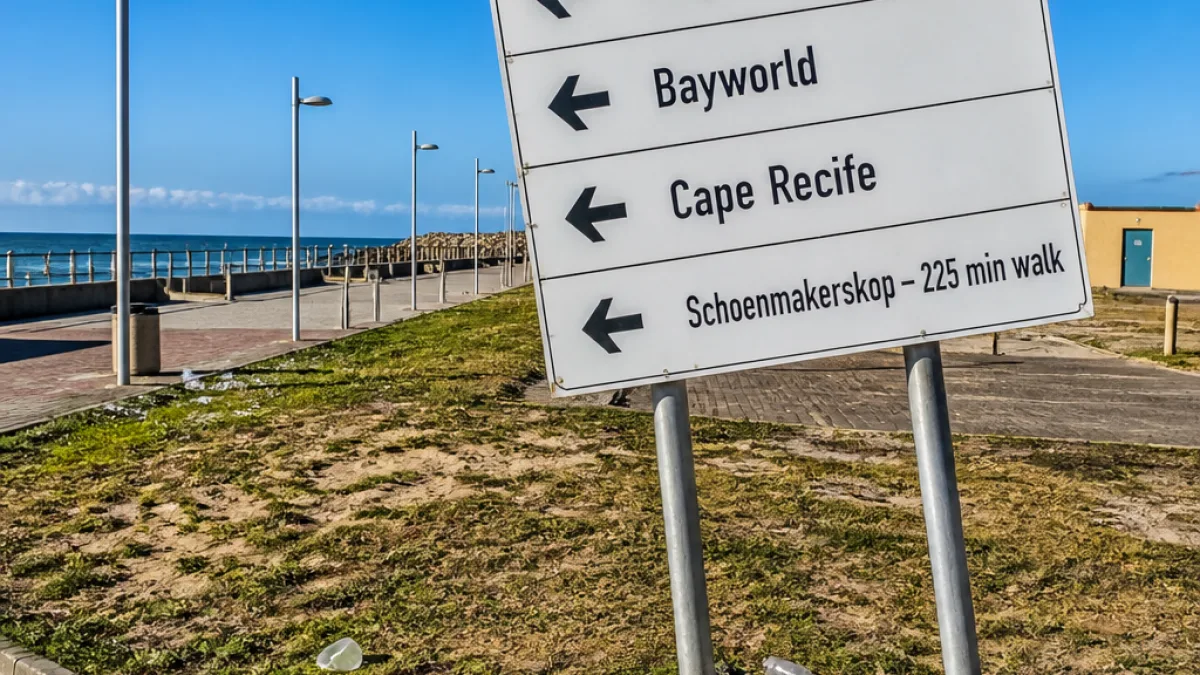
Sign error at Pollock Beach exposes wider municipal lapses
A freshly erected directional sign at the Pollock Beach parking area in Gqeberha has become a visible symbol of municipal slipshod work after its arrows were placed in reverse, pointing visitors away from attractions such as King’s Beach, Bayworld and Cape Recife, and absurdly noting that Schoenmakerskop is a 225‑minute walk away.
Rather than a harmless gaffe, ward representatives and politicians say the incorrect sign highlights deeper problems: persistent vandalism, non‑functioning streetlighting, poor maintenance and a pervasive lack of safety that has left residents and visitors exposed.
Democratic Alliance MP Baxolile Nodada raised the beachfront’s safety issues in Parliament after a violent attack on the promenade in June in which his companion was stabbed six times, according to reporting. Local ward councillor Sean Tappan said he had asked the metro to investigate the misplaced sign.
“I have not been to see the sign ... because I was attending to other business, but if the pole was drilled to the ground then it’s going to be difficult to correct it, but if not then it should be easy to fix,” said Tappan.
Tappan described the continuing presence of the wrong sign for several days as “shameful and unacceptable”, and questioned the procurement and approval process that allowed the error. He suggested the cost of the sign and who authorised it should be disclosed.
The city’s member of the mayoral committee for Economic Development, Tourism and Agriculture, Bassie Kamana, said he would ensure the sign was corrected, according to reporting. The incident follows years of complaints about beachfront neglect that residents say have made the area less safe and less attractive to tourists.
Local consequences and municipal accountability
While the misplaced sign is superficially amusing, councillors and community members say it risks normalising a culture of low standards in public works. The beachfront is a public space that the metro has a duty to maintain, and mistakes of this kind undermine confidence in the municipality’s ability to deliver basic services and keep citizens safe.
- Safety: The area continues to face violent incidents, which have been escalated to Parliament.
- Maintenance: Streetlights, signage and security patrols have been criticised as inadequate.
- Tourism impact: Misleading or damaged infrastructure can deter visitors and harm local businesses that depend on beachfront trade.
Questions remain about how the sign was manufactured, approved and installed. Tappan suggested the error could be the result of human negligence — or worse, a failure in oversight during procurement and project management.
| Feature | Note |
|---|---|
| Misplaced directional arrows | Point away from local attractions |
| Schoenmakerskop | Listed as a 225‑minute walk |
| Reported by | DA MP Baxolile Nodada and ward councillor Sean Tappan |
Residents and business owners along the beachfront have long urged the metro to tackle cable theft, vandalism and broken lighting. Those issues not only damage public infrastructure but also erode the sense of safety that encourages families and tourists to use the promenade after dark.
Municipal sources were reported to have acknowledged the mistake and indicated corrective action would follow. For many locals, however, a quick fix to the sign will not be sufficient; they want assurances that procurement procedures, quality control and routine maintenance will be tightened so small errors do not become symptomatic of larger governance failures.
The incident has renewed calls for clearer accountability and faster responses from the Nelson Mandela Bay metro, particularly as the city seeks to protect public spaces and shore up its tourism offering. With local government services under scrutiny, residents say visible, competent maintenance of public assets is a basic expectation — not an optional extra.















