
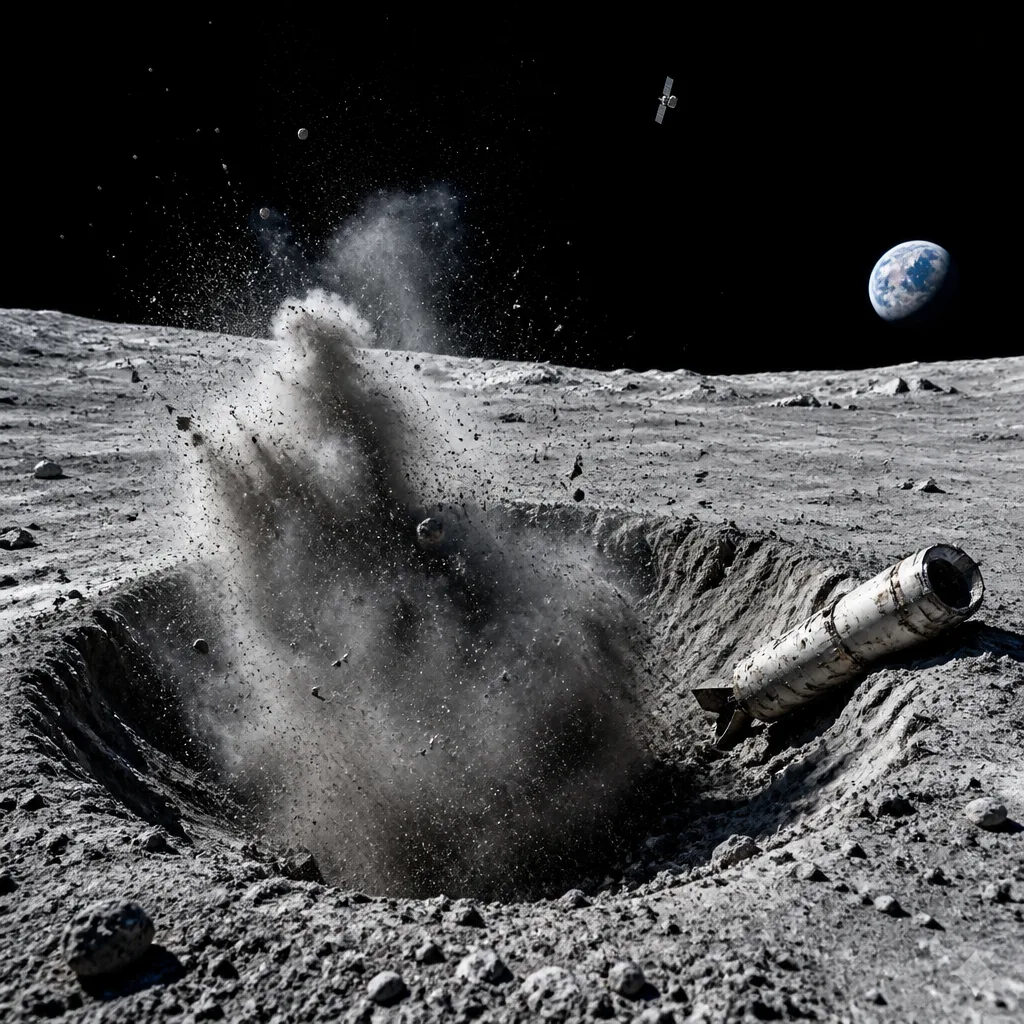
A stage from a SpaceX Falcon 9 rocket unintentionally collided with the Moon on 5 August 2026, travelling at about 8,700 km/h and weighing roughly 4,000 kg. The object had been left in cislunar space after the rocket launched two private landers in January 2025 and subsequently drifted from its expected course.
Immediate scientific value
Planetary scientists say the strike will provide useful measurements about the Moon's shallow subsurface. When a large object impacts a planetary surface, it excavates material from beneath the top layer of rock and regolith, allowing remote sensing and orbital cameras to detect changes and infer composition.
According to reporting, the collision offers what researchers call a natural "experimental" impact: the ejecta plume and altered surface can be examined by telescopes and lunar orbiters to test models of lunar geology and impact processes. Those observations may help refine our understanding of the Moon's crust and near-surface layering without the need for a deliberately targeted impactor mission.
How the object reached the Moon
The stage was a remnant of the Falcon 9 used to launch Firefly Aerospace's Blue Ghost and iSpace's Resilience to the Moon in January 2025. Rather than re-entering Earth's atmosphere, the spent hardware remained in space. Astronomers later realised its orbit was evolving toward the Moon.
SpaceX said the collision was not intentional. Julianna Scheiman, SpaceX's director of NASA science and Dragon programmes, told reporters that a combination of solar activity and gravitational perturbations altered the object's path so that it eventually intersected the Moon.
“What has happened is, essentially, a mixture of solar activity and gravity forces have put it on a path toward the moon,” Julianna Scheiman said.
Concerns about space junk and future missions
While the impact yields data, scientists and policy observers warn it underscores a growing problem: untracked or uncontrolled objects in cislunar space. Even when collisions do not cause catastrophic changes to celestial bodies, they add to the complexity of operating around the Moon and risk contaminating sites of scientific or historic interest.
Paul Delaney, professor emeritus of physics and astronomy at York University, said the behaviour followed from how some launches are executed: once a rocket has deployed payloads, its spent stages are sometimes left in trajectories without a controlled disposal plan. "After it did its job, SpaceX really did not care where it ended up, as near as I can tell," he said, reflecting concerns about current practices for upper-stage disposal.
Policy and operational questions
The incident raises questions that national space agencies and international bodies will need to address:
- Standards for end-of-life disposal of launch vehicle stages destined for cislunar space.
- Notification and tracking requirements for objects left in trans-lunar and lunar orbits.
- Planetary protection and preservation of scientifically sensitive sites on the Moon.
These are practical issues for operators planning crewed or sensitive robotic missions to the lunar surface. Unplanned impacts could complicate landing site selection, scientific sampling and the interpretation of surface features that might otherwise be attributed to natural processes.
What we can reliably say
The facts reported so far are these:
| Item | Detail |
|---|---|
| Event date | 5 August 2026 |
| Object | Stage of SpaceX Falcon 9 |
| Mass (reported) | ~4,000 kg |
| Impact speed (reported) | ~8,700 km/h |
| Origin | Falcon 9 that launched Blue Ghost (Firefly) and Resilience (iSpace) in Jan 2025 |
Observations of the impact site and subsequent scientific analysis will determine how much new geological information can be extracted. For now, the episode is both an opportunity for planetary science and a reminder that more robust international rules and technical measures are likely needed as lunar activity increases.
The balance between utilising unplanned impacts as scientific opportunities and preventing the steady growth of unregulated debris in cislunar space will be an important theme for space policy discussions in the coming months.


