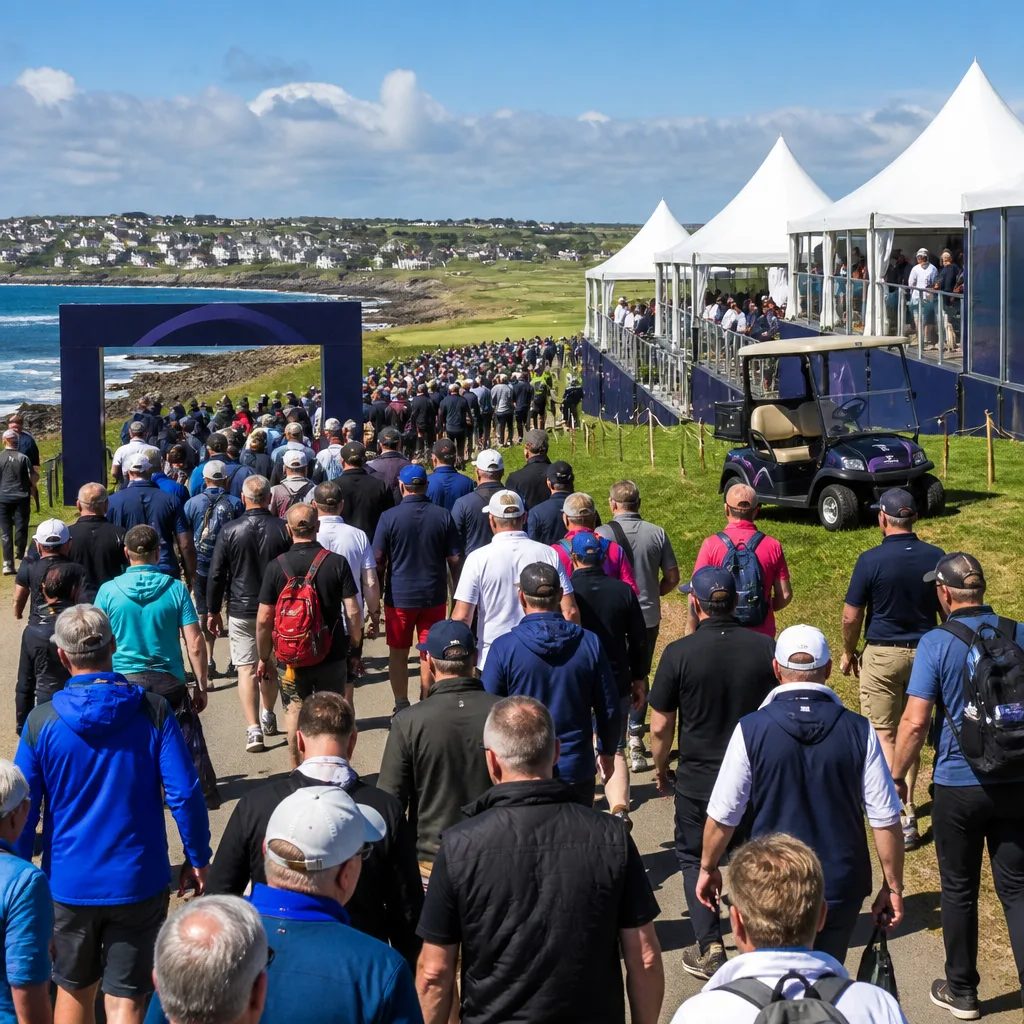
President Donald Trump spent the second day of a two-day visit to Ireland at his privately owned Doonbeg golf course, attending the Irish Open and placing his family business squarely at the centre of a trip that has already provoked diplomatic reaction.
Business optics in a small coastal community
The Trump Organisation bought the Doonbeg site in 2014, and the president’s presence on Sunday — when some 40,000 fans were expected at the tournament — turned the spotlight on the economic and reputational consequences for the village of Doonbeg, which has just 784 residents, according to reporting.
Irish Prime Minister Micheál Martin, at a meeting in Dublin, told Mr Trump that Doonbeg residents were “very grateful” for the investment. The president’s sons, Eric and Don Jr, who have been running the family business since his return to the White House last year, accompanied him to the west coast of Ireland.
“It may as well happen now,”
The visit combined private commercial interests with high-profile diplomacy after Mr Trump surprised hosts by saying he would “love to see” a united Ireland — a remark that broke with Washington’s traditional neutrality on the constitutional status of Northern Ireland and provoked criticism from unionists and political figures in Britain.
What it means for local economies and brand exposure
For a community the size of Doonbeg, hosting a major international golf event can deliver short-term revenue to hotels, restaurants and ancillary services. The presence of a headline political figure introduces both additional visitors and greater media attention, which can amplify brand recognition for the course and the Trump Organisation globally.
But bringing commerce and statecraft together also carries risks. Critics say the optics of a serving US president promoting family-owned assets on foreign soil can complicate diplomatic relations and invite scrutiny of conflicts between public duties and private gain.
- Investment timeline: Trump Organisation purchase — 2014.
- Local population: 784 residents in Doonbeg.
- Event scale: ~40,000 expected spectators at the Irish Open.
- Family role: Eric and Don Jr managing the business during the president’s return to the White House last year.
| Item | Figure |
|---|---|
| Year of purchase | 2014 |
| Local population | 784 |
| Expected tournament attendees | 40,000 |
| President’s age (reported) | 80 |
Diplomacy, domestic politics and commercial promotion
Mr Trump used the occasion to praise the course — describing it as “one of the greatest courses in the world” — and to laud Irish golfer Shane Lowry and Northern Irish champion Rory McIlroy, who is a major draw for the event. His remarks on Irish reunification, delivered earlier in Dublin, were an unofficial departure from long-standing US policy of neutrality on the constitutional question and prompt diplomatic pushback.
From a business perspective, the visit underlines how ownership of high-profile hospitality and sporting assets can be leveraged for publicity. For Doonbeg, the immediate economic lift from a large international tournament is clear; the longer-term benefits depend on sustained visitor interest, favourable media coverage and the management of local concerns about environmental and planning impacts that often accompany golf-resort developments.
The presence of the president, accompanied by his sons who run the family firm, also raises questions about the separation of official engagements from private business promotion. Those tensions are not unique to this trip but are amplified when a national leader’s commercial interests lie within the country he is visiting.
As the tournament concluded and the president prepared to depart for Washington, the Doonbeg stop remained an unmistakable example of how global business interests, local economies and international diplomacy can converge — with visible implications for reputations, local jobs and future tourism revenue.
WE NEWS offers business reporting to help readers understand how such events affect household budgets and employment prospects; this article is not financial advice.