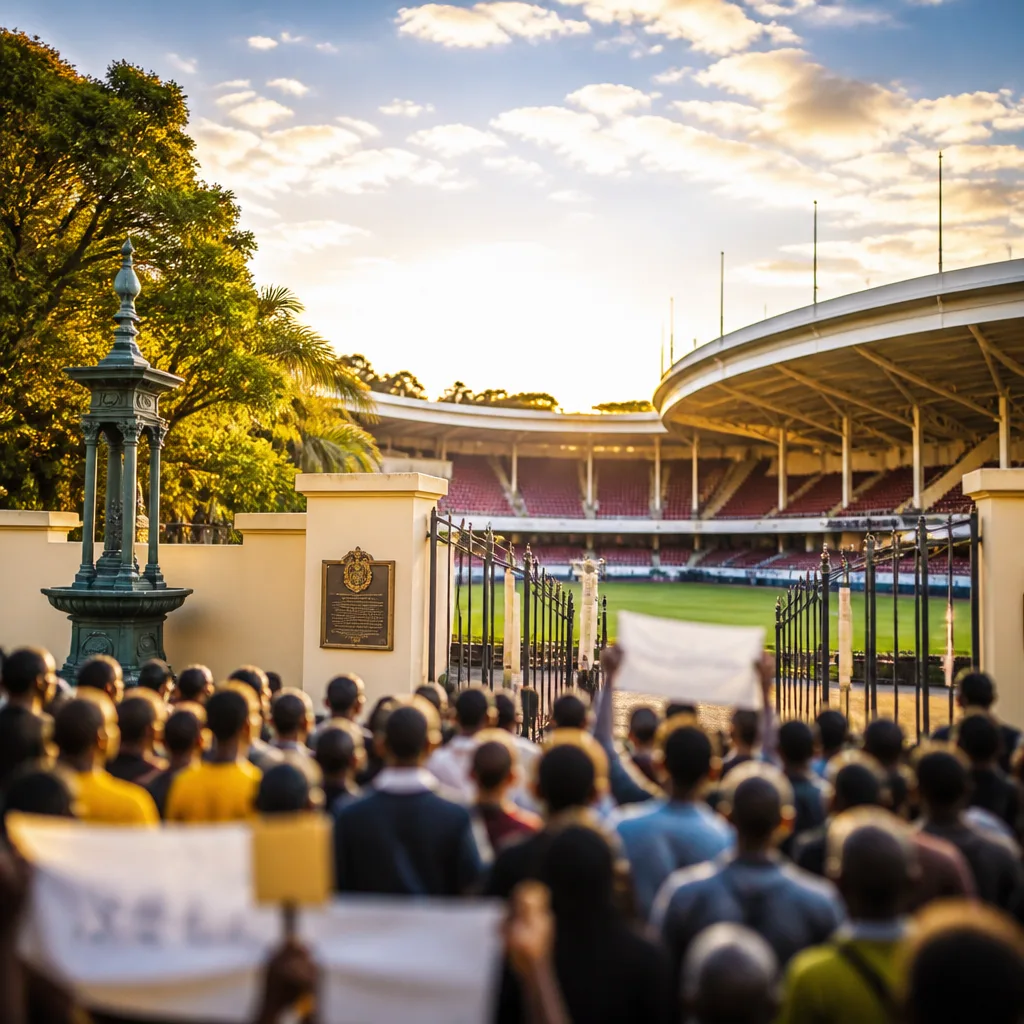
Curries Fountain Stadium in Durban has been formally declared a provincial heritage site, recognising the ground’s historical, cultural and social significance for KwaZulu‑Natal and the country.
Sporting ground that became a forum for struggle
The decision, announced during Heritage Month, was made by KZN Amafa and the Research Institute, the provincial heritage authority, with the declaration highlighted by the Department of Sport, Arts and Culture (DSAC). The Research of Curries and Surroundings (Rocs) project — formerly based at the Durban University of Technology (DUT) — provided the research underpinning the nomination, having documented the site’s importance in several publications.
The site takes its name from H.W. Currie, who, according to historical records, established Durban’s first reliable water source there in 1878 when he sank a well and installed pumps below the Botanic Gardens. Over time the area transitioned into a formal sporting ground: negotiations to develop Curries Fountain as a sporting venue began in 1920 and, in 1924, it was designated as a sports ground under the Durban Indian Sports Ground Association.
That sporting function coexisted with a broader civic role. From 1913 the grounds were used for large open‑air meetings, including rallies connected to the historic Durban strikes and later anti‑apartheid gatherings. The research cited by the declaring bodies highlights the dual character of Curries Fountain as both a sporting venue and a site of political and social mobilisation. The Department of Sport, Arts and Culture framed the declaration within Heritage Month’s theme:
“Celebrating our living Heritage: Strengthening the ties that bind us.”
Why the declaration matters for sport and memory
Sport, the Rocs research argues, is not just about fixtures and trophies; places like Curries Fountain carried deep civic meaning. The ground hosted multiple sporting codes and served as a communal space for social and labour movement activities, while also playing a notable role in the development of non‑racial sport in South Africa.
Sport administrators, historians and community stakeholders often point out that sites where ordinary people played and congregated have long memories that go beyond the scoreboard. The provincial heritage status both protects the physical place and formally recognises those layered memories: as a sports field, a meeting place for labour and political organisers, and a space where the struggle against segregation and racial exclusion found public expression.
- Key dates: well and pumps installed in 1878; mass meetings from 1913; sporting development negotiations from 1920; formal sports ground status in 1924.
- Stakeholders: KZN Amafa and the Research Institute (declaring bodies), Rocs project (research source), Department of Sport, Arts and Culture (policy framing).
- Significance: sporting venue, site of labour and anti‑apartheid gatherings, symbol of non‑racial sport.
| Aspect | Detail |
|---|---|
| Original purpose | Water source established by H.W. Currie (1878) |
| Sporting designation | Designated as sports ground under Durban Indian Sports Ground Association (1924) |
| Political use | Open‑air meetings from 1913; linked to Durban strikes and anti‑apartheid gatherings |
Heritage Month context and local resonance
DSAC said Heritage Month offers South Africans an opportunity to reflect on shared history and celebrate cultural diversity, underlining constitutional values such as human dignity, equality and non‑racialism. Heritage Day will be observed on 24 September. The Curries Fountain declaration was timed to coincide with these commemorations in KwaZulu‑Natal.
For the sport community, the ruling is a reminder that playing fields can be as politically resonant as any public square. The protection of Curries Fountain ensures the preservation of a physical space where sport, labour activism and the anti‑apartheid struggle intersected — a place of contestation, recreation and community organising.
As interest grows in protecting sites of popular memory across the country, Curries Fountain’s elevation to provincial heritage status adds to the list of sporting places recognised not only for the matches they hosted but for the broader social histories they embody. For athletes, administrators and fans who value history, the declaration is a moment of acknowledgement: it affirms that the everyday rituals of sport — training, supporting, meeting on the sidelines — are part of the national story.