
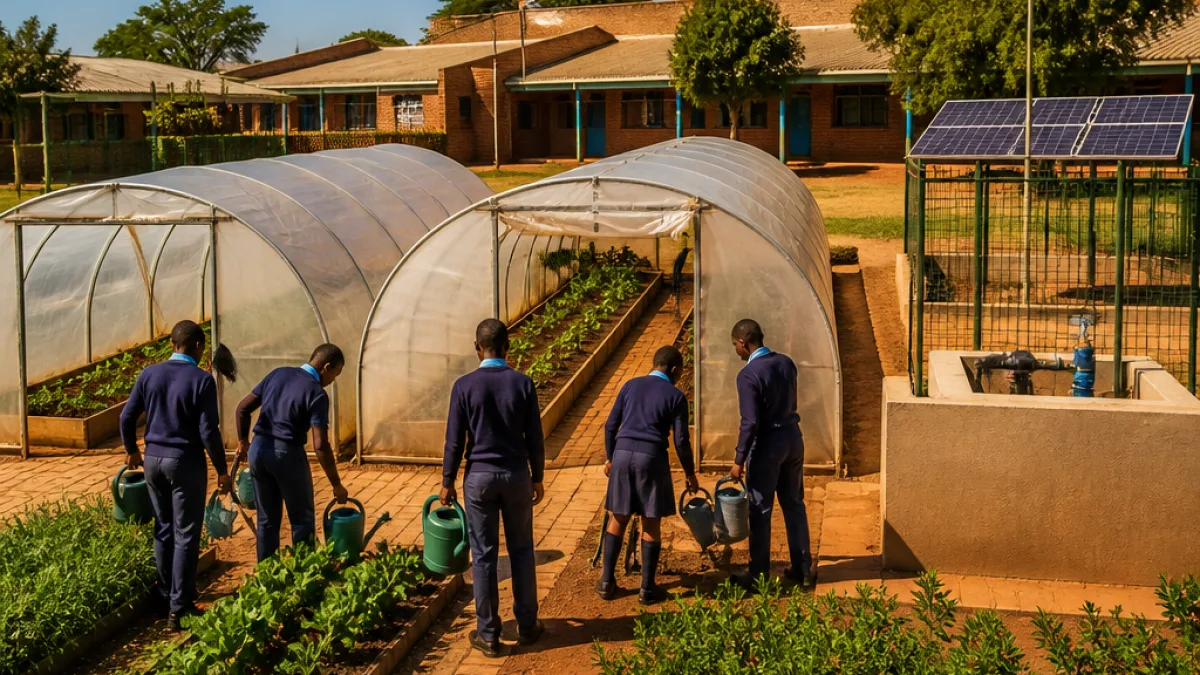
Practical farming skills come to Soshanguve classrooms
Soshanguve Engineering School of Specialisation now has two horticultural tunnels and a sustainable borehole to give learners practical experience in agricultural science, the Shoprite Foundation and local reporting have confirmed. The facilities were officially opened on 15 September 2026 and will be used primarily by Grade 9 learners for hands-on training.
The project is a partnership between the Shoprite Foundation and MarketPlace Academy, which acts as the implementation partner. MarketPlace Academy trains educators to facilitate the practical work and supports the addition of an accredited plant production part-qualification to the Curriculum and Assessment Policy Statement (CAPS), enabling learners to leave school with both matric and a recognised practical qualification, MarketPlace CEO Chantyl Mulder said, according to Inside Education reporting.
- Facilities: two horticultural tunnels and a sustainable borehole
- Beneficiaries: 40 Grade 9 learners initially
- Skills taught: soil science, crop rotation, compost production, irrigation, pest and weed control
The Shoprite Foundation noted that the Soshanguve expansion follows its earlier tunnel project at Oosrand Commerce and Entrepreneurship School of Specialisation. That initiative has produced about 5 000 units of produce for a school feeding scheme and community sales over two years, and more than 1 700 learners have received agricultural training through the foundation’s projects, the foundation reported.
“The tunnels give them a place to do that work. That means they can leave school with matric and a recognised qualification that gives them a first step into the industry,”
The quote is attributed to Chantyl Mulder, CEO of MarketPlace Academy, as reported by the Shoprite Foundation and Inside Education. Shoprite Foundation director Maude Modise was also quoted saying the aim was to give young people the chance to experience agriculture for themselves and to leave school with practical planting skills for sustenance.
What this means for Soshanguve learners
For a township that often sees technical and vocational pathways framed as alternatives to traditional academic routes, the horticultural tunnels offer a concrete route into the agricultural sector — and the potential to support school feeding schemes or small-scale enterprise. The practical training components listed by project partners include soil science, crop rotation, composting, irrigation and pest control — all core skills for smallholder production and food security initiatives.
Principal Mashiane Tladi described the project as a new chapter for a school known for engineering, automotive studies and innovation. Inside Education reported that the school moved from a 35% matric pass rate in 2017 to a 100% pass rate in 2025, a statistic the principal highlighted at the launch as evidence of the school’s turnaround and capacity to broaden its skills offerings.
The school already has a track record of applied learning: Shoprite Foundation reporting said learners at Soshanguve built Modjadji, a solar-powered train that won the Engineering category at the Gauteng Schools of Specialisation Festival. The horticultural tunnels add another practical environment to that learn-by-doing approach.
| Item | Detail |
|---|---|
| Opened | 15 September 2026 |
| Number of tunnels | 2 |
| Borehole | Sustainable installation supporting irrigation |
| Initial learners served | 40 Grade 9s |
Local residents and educators in Soshanguve have repeatedly emphasised the need for practical skills training that links learners to work or income-generating opportunities. By aligning the tunnels with an accredited part-qualification, the partners say learners could gain a recognised credential to help them access further training or employment in agriculture.
Project partners also framed the initiative as a boost to food security. At Oosrand, the produce harvests contributed to a feeding scheme and sales to the surrounding community; the Shoprite Foundation suggested the Soshanguve project could follow a similar model, although no specific targets for production or revenue were published at launch.
For Soshanguve, the horticultural tunnels represent an extension of the engineering-focused school’s mandate: combining technical learning and agricultural skills to broaden learners’ choices after school. The project is expected to be integrated into the school’s agricultural science lessons and into the new part-qualification practical requirements, MarketPlace Academy reported.
As the school begins practical sessions, residents and parents will be watching to see how the tunnels translate into tangible benefits — from improved learner outcomes to additional food for school schemes and local markets.











