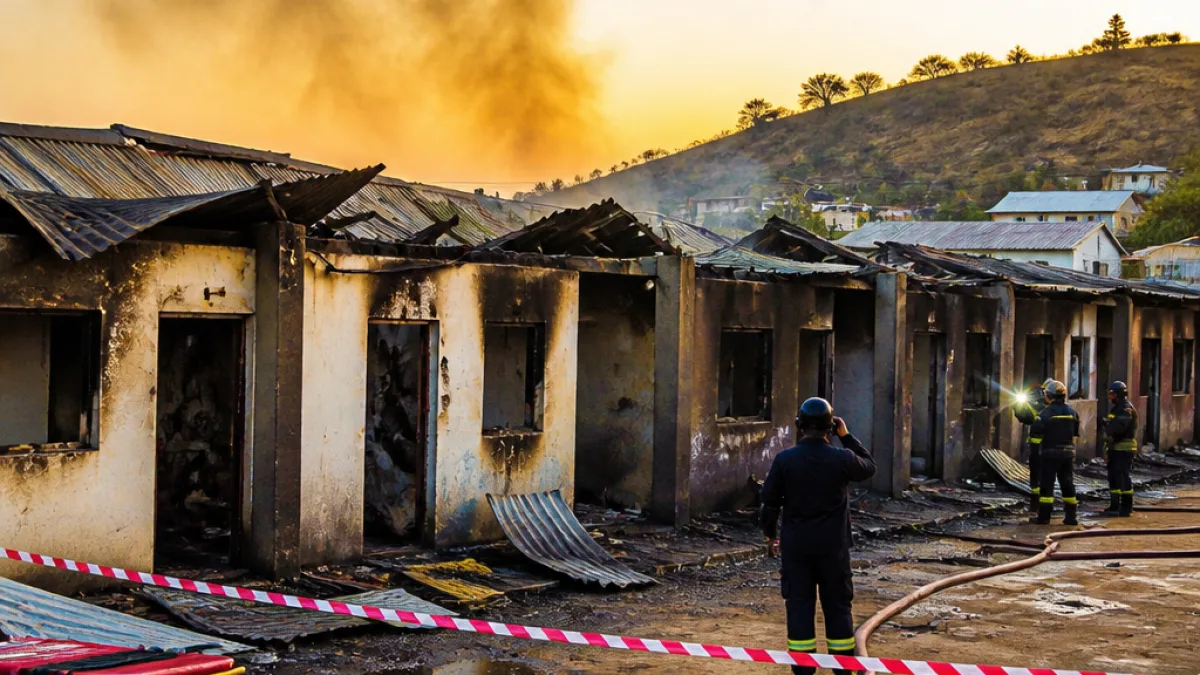
Five workshops and an additional storeroom were completely destroyed in a fire at Sewagodimo Technical School in Pella Village on Sunday, marking the second major school blaze in the North West in three days and prompting a sharp condemnation from Education MEC Dr Desbo Mohono.
What happened at Sewagodimo
The North West Department of Education said the school had hosted a matric camp over the weekend. Classes ended on Sunday afternoon and a parents’ meeting finished at 16:00. Educators left the premises at about 17:00. At 17:53 school management were alerted to a fire and immediately contacted the South African Police Service and local firefighters.
By the time emergency services arrived the department said the blaze was in its final stages. All five workshops — each containing a storeroom and classroom — were reportedly completely destroyed, together with a separate storeroom located outside the block. The department said the cause of the fire remained unknown and that investigations were under way.
"The burning of school properties is robbing our future generations of valuable educational resources," Dr Desbo Mohono said, describing the incident as a "barbaric incident" that placed further pressure on the department’s limited resources.
Context: a worrying pattern
The Sewagodimo fire follows an earlier incident on Friday at Matlhare Mokautu Secondary School in Monakato Township, where a school hall was burned down. That fire is being investigated as suspected arson. The two incidents come just over two weeks after the North West Legislature’s Portfolio Committee on Education visited Sewagodimo as part of an oversight programme and reported ageing infrastructure, broken doors and windows, dysfunctional toilets and inadequate perimeter fencing.
Mohono warned that the provincial education department already faces a backlog of schools that require construction or renovation, and that deliberate destruction of school property worsens pressure on scarce resources.
Immediate impact on learners and staff
The destroyed workshops at Sewagodimo are practical training spaces for learners. The loss reduces access to vocational and technical training at a time when matric learners were engaged in preparatory activities. School management and the department are assessing the damage and the immediate needs to ensure learners face minimal disruption, the department said.
- Structures destroyed: five workshops (each with a storeroom and classroom) and one external storeroom.
- Timeline: camp and meetings ended on Sunday; fire alerted at 17:53; firefighters arrived to find flames in final stage.
- Investigations: cause unknown at Sewagodimo; Matlhare Mokautu fire is treated as suspected arson.
| Item | Details |
|---|---|
| School | Sewagodimo Technical School, Pella Village |
| Damage | 5 workshops (each with storeroom & classroom) + 1 external storeroom |
| Time reported | 17:53 (Sunday) |
| Previous incident | Matlhare Mokautu Secondary School hall burned (Friday) — suspected arson |
Calls for security and community action
Education officials and the MEC have stressed the need for stronger protection of school property and greater cooperation from communities. The oversight committee’s earlier findings about ageing infrastructure and inadequate perimeter fencing highlighted vulnerabilities that may expose schools to opportunistic theft, vandalism or deliberate attacks.
While investigators determine the cause of the Sewagodimo fire, the department reiterated that any deliberate burning of school property deprives learners of educational resources and diverts funds needed for repairs and improvements elsewhere.
What happens next
Investigations by SAPS and fire authorities are under way to establish the origin and cause of the blaze at Sewagodimo. The provincial education department will need to finalise an assessment of structural safety, salvageable materials and the scale of replacement required before proposing short-term arrangements for classes and longer-term rebuilding plans.
For affected learners and parents, the immediate priority will be continuity of teaching and learning, particularly for matriculants who attended the weekend camp. The department has not yet set out plans for temporary accommodation of classes or replacement workshops.
These consecutive school fires underline the fragile state of some education infrastructure in the province and the strain on provincial resources when incidents remove vital teaching spaces. As investigations continue, the department and communities will need to work together to protect school assets and ensure learners do not pay the price.
— North West correspondent, Rustenburg