
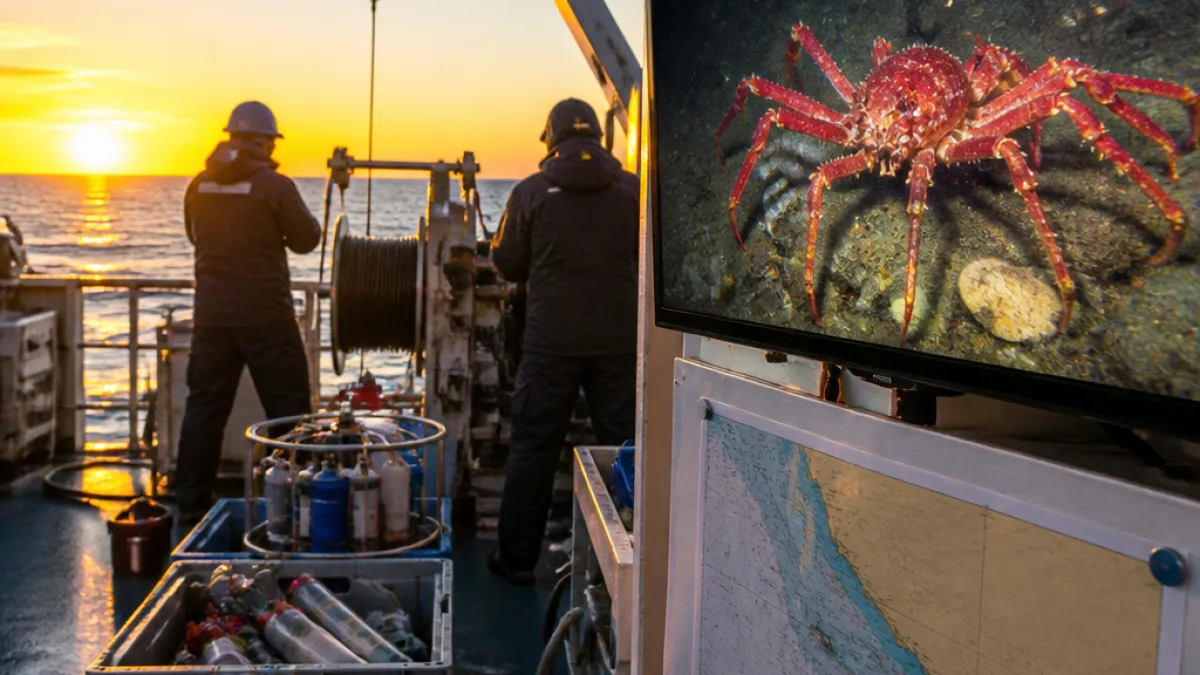
The Department of Primary Industries and Regional Development (DPIRD) has announced the discovery of a rare bright red crab off Western Australia’s north west coast as part of an ongoing deepwater exploration project funded by the Fisheries Research and Development Corporation (FRDC).
Discovery and its context
The specimen has been identified by the WA Museum as Paralomis papua. The find forms part of research aimed at mapping deepwater habitats and assessing what high‑value crustacean stocks may exist within the West Coast Deep Sea Crustacean Managed Fishery.
The managed fishery covers a large marine area from Cape Leeuwin in the south to WA’s border with the Northern Territory, and includes parts of the Indian Ocean and the Timor Sea within Australia’s exclusive economic zone. The fishery currently holds Marine Stewardship Council certification.
Research method and collaboration
DPIRD scientists said the project combines collaboration with local fishers and the use of deep‑sea cameras to survey remote and unfished areas. The cameras illuminate seafloor habitats and provide visual records of floral and faunal communities, helping researchers to build a baseline understanding of species present.
“This is the sixth species we have unearthed as part of the research,” DPIRD Offshore Crustaceans research scientist Jack Parker said. “Work is continuing with the likelihood of other new species being discovered that could be commercially viable in the future.”
The FRDC funded the work on behalf of the Australian Government under project 2024‑009, titled Exploring new resources for the West Coast Deep Sea Crustacean Managed Fishery in Western Australia. Further details are available on the FRDC website.
Other species flagged by the study
DPIRD said earlier phases of the research have flagged several species with potential commercial value. These include crustaceans already noted during the survey efforts.
- Red royal prawns
- Red reef lobster
- Mud rock lobster
- Slipper lobsters
- Scampi species
The newly identified Paralomis papua is the sixth species recorded by this project. DPIRD said work will continue to determine whether any of the species recorded might be developed sustainably and commercially, subject to environmental assessment and management planning.
Implications for the fishery and sustainability
Researchers framed the work as both an economic and stewardship exercise. The combination of exploratory surveys and MSC certification suggests the department and managers are mindful of sustainability while assessing commercial prospects. Visual survey data from unfished sites helps fisheries managers understand the baseline biodiversity and habitats that would need protection.
| Aspect | Detail |
|---|---|
| Funding | Fisheries Research and Development Corporation (FRDC) on behalf of the Australian Government |
| Project code | 2024‑009 |
| Fishery area | Cape Leeuwin to WA–NT border; Indian Ocean and Timor Sea (EEZ) |
| Certification | Marine Stewardship Council (MSC) |
For coastal communities and fishers, the research offers the prospect of new target species that could diversify catches and potentially add value. DPIRD stressed that any move towards commercial development would require further ecological assessment, stock appraisal and co‑operation with fishers to ensure harvests are sustainable.
Why this matters
National Science Week highlighted the discovery, underscoring the role of baseline marine science in informing fisheries policy and potential industry development. Deepwater environments remain among the least explored parts of Australia’s marine estate; the survey work helps to fill gaps in knowledge about species composition and habitat distribution in these depths.
DPIRD’s use of cameras and fisher collaboration illustrates an applied approach: combining local knowledge with scientific surveying tools to identify species before considering any commercial pathway. The department said the work will continue, with the expectation of further discoveries as surveys extend into additional areas of the fishery.
More information on the project is posted by the FRDC under project 2024‑009.










