
What to expect
People across England will have the chance to watch a rare partial solar eclipse on 12 August, when the Moon passes between the Earth and the Sun and hides most of the Sun’s disc. In some parts of the country observers can expect between 90% and 96% coverage of the Sun — the largest partial eclipse seen in England since the 1999 total eclipse.
Timing and duration
The celestial spectacle will run for roughly one hour and 50 minutes, beginning at about 18:20 BST and ending around 20:10 BST, with precise times varying by location. Viewers should check local listings or astronomical websites for exact contact times for their area.
Best places in England to see maximum coverage
Coverage will vary across the country, with the greatest obscuration expected in the South West of England. Other regions across England will still see a dramatic partial eclipse, but only some areas of Greenland, Iceland and northern Spain will witness a total eclipse.
- South West England: likely to see the most extensive coverage.
- South and North West England: significant partial coverage but less than the South West.
- London and Yorkshire: will experience a clear partial event suitable for organised viewings.
How to view the eclipse safely
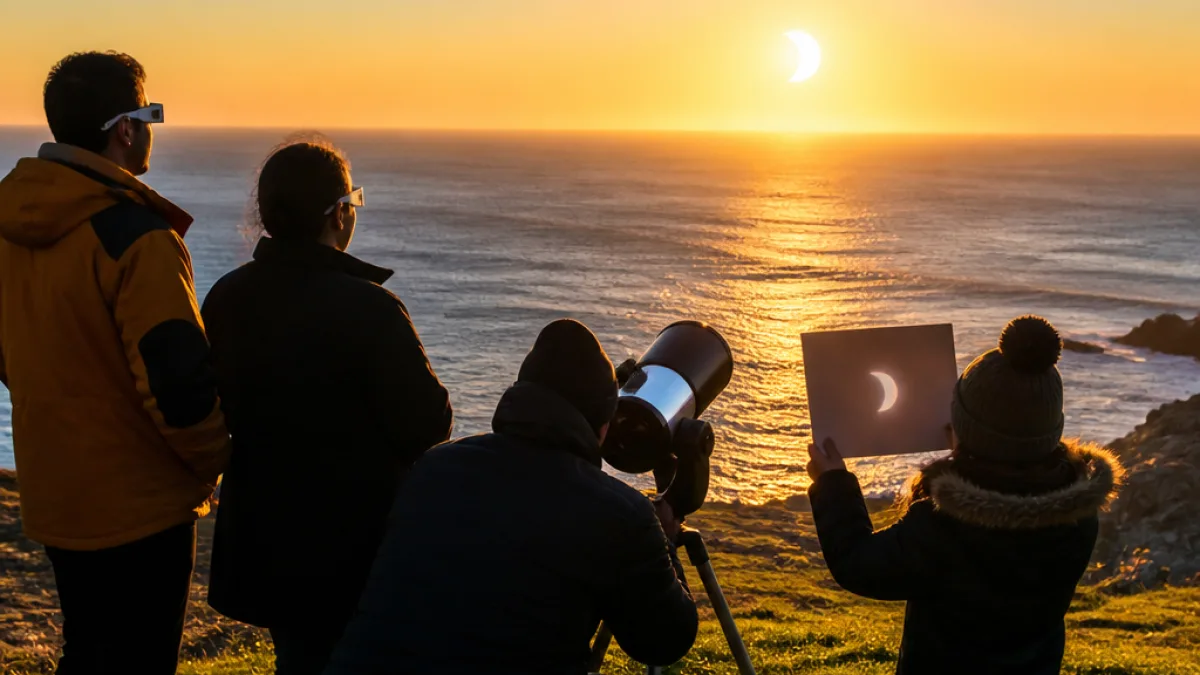
Directly looking at the Sun without proper protection can cause serious and permanent eye damage. The government recommends either using indirect viewing methods or wearing certified eclipse glasses that meet international safety standards ISO 12312-2:2015(E). Ordinary sunglasses are not safe for direct solar viewing.
Safe viewing options include:
- Using a pinhole viewer — a simple, homemade device that projects an image of the Sun onto a surface.
- Projecting the Sun's image through a colander or the gaps between tree leaves onto a flat surface.
- Making a small pinhole projector to cast the Sun’s image onto white paper or card for safe observation.
"It is not safe to just view it through sunglasses."
Organised events and community viewings
Dozens of public and community events are expected to mark the occasion across England, with many local astronomy clubs, universities and museums arranging supervised viewings. Those events supply certified viewing equipment and guidance on safe practices, and are the best option for families, schools and community groups who want to experience the eclipse under expert supervision.
Practical tips for attendees
Organisers and viewers should plan ahead. Consider the following practical points:
- Arrive early at popular viewing sites to secure a safe spot and avoid last-minute crowding.
- Bring warm clothing and refreshments — the event occurs in the evening and weather can change quickly.
- If using rented or borrowed eclipse glasses, check they are intact and carry the appropriate ISO mark.
- Use indirect viewing methods where equipment is unavailable, especially for children.
Why this eclipse matters
Partial eclipses offer a rare and accessible opportunity for public engagement with astronomy. Even when the Sun is mostly covered, the change in daylight and the crescent shapes projected by foliage or colanders provide striking visual effects that make the event valuable for education and community outreach.
| Item | Details |
|---|---|
| Date | 12 August |
| Approximate duration | 1 hour 50 minutes (about 18:20–20:10 BST) |
| Maximum coverage in England | 90%–96% (South West sees most coverage) |
| Safety standard for glasses | ISO 12312-2:2015(E) |
For anyone planning to attend a public viewing, check event details and any local guidance beforehand. Certified viewing equipment and properly supervised events remain the safest way for families and community groups to enjoy the eclipse.
The partial eclipse on 12 August will be one of the most notable astronomical events of the year for observers in England. With the right precautions, it can be an engaging science moment for communities, schools and amateur astronomers alike.










