
Malmesbury foundation’s prize highlights portable safety tech for deaf travellers
The national winner of this year’s James Dyson Award in the United Kingdom is a compact, on-device artificial intelligence system designed to keep people who are deaf or hard of hearing aware of important sounds while they are without hearing aids or cochlear implants.
The award is run by the James Dyson Foundation, which is based in Malmesbury. The announcement, made on 16 September, named engineer Gargi Agrawalla’s device, SIVO.GO, as the UK national winner. The project will progress to the international round of the competition.
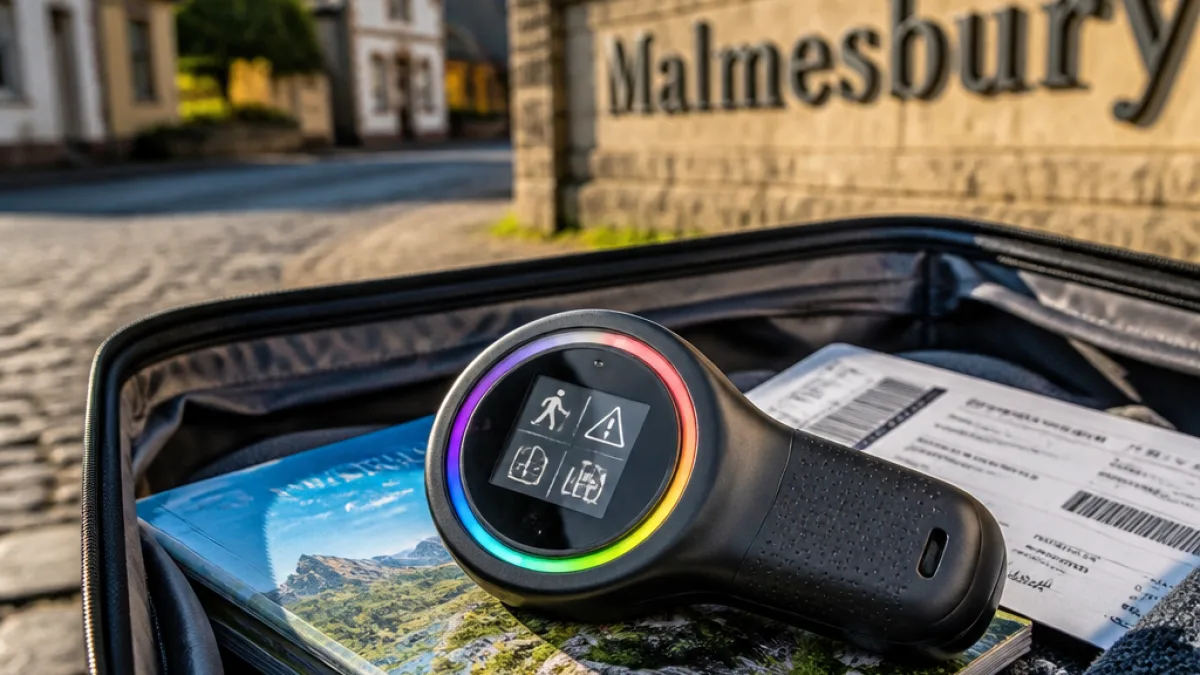
SIVO.GO is a handheld alert system that uses local AI to recognise critical sounds such as fire alarms and doorbells and combines that detection with a vibration sensor for knocks and door movement. The device displays alerts using colour-coded lights, screen symbols and adjustable vibrations and is designed to operate without Wi-Fi or cloud processing.
- Portable: intended to be carried by a user rather than fitted to a building;
- On-device AI: sound recognition happens locally, removing dependence on internet connectivity;
- Multimodal alerts: visual cues and vibration help users who cannot rely on audio signals.
The project was developed with feedback from deaf and hard-of-hearing individuals aged 18 to 70, who reported a need for reliable, discreet and portable alerting that does not depend on hotel or building installations. The device was conceived to support everyday situations in which users remove cochlear implants or hearing aids — for example while sleeping or showering — and where traditional auditory alerts are ineffective.
“Winning the James Dyson Award national prize means so much to me because SIVO.GO started from my own experience of being deaf and wanting to feel safer and more independent when I am not wearing my cochlear implants,”
According to the announcement, SIVO.GO’s designer will receive the UK national prize of £5,000 and will be included in the James Dyson Award’s global shortlist. The international Top 20 will be revealed on 14 October and the worldwide winners on 4 November.
| Date | Milestone |
|---|---|
| 16 September | UK national winner announced |
| 14 October | Global Top 20 announced |
| 4 November | Worldwide winners revealed |
The James Dyson Award is an international competition organised by the Malmesbury-based charity to celebrate engineering-led problem solving among students and early-career inventors. Since its inception, the foundation reports it has supported more than 400 projects and awarded over £1.5m in prizes. The foundation says its broader mission is to inspire the next generation of engineers.
For the Malmesbury community, the award is a reminder of the foundation’s global footprint. The prize offers local visibility to innovations addressing everyday challenges — in this case, a safety and accessibility problem affecting millions. The announcement also underlines the increasing role of compact AI systems that process data on device rather than relying on cloud connectivity, an approach that can be useful where internet access is unreliable or where privacy and latency are concerns.
Looking ahead, the designer said the next steps include refining the prototype, continuing user testing and exploring routes to market so that SIVO.GO could become a dependable product for daily use. The project’s emphasis on affordability and portability was highlighted as a response to existing alerting systems that are often described as bulky or costly.
Malmesbury residents involved in education, engineering and assistive-technology networks may find opportunities to watch the project’s progress as it moves into the international stage of the James Dyson Award. The foundation’s role in championing hands-on engineering projects continues to tie the town into a wider conversation about design, accessibility and the practical deployment of AI.











