
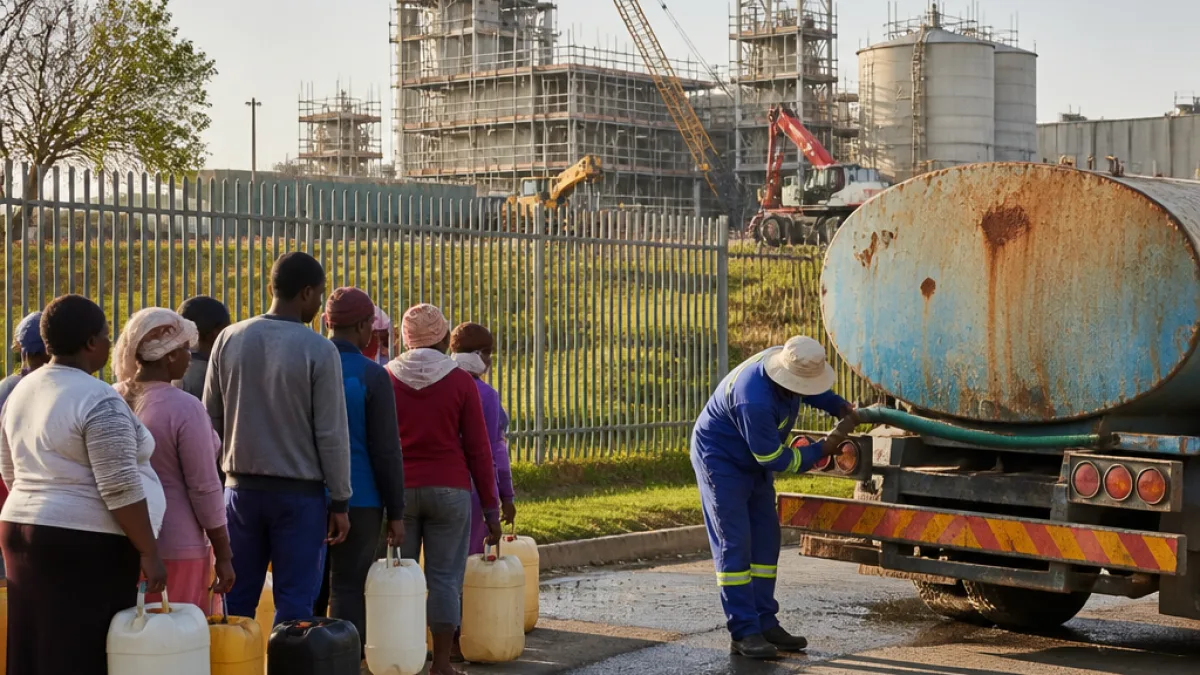
Decade-long outages persist while treatment plant works drag on
Many Makhanda households are still receiving water only intermittently, with supply often limited to early-morning windows that last a few hours. The shortage, now described as ongoing for at least 14 years, has forced residents and institutions who can afford it to arrange independent water sources while the much‑delayed upgrade of the James Kleynhans Water Treatment Works inches forward.
Residents in Fingo and Extension 6 described the same pattern of unpredictability. One Fingo resident said water appears in taps two or three times a week and when it does flow it is usually only for a few hours very early in the morning. Water delivery trucks are also inconsistent, and when they arrive drivers are often hurried, leaving people without the regular resupply they rely on.
"If you don’t wake up early you might miss it,"
Another resident in Extension 6 reported receiving water between about 4am and 5am, with supply cutting off after a few hours, though on some days it did continue until late morning. He said there are occasions when water does not return until mid‑afternoon, and sometimes no water arrives for two days.
Costs balloon as project slips further back
The Kleynhans upgrade began in 2015. Its original scope was to double output from 10 million litres per day to 20 million litres per day, and the work was due to finish in 2018 at a cost of R102-million. According to the implementing agent, Amatola Water, expenditure to date stands at R279-million. A third and final phase, started in March, is budgeted at an additional R223‑million, taking project spending to around R502‑million — more than quadruple the initial estimate and representing a R400‑million increase compared with the 2015 figure.
Amatola Water pointed to the technical difficulty of upgrading a plant while it continues to supply water, along with protracted procurement procedures, approvals and coordination with the Makana municipality, as reasons for the delays. The implementing agent reported that, six months into an 18‑month final phase, only 12% of that work had been completed.
| Item | Original plan | Current reported |
|---|---|---|
| Planned capacity (l/day) | 10 million → 20 million | Still below 20 million |
| Original budget | R102-million | — |
| Spent so far | — | R279-million |
| Final phase budget | — | R223-million |
| Estimated total cost | R102-million | ~R502-million |
Local consequences and accountability questions
The practical effect for residents is immediate: households use stretched salaries to buy water and businesses, schools and hospitals restrict operations or install private storage and boreholes where possible. The prolonged interruptions also raise questions about municipal planning, contract management and value for money.
Civic groups and residents have repeatedly called for clearer timelines and accountability from Makana municipality and project managers. Amatola Water acknowledged shortcomings in meeting the original schedule and defended the current approach as necessary to keep the plant operational during upgrades. The plant had not reached its intended 20‑million‑litre daily output after the second phase was completed.
- Immediate impact: frequent, unpredictable supply outages for thousands of households
- Financial strain: residents spend limited income on purchased water; institutions fund alternative supply
- Project delays and cost overruns: upgrade began in 2015; total spending now projected at around R502‑million
Residents and ratepayers in Makhanda are watching the Kleynhans upgrade closely. For many, the question is not only when full capacity will be restored but whether the final outcome will deliver reliable, equitable supply across the town rather than benefitting only those who can afford private alternatives.















