
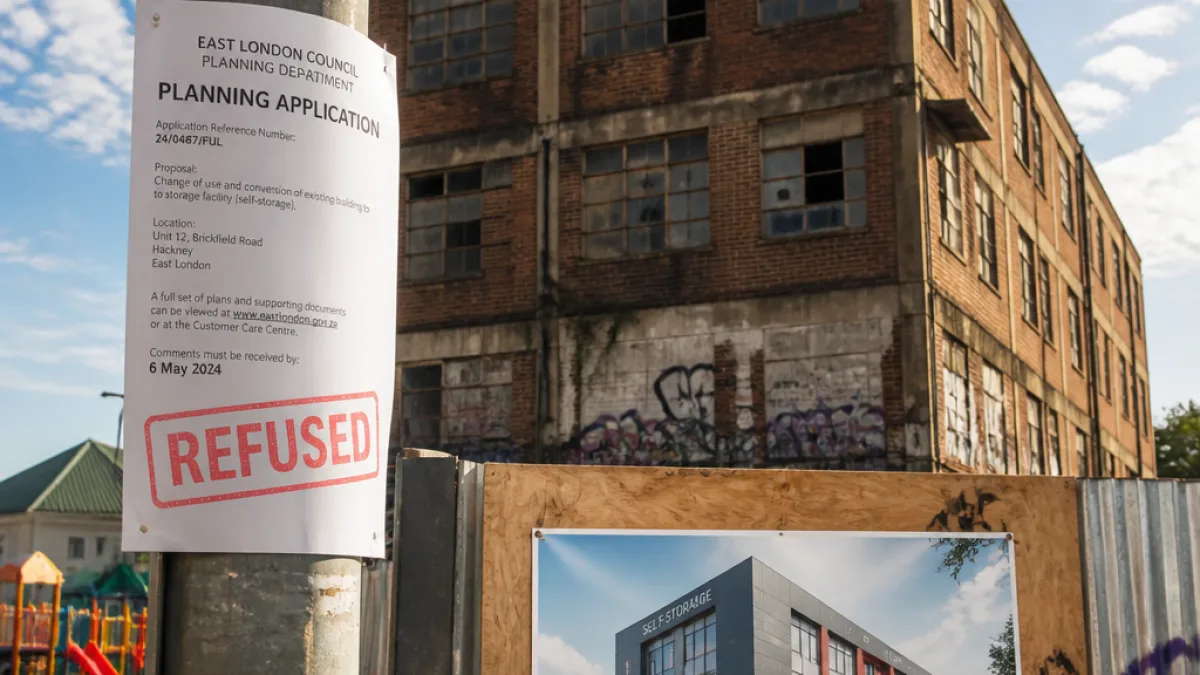
Hackney Council has refused an application to partially demolish and redevelop the long‑empty Anvil House into a modern self‑storage facility with digital workshops, after planners concluded the proposals failed to meet a range of design, safety and environmental requirements.
Why the scheme was rejected
Developer EQT Real Estate had proposed converting the crumbling former builder’s merchant on the edge of Hackney into a STOREX self‑storage warehouse featuring app‑managed units, smart locks, eight “Fab Lab” digital workshops and a small garden. The company said the project would create up to 60 local jobs and act as a quiet neighbour to a nearby primary school.
On 4 August the council’s planning authority turned the application down. Planners listed multiple concerns, including:
- an "excessively prominent" top storey that was judged out of character with surrounding streets;
- insufficient information on energy performance, insulation and measures to avoid overheating in line with council policy;
- a lack of evidence on security measures to prevent anti‑social behaviour;
- the absence of bat surveys for a building in poor condition;
- an undersized 318 sqm garden that planners said would be at risk of attracting anti‑social behaviour due to limited passive surveillance;
- concerns about external materials — the application favoured composite systems including brick‑slip cladding and steel sandwich panels rather than traditional brickwork;
- only a single shared bin store proposed for all facility users, considered inadequate by planners.
Assistant Director of Planning Natalie Broughton said the development would use "some poor quality external materials".
What was proposed and what the council said
The applicant’s design sought a mix of modern storage spaces managed through digital systems, coupled with small‑scale workshop space described as a community benefit. The council did not dispute potential job creation in principle, but placed weight on compliance with local planning policies covering design, materials, environmental performance and public safety.
Planners requested a major redesign, flagging the top storey’s prominence and concluding the scheme was insufficiently justified in relation to energy use and long‑term temperature regulation. They also noted the lack of ecological survey information — specifically bat surveys — for the existing degraded structure.
| Proposal element | Planner finding |
|---|---|
| Top storey | Excessively prominent; out of character |
| Garden (318 sqm) | Too small; at risk of anti‑social behaviour |
| External materials | Poor quality composite systems flagged |
| Energy performance | Insufficient detail on insulation and overheating mitigation |
| Ecology | No bat surveys submitted |
Local context and wider lessons
The decision underscores the level of scrutiny councils apply to redevelopment of older industrial and commercial buildings. For residents and planners in East London (Eastern Cape), the case offers several local lessons: redevelopment schemes promising jobs must still satisfy design, safety, environmental and community safety tests; small public spaces attached to developments are assessed for their practical safety; and ecological surveys remain a routine requirement where buildings of ageing fabric might house protected species.
While the applicant argued the scheme would be a quiet, technology‑driven neighbour and provide employment, the council’s refusal makes clear that social and economic benefits do not automatically outweigh policy compliance failures.
The developer can either submit a revised application addressing the council’s concerns or appeal the decision through the statutory channels. The council’s response also highlights that material selection and waste management arrangements — such as appropriate bin stores — are important considerations in contemporary planning assessments.
For East London readers watching how derelict sites are tackled internationally, the Hackney outcome is a reminder that regeneration proposals face multilayered tests beyond headline job numbers. Local authorities increasingly balance economic uplift against long‑term environmental performance, public safety and urban design character when deciding whether to grant permission.















