
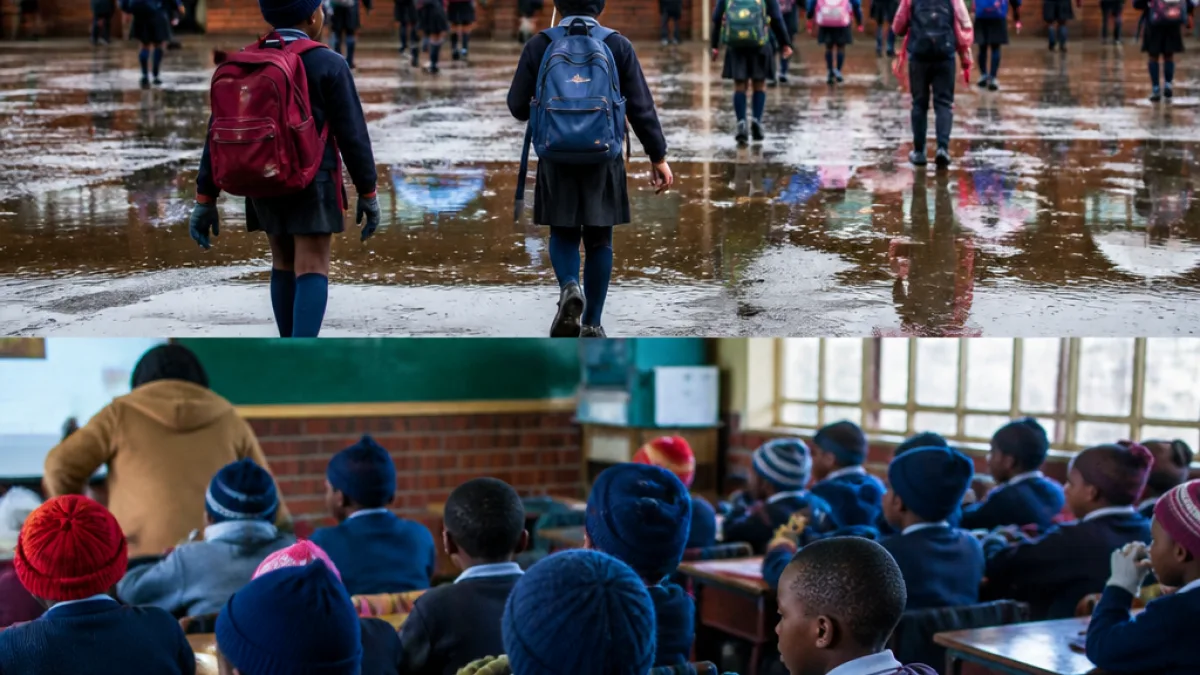
Gauteng has been gripped by unseasonably cold, wet conditions this week and some schools are already feeling the impact: attendance has fallen as learners struggle to travel to school and stay warm in classrooms that lack adequate heating.
Reduced attendance and cold classrooms
At Nkabinde Primary School the principal reported a marked drop in learners since Monday, attributing the fall to the biting cold and rainy weather. Temperatures in parts of the province have reached as low as 3°C, making walking long distances to school difficult for children without warm clothing.
Principal Vusi Nkabinde said the weather had discouraged many learners from coming to school and raised concern about lost teaching time. According to him, the school recently received a small donation of hats and gloves from a non-profit organisation, which helped about 100 learners, but demand remains high.
“Most of the learners were not here on Monday... Things would be better if we had heaters in all our classrooms, but that’s not the case; we hope to have them soon so learners don’t get discouraged when the temperatures are low,” the principal said.
Learners interviewed on their way to class described the strain of studying while cold. A 16-year-old, Busisiwe Hlongwane, said she found it hard to focus because she was busy trying to keep warm. A 17-year-old, Tisetso Mofokeng, added that standard school uniforms often do not provide enough insulation in these conditions.
What this means for learning
When attendance dips and learners arrive shivering, teachers face an uphill battle to maintain lesson momentum. Cold classrooms affect concentration and can lengthen the time it takes to complete planned work. For learners who commute by foot or public transport, exposure to rain and low temperatures can also increase the risk of illness, which in turn may lead to further absenteeism.
- Temperature reported: as low as 3°C
- Clothing assistance: donation covered about 100 learners
- Immediate needs: warmer uniforms, protective outerwear, and classroom heating where feasible
Practical measures and community responses
School leaders and parents can take steps to reduce the impact of cold weather on learners. These include ensuring children have layered clothing and waterproof footwear for wet days; schools can consider short-term measures such as rearranging timetables to prioritise core lessons when attendance is highest, or using communal spaces that are easier to heat.
Local non-profit groups and community organisations can play a role by organising clothing drives or targeted donations of warm clothing and beanies, similar to the recent contribution some learners at Nkabinde Primary received. School governing bodies and district education offices are the appropriate channels to coordinate such assistance.
Weather outlook and what parents should watch for
Meteorological reports indicate the cold spell may persist for several days. Parents should monitor local forecasts, dress children warmly and ensure they have a dry change of clothes where possible. If a child is unwell or demonstrating symptoms of a respiratory infection, parents should follow health guidance and contact the school to explain the absence so that missed work can be tracked.
| Issue | Immediate impact |
|---|---|
| Low temperatures (around 3°C) | Reduced attendance, difficulty concentrating |
| Wet conditions | Travel problems for learners who walk; risk of getting ill |
| Limited heating in classrooms | Cold learning environments; calls for heaters |
Education authorities did not provide an immediate comment on plans to address heating in classrooms. For now, principals like Nkabinde are appealing to community organisations and parents to help keep learners warm and in school while the cold snap continues.
As the province rides out the cold, ordinary parents and teachers are being tested on how quickly they can marshal practical solutions to protect learning time. For many learners in Gauteng the weeks ahead will be a balancing act between staying warm, staying healthy and staying in the classroom.
Gauteng correspondent reporting from Johannesburg.











