
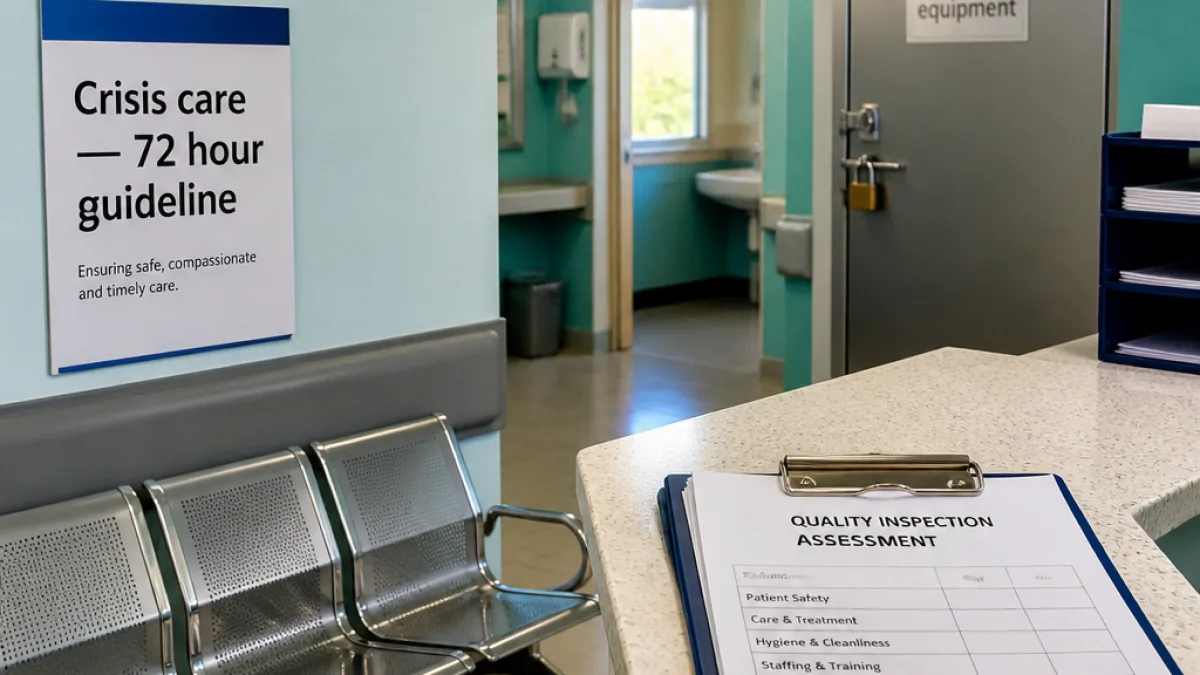
The Care Quality Commission (CQC) has downgraded emergency mental health services run by the East London NHS Foundation Trust from Good to Requires Improvement, citing what inspectors described as serious safety and staffing shortfalls. The regulator's findings highlighted large gaps in staff supervision, prolonged stays in crisis care and concentrated use of restraint in a Health-Based Place of Safety.
What the inspection found
According to the CQC report, key concerns included:
- Around 68% of staff in the City and Hackney crisis services had missed required supervision sessions;
- 30% of patients remained in crisis care for longer than 72 hours, with the average stay reported at 70 hours;
- Half of recorded restraints took place at the Health-Based Place of Safety — presenting questions about how acute distress is managed.
Despite the downgrade for that service line, the trust kept its overall Outstanding rating for other areas, underscoring how one underperforming service can sit within an otherwise strong organisation.
“The rating drop from 'Good' to 'Requires Improvement' highlights how regulators are intensifying scrutiny of how mental health services manage risk, supervision and patient safety,” the report said.
Why the finding matters beyond the UK
While the inspection relates to a trust in London's east, the issues it raises are pertinent to health systems worldwide — including in the Eastern Cape — where crisis services face growing demand, staffing shortages and heightened regulatory attention. Supervision of frontline staff is a recognised protective factor: without regular clinical oversight and debriefing, the risk of care lapses, burnout and inconsistent use of restrictive interventions rises.
For local managers and policymakers the CQC findings act as a prompt to review three practical areas that affect patient safety:
- regularity and documentation of staff supervision;
- flow through crisis services to avoid prolonged stays beyond recommended timeframes;
- how and where restraint is used, and the availability of alternatives and de-escalation training.
These are matters of clinical governance and workforce planning rather than geography — a reminder that governance failures can appear in any system under strain.
Key figures from the inspection
| Metric | Reported figure |
|---|---|
| Staff missing required supervision | 68% |
| Patients in crisis care >72 hours | 30% (average stay 70 hours) |
| Restraints at Health-Based Place of Safety | Approximately 50% |
Local clinicians and administrators in the Eastern Cape routinely contend with staff shortages, limited bed capacity and high demand for emergency mental-health support. The UK regulator's focus on supervision and documented risk assessment is therefore directly relevant: strengthening supervision systems is often achievable with policy changes and reprioritisation even where budgets are constrained.
It is also a reminder to city health oversight bodies and the provincial health department that external scrutiny — whether by a national regulator or by local audit — often centres on measurable governance practices: supervision rates, length of stay, incident reporting and the setting of care for acute interventions.
Health leaders wishing to draw practical lessons from the CQC inspection should consider audit of supervision compliance, clearer escalation routes for prolonged crisis stays and targeted training in de-escalation to reduce reliance on physical restraint. Where interventions require additional resources, clear evidence from audits can support requests to the provincial Department of Health or partners for targeted funding or programme support.
For families and community groups, the report is a prompt to ask about governance: how often staff are supervised, what the expected maximum duration of crisis care is, and what safeguards exist where restraint is used. Those are the kinds of questions that drive safer services, whether in the UK or in South Africa.
The CQC inspection underlines a simple operational truth: strong governance and consistent supervision matter as much to patient safety as the headline rating of a trust or department.












