China’s vocational education system supplied an average of almost 10 million skilled workers to industry each year in recent years, a white paper released at the World Vocational and Technical Education Development Conference in Tianjin said on 17 October 2026.
Scale and outputs
The document, presented at the three-day international conference, states that the typical level of schooling among newly added skilled personnel has reached an average of 14.35 years. In 2025 alone, the white paper reports 5.82 million graduates from higher vocational institutions and nearly 5.22 million from secondary vocational schools.
China’s vocational network is described in the paper as the world’s largest, comprising:
- 9,151 secondary vocational schools;
- 1,554 higher vocational colleges;
- 124 vocational undergraduate institutions;
- 52 regular higher education institutions that also offer vocational undergraduate programmes.
The white paper notes that higher vocational institutions now make up more than half of the country’s higher education institutions.
| Indicator | Figure (2025) |
|---|---|
| Higher vocational graduates | 5.82 million |
| Secondary vocational graduates | 5.22 million |
| Average years of education (new skilled personnel) | 14.35 years |
Breadth of training and international collaboration
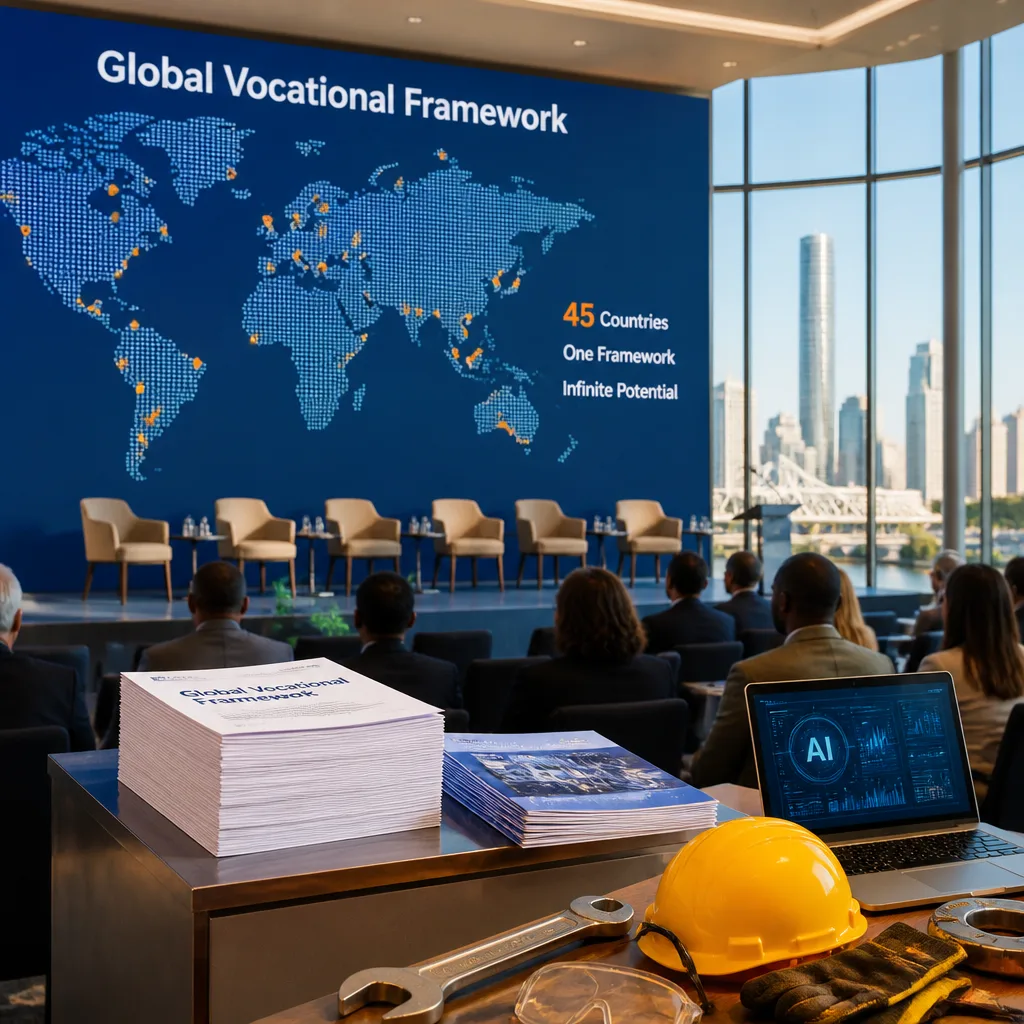
According to the paper, China’s vocational catalogue covers 19 major categories, 97 categories and 1,491 majors, mapped across all 41 major industrial categories of the national economy. The organisers of the Tianjin conference also released the Framework of World Vocational and Technical Education Standards. The framework — which China led the development of and which was jointly released by representatives from 45 countries — sets out priorities such as improving school systems, establishing lifelong education and training pathways, strengthening industry–education cooperation on teaching materials, and building teaching teams through school–enterprise partnerships.
The white paper stresses the role of technology in reforming vocational education, explicitly highlighting artificial intelligence as a driver of change in curricula and pedagogy. Four national standards for Luban Workshops, put forward by China’s Ministry of Education, were also unveiled at the conference.
What this means for South Africa
For South Africa’s education community, the Chinese account reinforces several themes that recur in local policy debates: the need to scale credible vocational pathways, link training to employers, and design lifelong learning systems that accommodate rapid labour-market change. The scale of China’s output — millions of vocational graduates annually and thousands of institutions — illustrates one model for aligning skills supply with industrial demand, though the social, economic and governance contexts differ markedly between the two countries.
Key implications to consider:
- System capacity: growing numbers of vocational graduates at scale requires sustained investment in physical infrastructure, teacher training and quality assurance.
- Industry partnerships: the emphasis on school–enterprise collaboration in the framework underlines the importance of employers in shaping curricula and offering workplace learning.
- Technology and pedagogy: using AI to support teaching and assessment may improve responsiveness but also raises questions about equity of access and teacher readiness.
Understanding the policy choices behind China’s statistics can help South African policymakers and education leaders weigh models for expanding vocational provision while protecting learners’ opportunities and outcomes.
The World Vocational and Technical Education Development Conference provided a platform for countries to exchange approaches to vocational training and to advance common standards. The full white paper and the jointly released framework set out a package of actions intended to strengthen vocational pathways, emphasise lifelong learning and deepen collaboration between educators and employers.
As South Africa continues to debate how best to match education and training provision with a challenging labour market, the Chinese report offers data and approaches that will likely feed into comparative analysis and policy discussion. Any adoption of ideas will need careful adaptation to local priorities, funding realities and equity goals.