
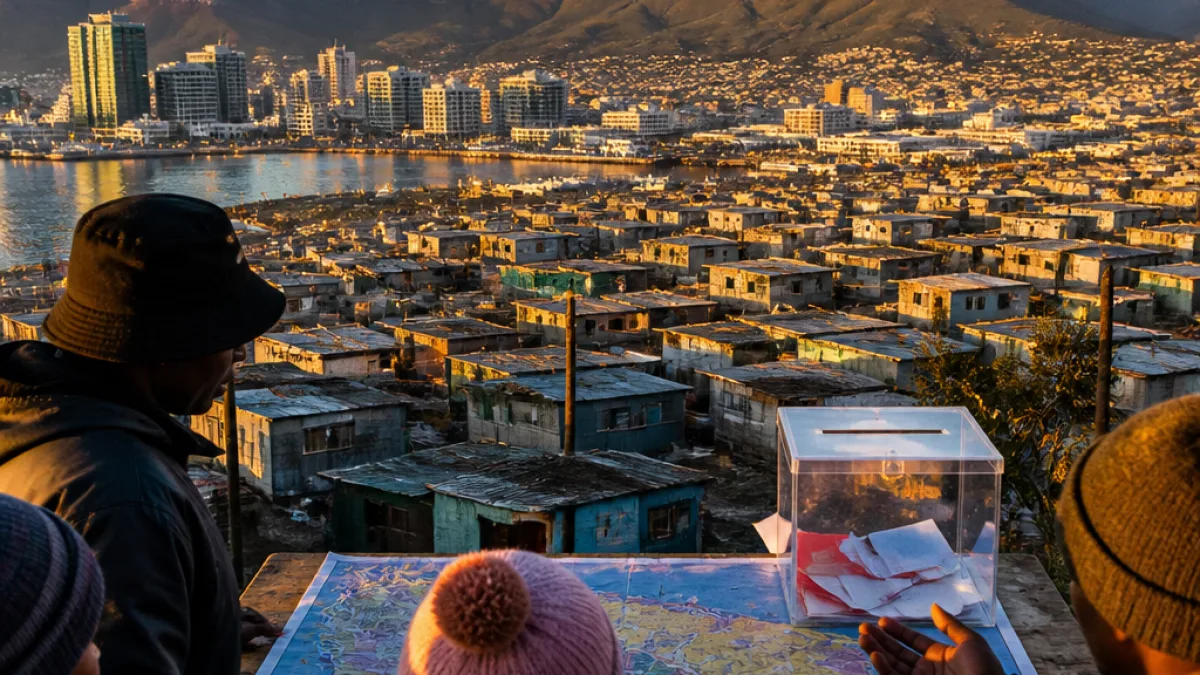
Election debate reopens questions about City identity and spatial justice
The lead-up to the 2026 local government elections has focused attention on how Cape Town defines itself — not merely as a functional metropolitan centre but as a city with an inclusive public imagination. In a recent commentary, Lorenzo Davids argued that the elections echo earlier moments in South African history and challenge the city’s leaders to confront whether prosperity is being organised for everyone or only for enclaves.
Davids framed the 2026 contest as a reprise of three seismic political conflicts from South African history, arguing these earlier struggles were about who is allowed to shape the nation and its towns. He suggested that, after 32 years of democracy, nostalgia for separatist doctrines persists and that current planning policy risks reproducing exclusions rather than remedying them.
“The 2026 Local Government elections increasingly sound like a replay of three major political contests from 1880, 1899, and 1948,”
The piece contrasts two broad critiques. One accuses the ANC of misgovernance nationally — citing Johannesburg as an example where democratic promise has been eroded into municipal failure — and says that has created space for those who imagine a return to exclusionary policy. The other critique addresses the DA-led governance of Cape Town: while the city has become prosperous and well-run in many respects, Davids argues it has failed to imagine or implement an "African city" in which success is a public, not merely private, good.
That argument centres on how urban policy frames problems. Drawing on sociological ideas about the link between personal troubles and public issues, the commentary says Cape Town often treats systemic problems as individual failings — thereby avoiding the structural changes that integrated planning, housing and transport would require.
What this means for Cape Town residents
- Spatial inequality: The commentary highlights the persistence of enclaves of prosperity alongside under-served communities, suggesting current approaches to planning and service delivery still reflect apartheid spatial patterns.
- Political narratives: The 2026 vote will not only be about service delivery statistics; it will be contested as a debate over identity and whose needs are prioritised in city planning.
- Policy implications: If Davids’ concerns resonate with voters, political parties will face pressure to propose more integrated, city-wide interventions rather than measures that benefit confined areas.
For Cape Town, where tourism, finance and a buoyant property market coexist with informal settlements and constrained economic opportunity for many, the question raised is practical as well as symbolic: can municipal policy knit together a city whose public spaces, transport corridors and housing strategies enable social mixing and economic inclusion?
The commentary points to Johannesburg’s experience as a cautionary tale. Davids argued Johannesburg — once central to liberation politics and home to landmark sites such as Soweto and the offices associated with Mandela and Tambo — has lost much of its aspirational energy and become, in his words, an "ATM" for the ruling party. He then contrasted that with Cape Town’s material successes under DA leadership but insisted material success has not yet translated into an urban imagination that treats prosperity as universal.
Local government elections determine who makes decisions on zoning, public transport, housing allocations and municipal budgets. Those choices directly affect day-to-day life across the metro: commuting times, access to sanitation and water, town planning and the location of social services. The contest over whether Cape Town will continue to be organised as prosperous pockets amid wider inequality, or whether it will pursue more redistributive urban policies, is therefore highly consequential.
Neither the commentary nor the wider debate prescribes a single policy solution, but it does push an important question onto the local agenda: will political competition in 2026 produce plans that confront the spatial legacy of apartheid and expand the public imagination of the city so that success is shared?
As voters prepare to head to the polls next year, the debate over identity, planning and who the city is being built for will shape campaign promises and municipal priorities — and, ultimately, the lived experience of Cape Town’s diverse communities.
| Issue | Questions for 2026 |
|---|---|
| Housing & spatial planning | Will policy favour integrated housing and transport or maintain enclave development? |
| Service delivery | How will the city ensure services reach informal settlements and lower-income areas? |
| Political narrative | Will campaigns address structural inequality or emphasise individual responsibility? |













