
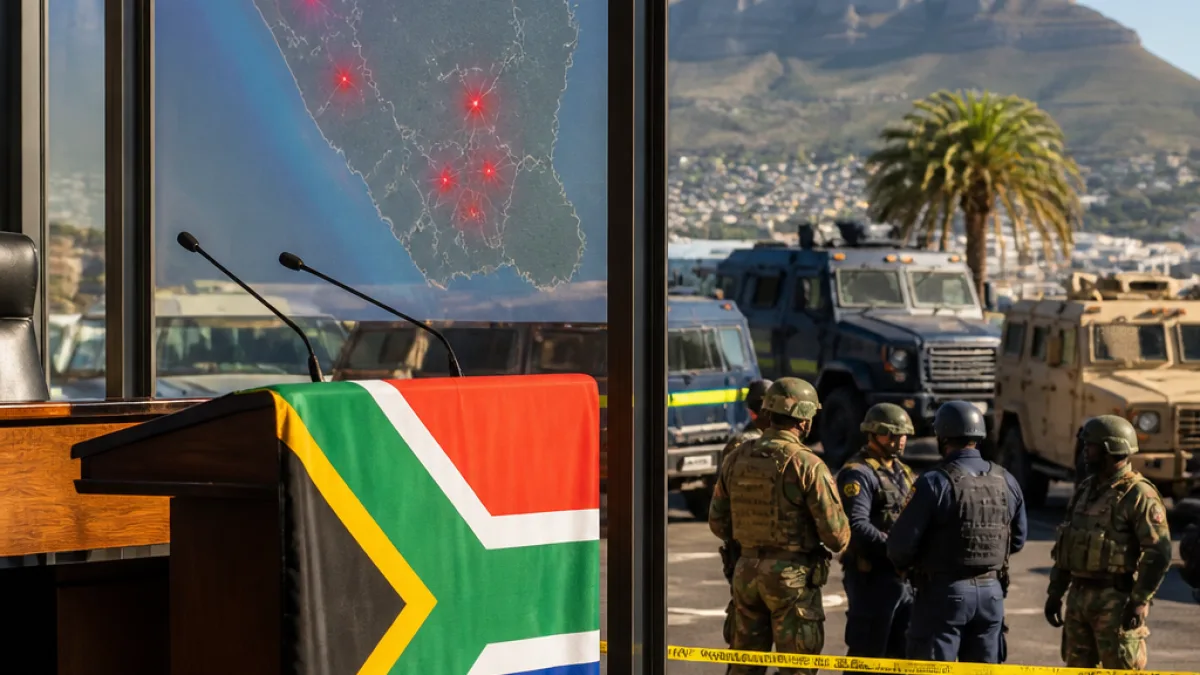
Acting Police Minister Firoz Cachalia has defended Operation Prosper, saying the deployment has produced arrests, firearm seizures and reductions in some crime indicators even as gang-related killings continue to claim lives across the Western Cape.
National response meets local scepticism
Cachalia made his remarks in response to a parliamentary question from the Umkhonto weSizwe Party (MKP) MP Glen Taaibosch, who raised concerns that killings and mass shootings appeared to have increased rather than fallen since the April launch of the operation. The deployment — a joint effort by the South African Police Service (SAPS) and the South African National Defence Force (SANDF) — was funded with more than R823 million, according to reporting by IOL.
Opposition and oversight figures have pointed to a string of high-profile mass shootings since Prosper began. IOL previously reported that at least 29 people were killed in eight mass shootings during the operation’s early months, while another weekend more recently saw more than 30 fatalities in the Western Cape.
Shift to intelligence-led approach, says Cachalia
In his response, Cachalia said that Prosper was transitioning from an initial high-visibility, stabilisation phase to operations guided by intelligence. He described the aim as disrupting, disabling and dismantling organised criminal and gang networks through targeted action against key role-players.
He also placed Prosper within a broader framework led by the National Joint Operational and Intelligence Structure (NatJoints), with SANDF support in priority areas. Cachalia maintained that SAPS had recorded positive results in some operational areas, despite localised flare-ups of violence.
What critics say
Critics have questioned whether the deployment’s heavy expenditure has translated into meaningful reductions in gang power. Police Portfolio Committee chairperson Ian Cameron has publicly asked whether Prosper is making a measurable impact after weekends that produced dozens of deaths.
Earlier comments acknowledged by authorities noted that no gangs had been fully dismantled during Prosper’s initial phase. That admission has bolstered calls from some MPs and civil society for a clearer, evidence-based assessment of the operation’s outcomes and for published, time-bound milestones.
Operational details and reported outcomes
The government has described the shift towards intelligence-led work as intended to move beyond visible deployments to focused disruption of criminal networks. According to reporting, outcomes cited by the department include arrests and firearm seizures, though a comprehensive breakdown of numbers, locations and the nature of arrests has not been made publicly available in detail.
- Launch: April (operation commencement)
- Funding allocated: R823 million+
- Early casualties reported: 29 killed in eight mass shootings (early months)
- Recent spike: more than 30 killed in the Western Cape over a single weekend
| Item | Reported figure |
|---|---|
| Allocated budget | R823 million+ |
| Early mass shooting fatalities | 29 (eight incidents) |
| Recent weekend fatalities | More than 30 |
Questions for accountability
For communities living with daily threats from gangs, visible boots on the ground are only part of the picture. Analysts and opposition politicians alike have urged the executive and SAPS to publish detailed operational metrics: which network leaders have been arrested, what quantity of firearms has been recovered, and where intelligence-led disruptions have severed criminal revenue streams such as extortion.
Without that granularity, the public is left to weigh high-level claims against continued fatal violence. Cachalia’s assurance that the operation is evolving toward intelligence-driven tactics will be tested in coming months when the department is expected to show measurable declines in organised-gang capability rather than temporary, localized reductions in incidents.
What to expect next
Parliamentary oversight is likely to intensify as MPs press for evidence of Prosper’s efficacy. The Police Portfolio Committee and other oversight bodies may request briefings on the operation’s objectives, outputs and outcomes. Civil society groups and community leaders in the Western Cape will continue to demand accountability for both lives lost and the large public funds committed to the deployment.
For residents, the immediate priority remains improved safety on the streets and in townships. For national and provincial authorities, the challenge is to translate resources and short-term visibility into sustainable dismantling of the networks that drive gang violence.
Reporting is based on Cachalia’s parliamentary response and IOL coverage.













