
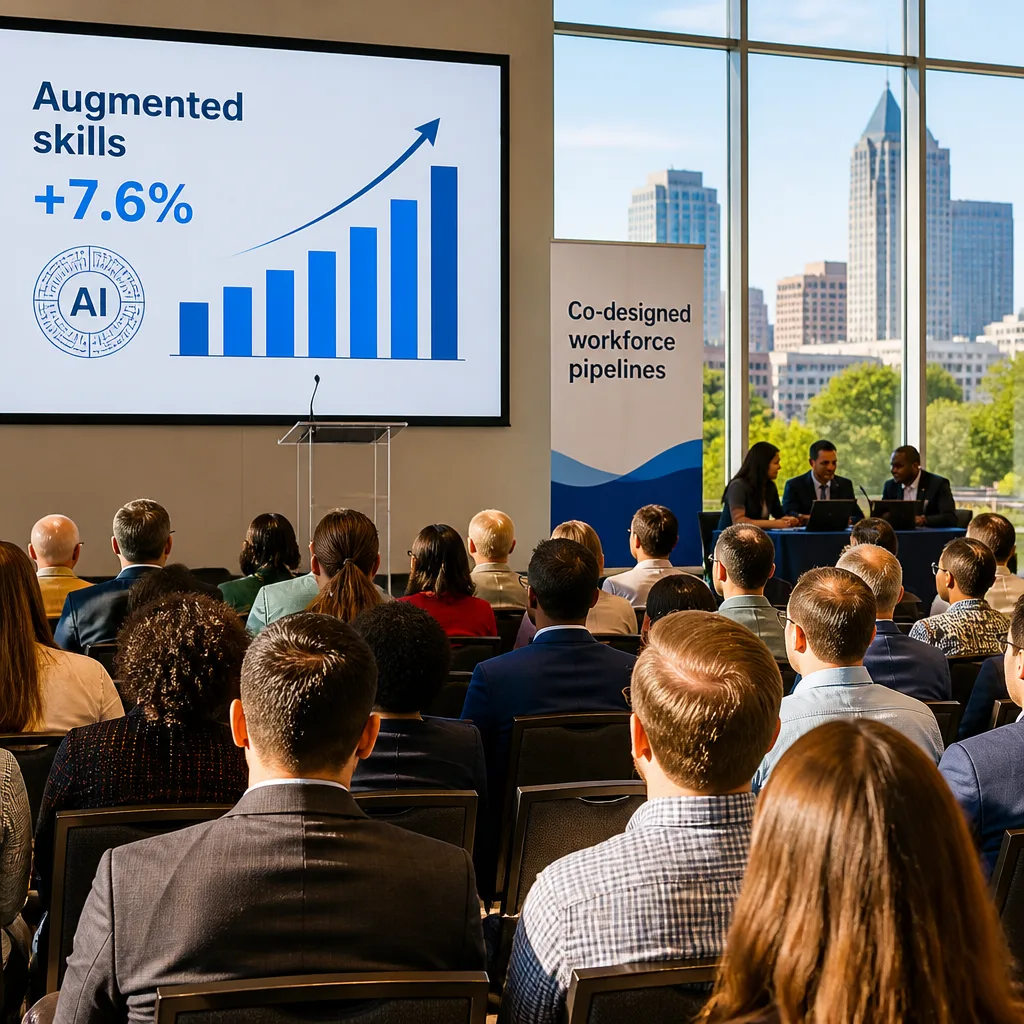
RALEIGH — Education and business leaders gathered Aug. 3 at the North Carolina Chamber’s Education and Workforce Conference to press for closer collaboration among employers, K-12 systems, community colleges and universities as artificial intelligence changes what employers want and how students learn.
Building a shared framework for workforce development
Speakers framed the gathering around a persistent problem: workforce-development efforts often operate in silos without a common, measurable goal. That critique, originally raised at last year’s conference, was reiterated this year as panelists urged partners to develop a coordinated plan that translates regional labor needs into actionable education pathways.
Vincent Ginski, senior director of workforce competitiveness at the NC Chamber, has advocated for a unifying objective that defines specific labor-force shortfalls and assigns responsibility across institutions to meet it. He said such a target could change isolated efforts into an aligned pipeline.
“absence of an underlying framework”
AI’s growing impact on skill demand
Experts at the conference also focused on how emerging technologies, particularly artificial intelligence, are altering the kinds of skills employers seek. Erik Leiden, managing director of workforce strategy at The Burning Glass Institute, urged educators and employers to consider whether AI is augmenting human work or automating it — a distinction that affects training priorities.
Leiden’s presentation highlighted a measurable shift in job postings since the public debut of ChatGPT: a 7.6% increase in demand for so-called augmented skills, including decision-making and leadership. Those are the kinds of competencies employers look for when technology expands workers’ capabilities rather than replaces them.
| Measure | Change | Source context |
|---|---|---|
| Demand for augmented skills | +7.6% | After ChatGPT’s introduction (presentation by The Burning Glass Institute) |
What leaders proposed
Panelists emphasized that closing the gap between education outputs and employer needs requires intentional, shared planning. Recommendations discussed at the conference included:
- Co-designing program curricula with employers so training maps directly to regional labor needs.
- Defining a clear, quantifiable “north star” goal for workforce development that all partners can align behind.
- Focusing on skills that are complemented by AI—such as leadership and complex decision-making—rather than those most easily automated.
Speakers noted the state’s economic growth even as poverty rates remain a concern, underscoring urgency for systems that convert educational attainment into broadly shared opportunity. The discussion called on K-12 districts, community colleges and universities to take ownership of pieces of a larger workforce solution rather than operating in isolation.
Implications for educators and employers
For K-12 and postsecondary leaders, the conference suggested practical shifts: revise curricula to emphasize augmented skills, partner with employers on experiential learning, and adopt shared metrics that measure how well graduates meet local labor demand. For employers, presenters urged clearer communication about the skills they need and greater participation in co-developing training pathways.
The conference highlighted that as AI continues to enter workplaces, the balance between automation and augmentation will determine which jobs and skills grow. Attendees left with a renewed call to coordinate across sectors so that education systems can more quickly adapt to changing employer expectations.














