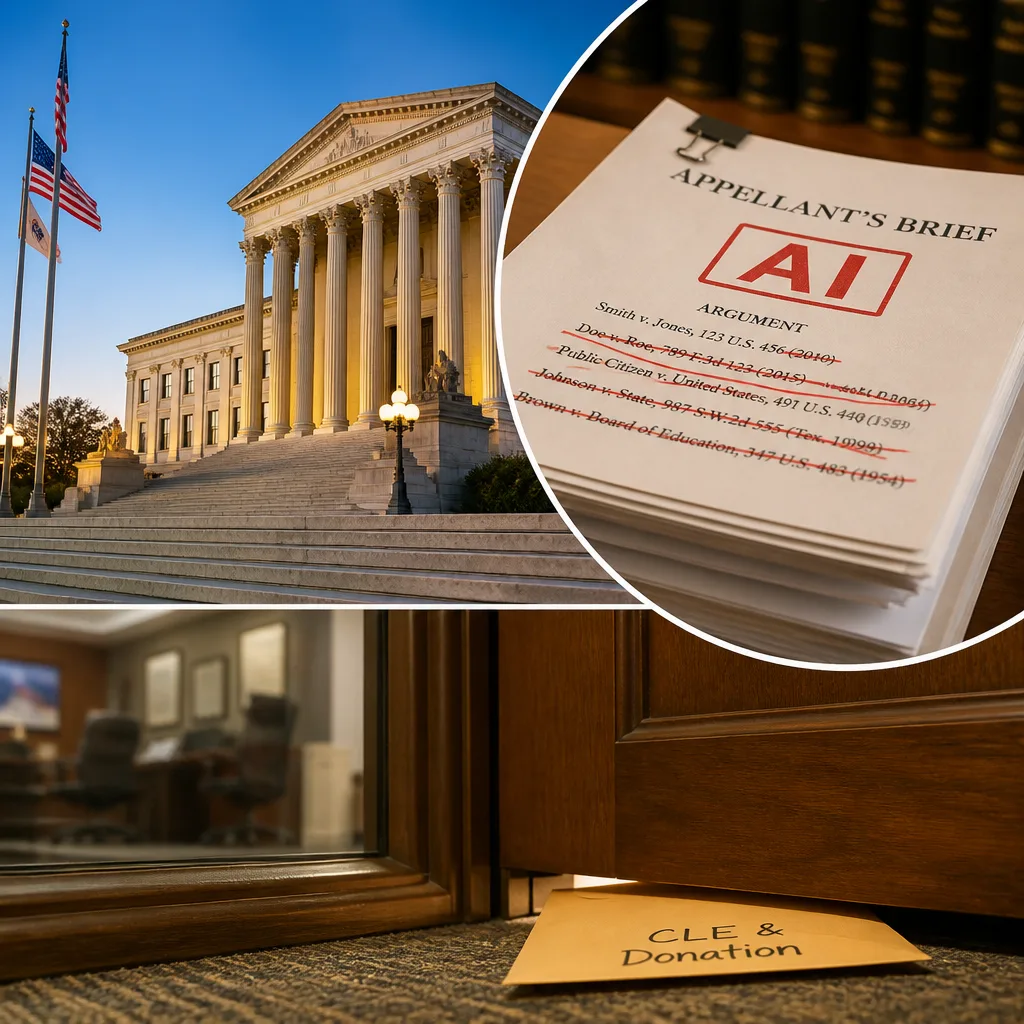
The Connecticut Supreme Court issued sanctions against a lawyer and his firm after appellate filings contained inaccurate citations produced by generative artificial intelligence, and the court mandated targeted continuing legal education and modest charitable donations to promote professional learning about AI.
Court stresses lawyer responsibility to verify AI output
The ruling names attorney Ian G. Gottlieb, a partner at GLG Law in Wallingford, and requires him to complete a total of six hours of continuing legal education (CLE) focused on ethics and office management, with three hours specifically addressing the use of generative AI. The court also ordered both Gottlieb and his firm to make $1,000 donations each to a bar organization that provides education on AI tools.
“This order should serve as a reminder to all members of the legal profession to learn about the risks and limitations of the technologies they use in the practice of law because they remain personally responsible to make certain that all information submitted to the court is true and accurate,” the court wrote.
Court documents indicate the sanctions stem from “hallucinated” or fabricated legal authorities that appeared in briefs Gottlieb filed in eviction-related appeals. The decision underscores the problem courts nationwide are confronting as generative AI systems sometimes fabricate case citations, statutes or other legal authorities that do not exist.
Growing judicial concern, procedural responses
The Connecticut action follows similar incidents elsewhere. Federal and state judges have flagged instances where AI-assisted drafting produced fictitious legal citations. In one example cited by the court, a New York lawyer was fined $500 last year for an inaccurate filing. In response to such occurrences, state Superior Court judges in Connecticut revised their rules to require that anyone using generative AI in filings independently verify all citations, authorities and evidence produced by the technology. The state’s appellate courts are also crafting their own AI-related rules.
Legal and law-enforcement communities have expressed parallel concerns about AI in other contexts. Prosecutors and police leaders have at times urged pauses in adopting AI-powered tools for law enforcement until the technologies are tested and clear usage rules are in place.
Sanctions and education requirements
The court’s disposition mixes remedial education with nominal financial penalties intended to promote professional development. The specific requirements are summarized below.
| Measure | Requirement |
|---|---|
| Continuing legal education | 6 hours total; 3 hours on generative AI, remaining on ethics/office management |
| Donations | $1,000 each from the attorney and the firm to a bar group offering AI education |
- The case arose from appeals related to landlord-tenant rent disputes.
- The court emphasized professional accountability even when lawyers use new drafting technologies.
- Judicial bodies are increasingly adopting rules that place the onus on filers to confirm AI-produced material.
The sanction is positioned by the court as a broader caution to the legal profession: attorneys must educate themselves on the limitations and hazards of generative AI and ensure the accuracy of submissions to the courts. By pairing mandated CLE with donations supporting AI education, the court sought to both correct the specific misconduct and encourage wider professional learning about emerging technologies.
As courts and regulators continue to confront issues posed by generative AI, this decision is likely to influence how bar groups, firms and individual practitioners approach the verification of AI-generated content and the incorporation of AI-focused training into professional development programs.