
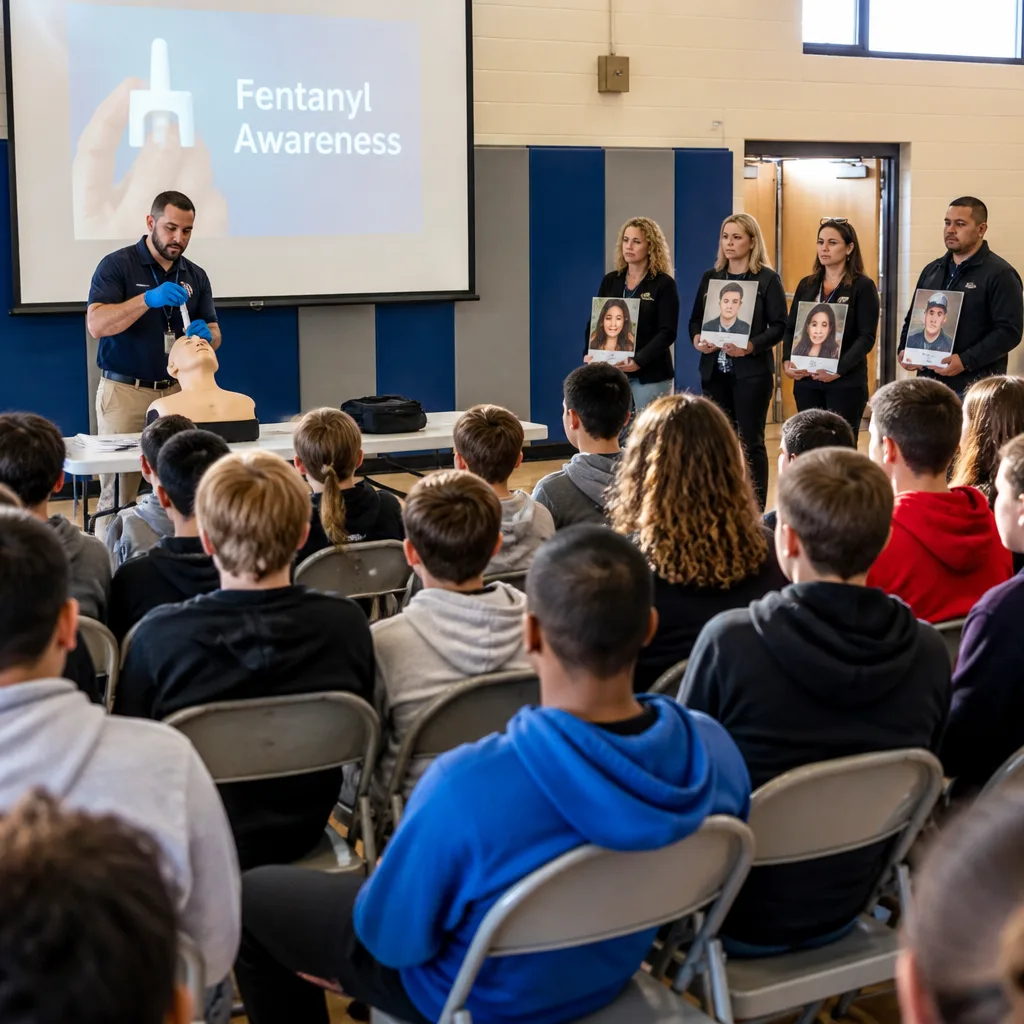
More than 100 Salina Middle School students attended an assembly this week that combined first-person testimony and a hands-on demonstration of naloxone — the opioid overdose reversal drug commonly known by the brand name Narcan — under a new Oklahoma law requiring fentanyl education for grades six through 12.
Law pushes fentanyl education into classrooms
Oklahoma lawmakers this year approved what supporters have called Rain’s Law, which directs school districts to provide fentanyl-abuse prevention and drug-awareness instruction for students in sixth through 12th grades. The Salina assembly was one of the early school events tied to the statute, bringing together families impacted by overdose and community educators.
At the event, parents who lost children to suspected fentanyl poisoning spoke to students about the lethality of illicit fentanyl and the risks posed by counterfeit pills. The gathering also included a demonstration of how to recognize an opioid overdose and how to administer naloxone.
Parents share personal losses, warning
Greg Swan, a father who lost his son in 2013, described the medication used to reverse overdoses and urged students to treat the threat seriously. He demonstrated a naloxone device and said schools should use the law to expand fentanyl awareness.
“That’s Narcan. That is called the Lazarus drug. That will save somebody who is down, passed out from an opioid overdose,” Swan told students.
Swan said his son, Drew, was 24 when he died April 3, 2013. He told students Drew had taken an unprescribed pill his roommate provided; the medical examiner said the pill likely contained fentanyl but could not conclusively rule it in. Swan described his son as intelligent and active and said losing him was devastating.
The assembly also featured another parent whose child was named Rain; that mother was central to passage of the new law, its supporters said at the event. Organizers emphasized that fentanyl can be fatal in very small amounts and that awareness and timely intervention can save lives.
Students learn prevention and response
During the session, students were instructed on signs of an overdose and how naloxone may be used to respond. Presenters framed the instruction as both a prevention measure and an emergency response skill, noting that rapid administration of naloxone can reverse life-threatening opioid depressant effects long enough for emergency services to arrive.
Educators and advocates at the assembly urged school districts across Oklahoma to prioritize the new requirements and to incorporate both prevention messaging and practical training for students and staff.
- Audience: More than 100 Salina Middle School students
- Law: Rain’s Law requires fentanyl education in grades 6–12
- Demonstration: Naloxone (Narcan) use and overdose recognition
| Element | Details from assembly |
|---|---|
| Speakers | Bereaved parents including Greg Swan |
| Key message | Fentanyl is lethal in small amounts; naloxone can reverse overdoses |
| Target students | Grades 6–12 (law requirement) |
Advocates say classroom-based education about fentanyl aims to reach students before they encounter counterfeit pills or other sources of illicit opioids. The Salina assembly illustrated how the law is being translated into immediate outreach: combining personal testimony, practical training, and calls for districts to make fentanyl education a sustained part of health instruction.
As states nationwide grapple with opioid and synthetic opioid overdose deaths, the Oklahoma model may influence how other school systems balance prevention education, harm-reduction training and parental engagement. For now, Salina’s event represents a localized effort to meet the new statutory requirement and to give students tools and information intended to prevent further tragedies.














