
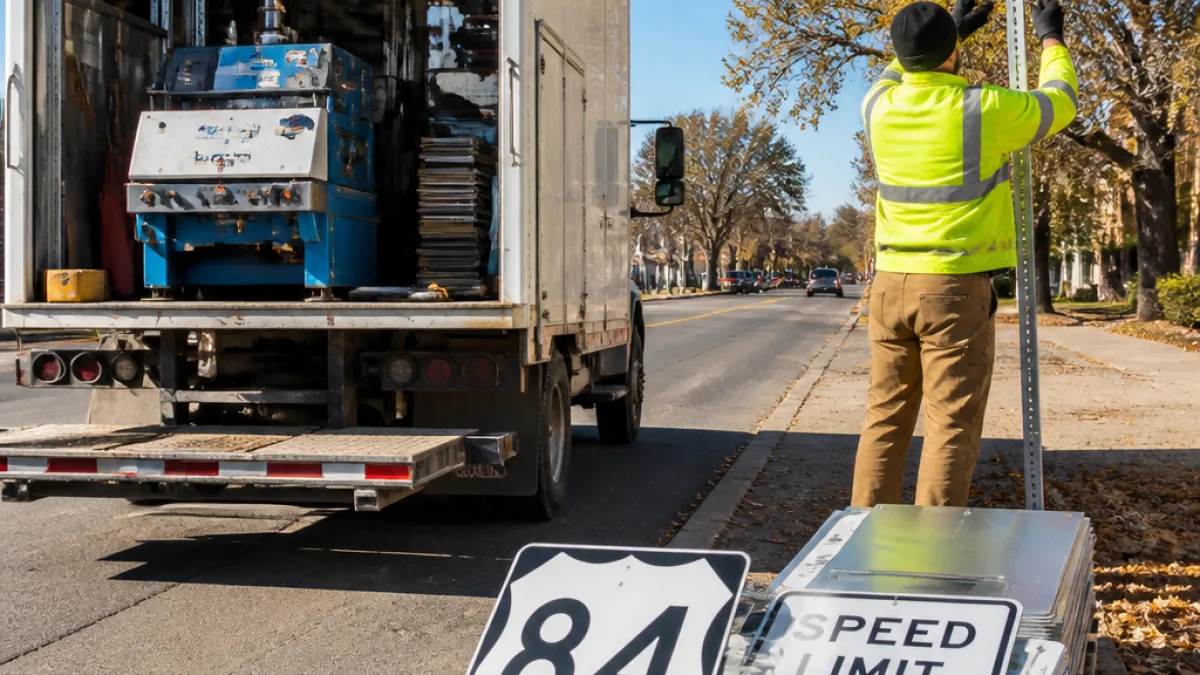
NAMPA — The recent removal and recycling of 70-mile-per-hour speed-limit signs for semitrucks across Idaho has renewed attention on who is responsible for maintaining the signs motorists rely on. In Nampa, jurisdiction over signs along state routes is split between the Idaho Transportation Department and the city, leaving municipal crews to manage the bulk of everyday signage.
Where responsibility falls
Within city limits, State Highways 45 and 55 run through Nampa and are joined by Interstate 84 business loops. City traffic officials say Nampa handles maintenance for 12th Avenue, which is Highway 45, as well as the business loop routes and Highway 55. However, the Idaho Transportation Department retains authority over speed-limit signs and the black-and-white shields that identify state highways.
“We take care of 12th Avenue, which is Highway 45,” said Robert Newman of the Nampa Traffic Division, explaining the split responsibilities. The city is charged with other traffic-control devices: stop signs, one-way indicators, traffic-flow signs, warnings, advisories and most regulatory signage.
Scale of the workload
That division places more than 17,000 plotted signs under the city’s care, not including signage added for new development, construction projects or signs brought into the city through annexation. The number underscores the scope of maintenance, replacement and production work required to keep streets safe and navigable.
| Type of Sign | Maintained By |
|---|---|
| Speed limit signs & highway shields | Idaho Transportation Department |
| Stop signs, one-way, traffic-flow, warnings, advisories | City of Nampa |
Priorities and response times
How quickly crews respond depends on the sign type. Stop and yield signs are treated as emergencies; city staff aim to address those immediately. Speed-limit and no-parking signs are typically lower-priority items.
“Yield signs, they’re just like a stop sign. They are considered an emergency,”
Newman said the city dispatches crews as soon as an emergency condition is reported. When a replacement marker is not already on hand, workers estimate they can produce and reinstall a sign in roughly an hour.
In-house production and savings
Nampa manufactures many of its own signs. Stephanie Baldwin said producing signs internally reduces costs and shortens wait times for replacements. She estimated in-house production saves the city about 60% to 70% compared with outsourcing.
“It would take like a week or more to be able to order something in compared to us just being able to go to our computer and print everything out,”
Crews use reflective materials printed with the sign design, then apply a laminate to protect against ultraviolet light and fading, as well as some vandalism. That capability allows the city to respond faster to urgent needs and to maintain a large inventory without depending solely on external suppliers.
Public impact and takeaways
The distinction between state and city responsibilities can be confusing for drivers who see a knocked-down sign or outdated marker and are unsure whom to contact. For motorists, the crucial takeaway is that emergency devices like stop and yield signs should be reported immediately to the city so crews can act quickly. Nonemergency items such as damaged speed-limit or parking signs may take longer to replace because of lower priority and separate jurisdictional responsibility.
- Idaho Transportation Department retains speed-limit and highway-shield responsibility on state routes.
- City of Nampa maintains more than 17,000 plotted signs including stop, warning and regulatory signs.
- Nampa produces many signs in-house, saving roughly 60–70% and enabling about one-hour emergency replacements when parts aren't on hand.
As communities in the region grow and road projects continue, the daily work of tracking, producing and replacing thousands of signs will remain a routine but essential function for municipal traffic divisions. Understanding which agency manages which signs can help residents report problems to the right place and speed up repairs that affect safety and traffic flow.

















