
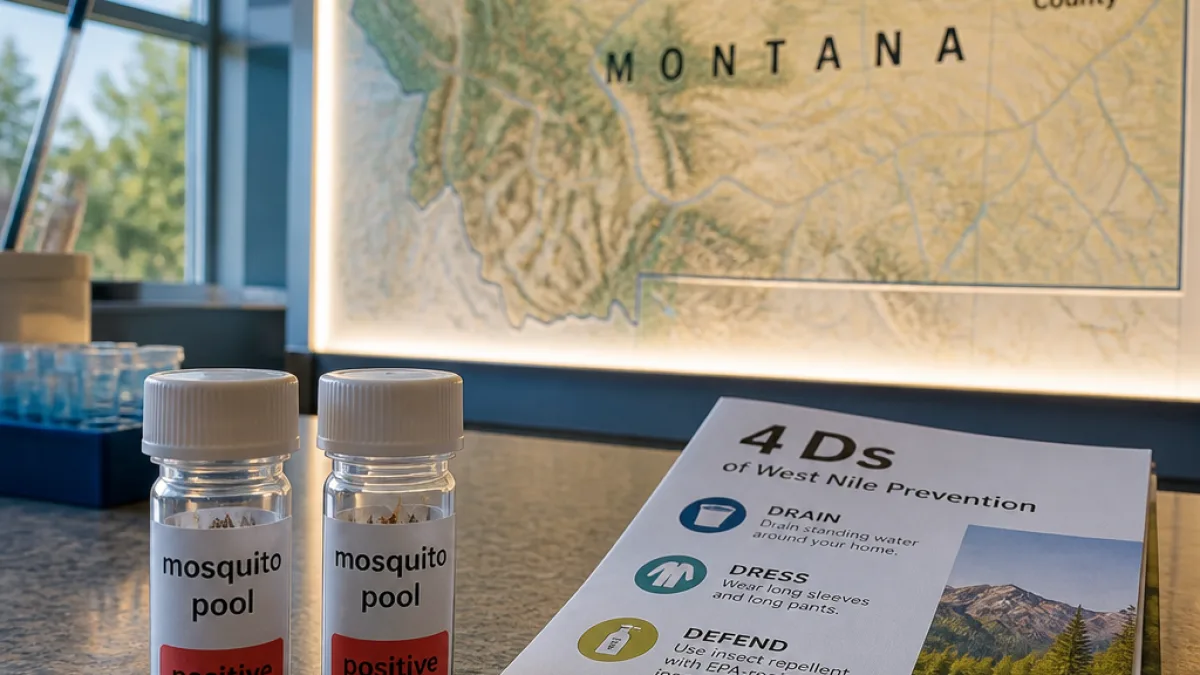
HELENA — State and local health officials confirmed the first mosquito detections of West Nile virus in Montana for summer 2026 on Wednesday, announcing two positive mosquito pools in Roosevelt County and urging increased protections against mosquito bites.
Early detection raises concern about spread
The Montana Department of Public Health and Human Services (DPHHS) said the positive mosquito tests are an early indicator that West Nile virus activity is rising and that the virus is likely to spread across the state as long as mosquitoes remain active. No human or horse infections have been reported so far this season.
“Detection of WNV in mosquitoes is an early indicator that activity is increasing within the state, elevating the risk of human illness,” the department said in its news release.
“The risk of severe illness is a serious concern. Every year, some Montanans experience neurological complications that can cause permanent disability or death.” — Devon Cozart, DPHHS vectorborne disease epidemiologist
What the numbers mean
DPHHS emphasized that finding West Nile virus in mosquito pools does not mean immediate human cases are inevitable, but it does raise the level of concern. The department noted that increased transmission risk typically continues through October or as long as mosquitoes remain active.
The health department reiterated the illness profile: about one-in-five infected people experience mild symptoms such as headache, rash, body aches, joint pains, fatigue, vomiting and diarrhea. A much smaller fraction — roughly one-in-150 — can develop severe neurologic illness.
Practical prevention steps for Montanans
State health officials urged residents to take personal precautions and follow the “4 Ds of Mosquito Bite Prevention.” Those measures are designed to reduce the chance of being bitten and therefore lower the risk of infection.
- DEET: Use EPA-registered insect repellents containing active ingredients such as DEET or picaridin. The EPA website lists effective repellents.
- DRAIN: Eliminate standing water around homes to reduce mosquito breeding sites.
- DAWN/ DUSK: Mosquitoes are most active at dawn and dusk. Stay indoors or take added precautions during these times.
- DRESS: Wear long sleeves and long pants when possible to reduce exposed skin.
Local implications and monitoring
The positive mosquito pools were detected in Roosevelt County. Local public health authorities coordinate surveillance and may increase mosquito monitoring, larval control, or public outreach where needed. DPHHS said it expects continued surveillance to track how widely the virus spreads across Montana this season.
There is currently no vaccine or targeted antiviral medication for West Nile virus in humans, the department said. Prevention through limiting mosquito exposure remains the primary defense.
When to seek care
Most people with West Nile virus will have either no symptoms or only mild illness. However, the department warned that severe complications can occur and urged prompt medical attention for:
- High fever or sudden onset of neurologic symptoms such as severe headache, stiff neck, disorientation, seizures or muscle weakness.
- Symptoms that rapidly worsen or do not improve with time.
| Feature | What to know |
|---|---|
| Current detections | Two mosquito pools positive (Roosevelt County) |
| Human cases | No human or horse infections reported yet this season |
| Risk window | Expected to continue through October or while mosquitoes are active |
DPHHS recommended that Montanans check local public health advisories and the agency’s website for updates on surveillance data and guidance. With mosquitoes active and warmer weather continuing in many parts of the state, officials urged residents to adopt the simple prevention steps that reduce risk.
Local health authorities will continue to monitor mosquito pools and provide updates if human or equine cases are identified. For now, public health leaders said awareness and basic protective measures are the best tools residents have to limit transmission.
Travis Wheeler is the state correspondent for WE NEWS.
















