
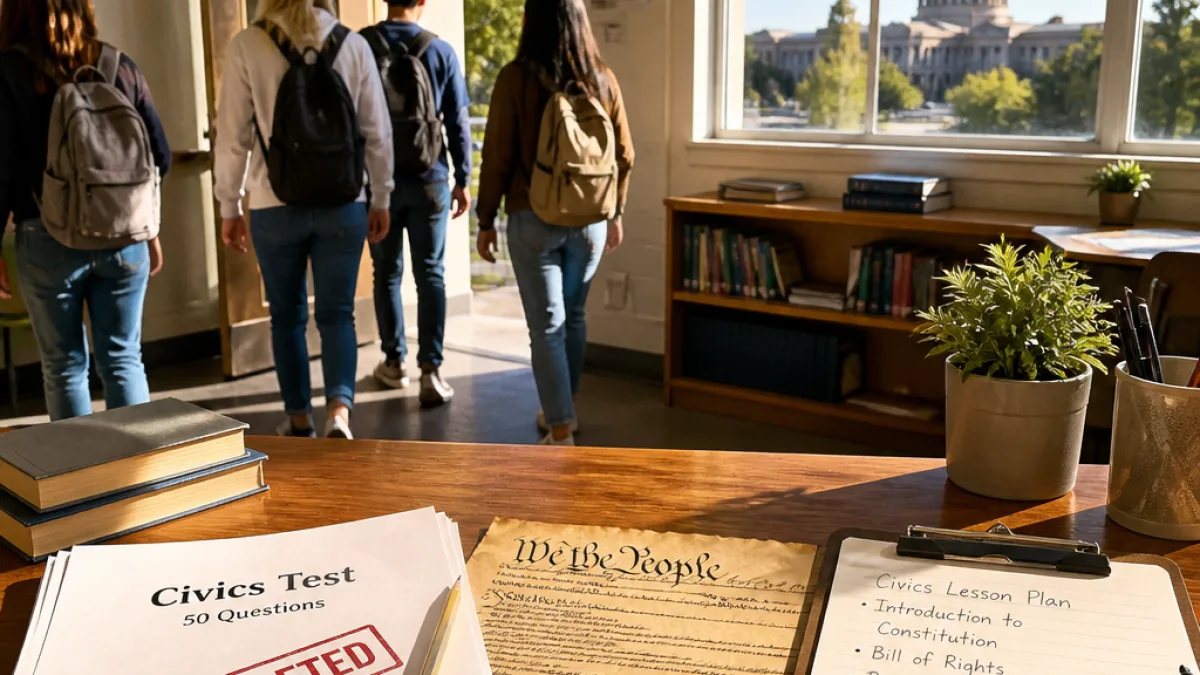
BOISE — Idaho will require high school students to pass a new 50-question civics test beginning in the 2027-28 school year, the Idaho Department of Education says, replacing a prior 100-question citizenship test and prompting educators to reconsider classroom instruction in U.S. history and government.
What the new exam covers
The revised assessment focuses on students’ understanding of American government, the nation’s founding principles and constitutional amendments. While the question count is half that of the previous exam, state education officials describe the instrument as more rigorous, and they cautioned that teachers may need to adapt coursework to prepare students.
Examples of item prompts released by state officials include:
- Define the concept of democracy.
- Define the concept of liberty.
- Explain the benefits of a bicameral legislature.
Those sample questions indicate a shift from rote recall toward explanation and application of civic concepts.
Legislative origins and political debate
The new test was created under Senate Bill 1366, which passed this year with support only from Republican lawmakers. The change followed concerns from some legislators who said existing civics instruction in Idaho schools was insufficient.
"We need to do something to help get our young people back (to) loving our country," said sponsoring Rep. Barbara Ehardt, R-Idaho Falls. "It is impossible to teach somebody to love our country by teaching them propaganda that is antithetical to how this country came about."
Lawmakers who supported the measure also argued the previous 100-question citizenship exam was too trivial, a criticism voiced by Rep. Tony Wisniewski, who proposed a new civics test in 2025.
Reaction from educators and implications for classrooms
The Idaho Department of Education has warned that the new exam’s increased rigor may require changes to instruction and assessment in high school U.S. History and U.S. Government courses. That could mean more classroom time devoted to explanation of civic principles and to analyzing how government structures operate, rather than only memorizing facts.
School administrators and teachers will face decisions about how to align curricula with the new measure. Because the law replaces an existing graduation requirement, districts must ensure students slated to graduate in or after 2028 are aware of the change and have access to preparatory materials.
What remains contested
Beyond questions of pedagogy, debate over the test reflects broader disagreements about how history and government should be taught. Sponsors framed the change as corrective — a way to strengthen patriotism and civic knowledge — while critics argued the legislation circumvented the normal process for changing academic content standards, a multi-year process that typically begins with a standards review.
The bill’s passage without Democratic support drew additional scrutiny from educators and observers who said that altering civics instruction through legislation, rather than through the established standards process, risks politicizing curriculum decisions.
Key facts at a glance
| Item | Previous test | New test |
|---|---|---|
| Number of questions | 100 | 50 |
| Primary focus | Citizenship knowledge | Government, founding principles, amendments |
| Effective | Previously required for graduation | 2027-28 school year |
| Legislation | N/A | Senate Bill 1366 |
As implementation proceeds, district leaders will need to communicate how the new requirement affects graduation pathways, testing windows and remediation options for students who do not pass on initial attempts.
What students and parents should know
State officials have not released a full administration schedule or detailed passing criteria tied to the new exam beyond its scope and effective year. Educators say schools typically provide instruction aligned to state standards and offer retesting or alternative demonstration of competency when required for graduation; families should monitor district communications for local plans and resources.
The change arrives amid heightened national attention on civics education, and Idaho’s move to a shorter yet tougher exam underscores an ongoing state-level debate about how to balance factual knowledge, critical thinking and civic values in public schools.
—
Reporting for this story used material from IdahoEdNews.org and state education announcements.















