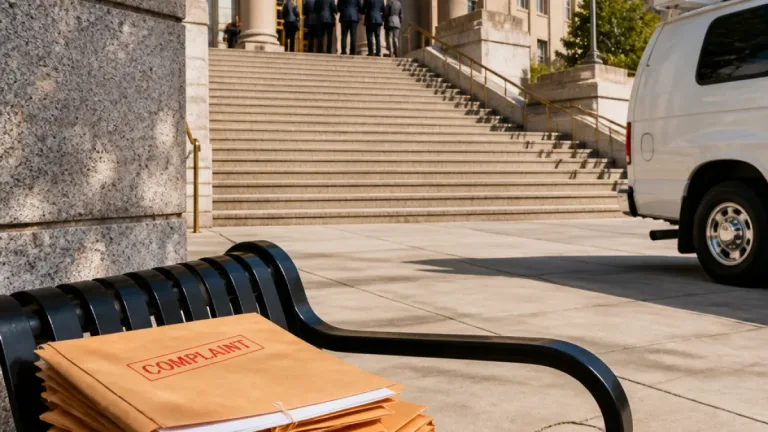
Aurora, Colo. — A federal judge on Thursday issued a partial preliminary injunction blocking key provisions of a newly enacted Colorado law that would have given state health authorities the power to carry out unannounced inspections at immigration detention centers and impose heavy fines for noncompliance.
Judge: law targets federal activity
U.S. District Judge Daniel Domenico granted the injunction after hearing a challenge by The GEO Group, the private company that runs the state’s only immigration detention facility in Aurora. Domenico’s order prevents enforcement of the portion of House Bill 26-1276 that required at least four unannounced inspections per year and included substantial penalties for refusal to allow those inspections.
"The bill therefore facially singles out federal activity for state regulation. That is typically enough for preemption," Domenico wrote.
In his ruling, Domenico said the law "unfairly targets a federal contractor" and extended beyond treating the GEO-run facility the same as other correctional institutions in Colorado. He found that HB 26-1276 appears to regulate federal activity carried out at a facility that is distinctively connected to federal immigration enforcement.
What remains in force — and what does not
The court left intact several other provisions of the law that clarify county inspection authority and authorize the Colorado Department of Public Health and Environment (CDPHE) to develop new staffing and record-keeping rules for the facility. Domenico noted the department has not yet undertaken the rulemaking process required to create those standards, and therefore GEO was not facing imminent harm from those parts.
But the judge signaled that the balance could shift if the state begins to implement those rulemakings in a way that materially affects GEO, leaving the door open to future legal disputes should CDPHE move forward.
Timing tied to federal contract
The injunction is temporary and tied to the term of GEO’s contract with federal immigration authorities. The company’s current agreement with the federal government is set to expire in October, and Domenico’s order stays the contested inspection and penalty provisions at least until that contract lapses.
State argues public-health interest
State attorneys, in hearings prior to the ruling, told the court Colorado has a legitimate interest in regulating conditions for people detained within its borders. They argued that inspections and oversight are necessary to protect health and welfare, particularly in confined environments where communicable disease, sanitation and medical care are critical concerns.
Domenico acknowledged the state’s interest, but wrote that those concerns did not outweigh GEO’s asserted constitutional protections in this case. The judge’s analysis relied on federal preemption principles that bar certain state laws from intruding on federal operations.
Local and policy implications
The ruling has immediate consequences for oversight of the Aurora immigration detention facility and highlights broader tensions between state attempts to regulate conditions in facilities tied to federal immigration enforcement and the constitutional limits on state power.
- Short-term effect: Unannounced inspections and fines required by HB 26-1276 may not be enforced against GEO while the injunction is in place.
- Remaining tools: Counties and CDPHE retain authority clarified in the law, and the department can pursue rulemaking for staffing and records.
- Future litigation: If CDPHE completes rulemaking and begins enforcement, GEO could return to court.
What to watch next
Key developments to monitor include whether Colorado proceeds promptly with CDPHE rulemaking, any appeals by the state to lift the injunction, and whether the federal contract with immigration authorities is renewed or allowed to expire in October. Each of those steps could change the legal landscape and the state’s ability to regulate the Aurora facility.
| Item | Status |
|---|---|
| Unannounced inspections (at least 4/yr) | Blocked (partial preliminary injunction) |
| CDPHE staffing and recordkeeping rules | Intact; rulemaking pending |
| Injunction duration | Through GEO's federal contract expiration in October |
The interim ruling leaves Colorado officials with limited options: pursue administrative rulemaking, appeal the judge’s order, or await the contract’s conclusion in October. For advocates, lawyers and families with connections to the Aurora facility, the decision is likely to prompt renewed scrutiny of state and federal responsibilities for detention conditions.
As this matter proceeds through the courts and state agencies, the balance between protecting public health in Colorado and respecting federal authority over immigration enforcement will remain the central legal question.
— Hannah Sorensen, State Correspondent