
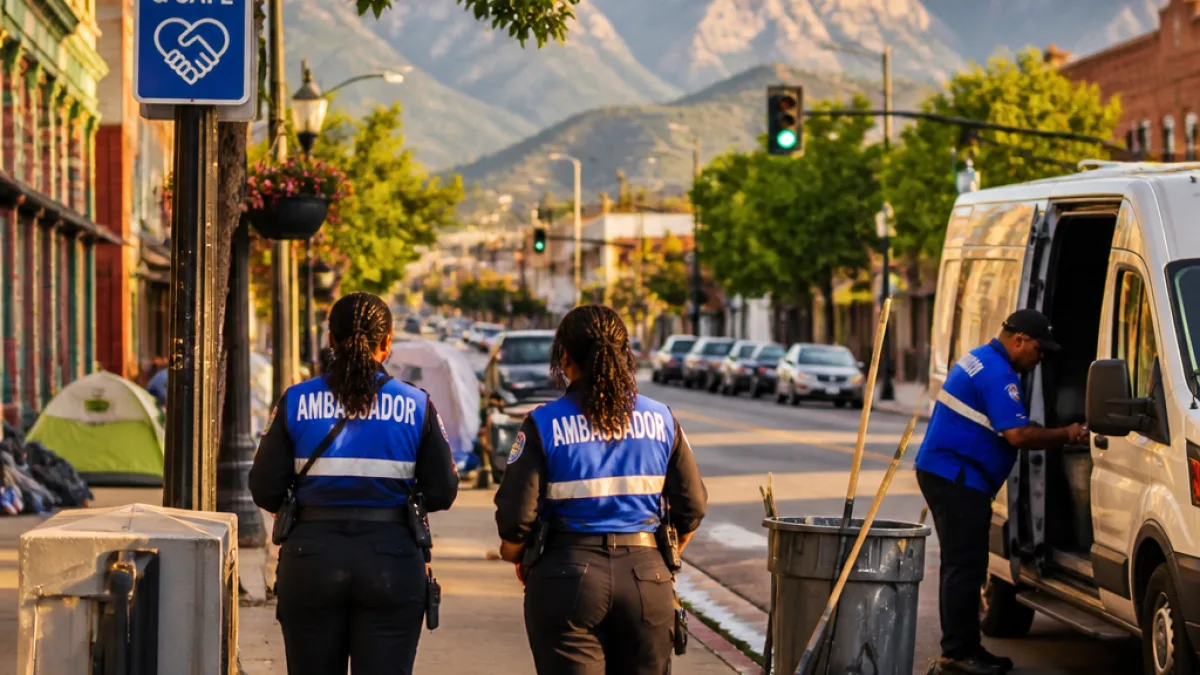
The Downtown Partnership's $1.8 million pilot aimed at improving safety and cleanliness in downtown Colorado Springs is reporting early progress — measured in fewer police responses, thousands of ambassador contacts and dozens of unhoused people connected to services — even as leaders say homelessness and behavioral-health challenges remain the project's principal barrier.
Early results and how the program works
The 19-month pilot combines private security, downtown ambassadors, cleaning crews and dedicated homelessness outreach. In a presentation to City Council, program leaders reported that private security officers logged 2,850 incidents in the first year, but only 2% of those required a police response. Ambassadors counted 10,000 interactions with visitors, businesses and people experiencing homelessness. Outreach staff from Homeward Pikes Peak provided case management to 135 unhoused people; another 158 are pursuing housing options, and 24 moved into permanent supportive housing.
City officials invested $700,000 in the pilot; the remainder of the $1.8 million comes from private and partnership funding through the Downtown Partnership. The program’s stated goal is to address quality-of-life concerns before they escalate to law enforcement involvement.
What leaders are saying
"Businesses are benefiting, people are getting connected to the services they need, and downtown is growing stronger," Mayor Yemi Mobolade said in a statement.
City Council discussion during the presentation revealed sharp differences about the best approach to people experiencing homelessness. At-large Councilmember David Leinweber voiced concern about criminalization as a primary tool of response, saying he was not comfortable with using jail as a principal measure.
Where the pilot is succeeding — and where it is stymied
Program leaders and city officials pointed to concrete benefits: private security and ambassadors have reduced immediate demands on police; outreach teams have engaged hundreds of people and moved some into housing; and the visible presence of cleaning crews has been part of an effort to improve perceptions of safety and business confidence downtown.
But officials also identified persistent obstacles. The project struggles with continual waste and sanitation needs, limited enforcement tools, and the outreach teams’ inability to compel services for people who decline them. City leaders said a relatively small cohort of people with recurring behavioral-health, addiction and homelessness problems accounts for many of the most visible disruptions.
- Private security incidents recorded: 2,850 (2% needed police)
- Ambassador interactions: 10,000
- Individuals receiving case management: 135
- Pursuing housing options: 158
- Moved into permanent supportive housing: 24
Those figures suggest the pilot is making measurable inroads on engagement and diversion from criminal justice responses. But the data also underline the scale of needs downtown: connecting dozens into housing is progress, yet it does not by itself resolve ongoing public disturbances or the larger housing and behavioral-health systems that contribute to repeated crises.
Implications for downtown recovery and city policy
Downtown business owners and property managers have long cited safety and cleanliness as critical to attracting customers, tenants and investment. Program backers argue the Clean and Safe pilot is intended to bolster those conditions while complementing, rather than replacing, broader human-services work.
The pilot’s mixed results highlight policy choices for city leaders. Should the city expand non-law-enforcement responses such as ambassadors and outreach? Increase funding for housing and behavioral-health services? Seek additional enforcement tools? Council debate at the presentation indicated no consensus, with members split over the balance between services and enforcement.
| Metric | First-year result |
|---|---|
| Pilot budget | $1.8M |
| City contribution | $700,000 |
| Security incidents logged | 2,850 |
| Incidents requiring police | 2% |
| Ambassador interactions | 10,000 |
| Case-managed individuals | 135 |
As the pilot moves toward its 19-month midpoint, officials say continued monitoring of outcomes and costs will guide any decision about extension or expansion. For residents and downtown stakeholders, the critical tests will be whether the program can sustain reductions in law-enforcement interventions, connect larger numbers of people to stable housing and reduce the repetitive, high-visibility incidents that sour the downtown experience.
City Council members and program administrators face pressure to translate early gains into longer-term strategies that address both immediate cleanliness and safety concerns and the upstream factors — housing, mental health and substance-use services — that drive periodic crises. The pilot provides data to inform that debate; the challenge will be turning those data into coordinated policy and funding decisions that satisfy a divided public.

















