
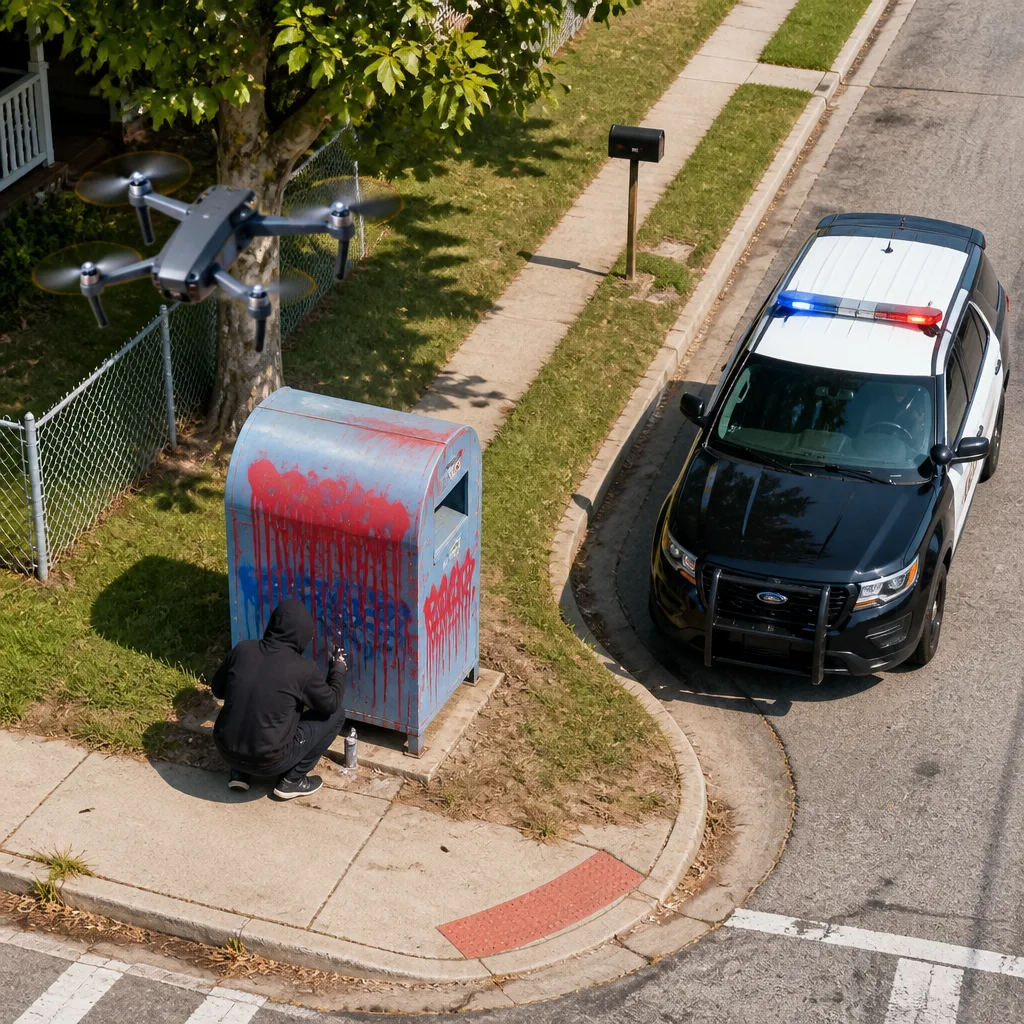
BALTIMORE COUNTY, Md. — Drone video released by Baltimore County police shows a person apparently spray-painting a donation bin in Towson on June 22, a recording that investigators say helped secure an arrest for destruction of property.
Drone program captured action before officers arrived
Authorities say the incident occurred about 3 p.m. on the 900 block of Fairmont Avenue. Police deployed a unit from their "Drone as First Responder" (DFR) program after receiving a report of property damage. The department released the aerial footage Saturday, which it says depicts the suspect committing the act prior to patrol officers reaching the scene.
Body-worn camera video obtained by police shows an officer speaking to the individual after arrival. In the recording, the officer asks whether the person had marked a trash receptacle; the person denies it, saying they were asked and had already answered. A line from the body camera exchange is included below:
"Did you draw something on, like, a trash can?" "No." "Were you drawing something on a trash can?" "No! You asked me, I told you. I have no idea what you're talking about."
Investigators say the drone imagery appears to contradict the denial and shows the person using spray paint on a donation bin located on the block. The property owner told officers each donation container is worth $2,000.
Arrest and evidence gathering
After officers reached the scene, body camera recordings capture the interaction that culminated in the suspect being taken into custody. Police said the arrest was made on a charge of destruction of property. The department released both the drone and body camera clips as part of its public information about the case.
The department's DFR program is intended to provide rapid situational awareness by sending an unmanned aerial system to a reported incident before officers arrive. In this case, officials said the video supplied direct visual evidence of the alleged act, which investigators used alongside on-scene witness statements and the property owner's valuation to proceed with charges.
Context and policing implications
Use of drones by police raises questions about evidence handling, privacy and oversight as more departments adopt airborne technology for first-response roles. Advocates for police transparency note that paired drone and body-camera footage can clarify events, while civil liberties groups caution about unchecked surveillance and the need for clear policies governing flight deployment, data retention and public release.
This incident in Towson provides a case study of how an aerial recording and officer-worn cameras can be combined to document a relatively low-level property crime that nonetheless carries financial consequences for private owners and organizations that rely on donated goods.
- Date and time: June 22, about 3 p.m.
- Location: 900 block of Fairmont Avenue, Towson
- Program used: Drone as First Responder (DFR)
- Reported property value: $2,000 per donation bin
Police did not release the suspect's name or further details about any pending court proceedings at the time the footage was made public. The department’s statement accompanying the video emphasized the role of the DFR unit in aiding patrol response and evidence collection.
| Item | Detail |
|---|---|
| Incident type | Alleged graffiti / destruction of property |
| Evidence | Drone footage and body-worn camera video |
| Property loss cited | $2,000 per donation bin |
As departments nationwide expand the use of unmanned aircraft in everyday policing, officials and community stakeholders continue to debate how to balance investigative benefits with safeguards for privacy and civil liberties. This Baltimore County case illustrates how the technology can be applied to relatively minor crimes but still affect decisions about arrests and prosecutions.
Police released the drone and body camera footage publicly Saturday; investigators said it was central to their response and to documenting the alleged incident.















