
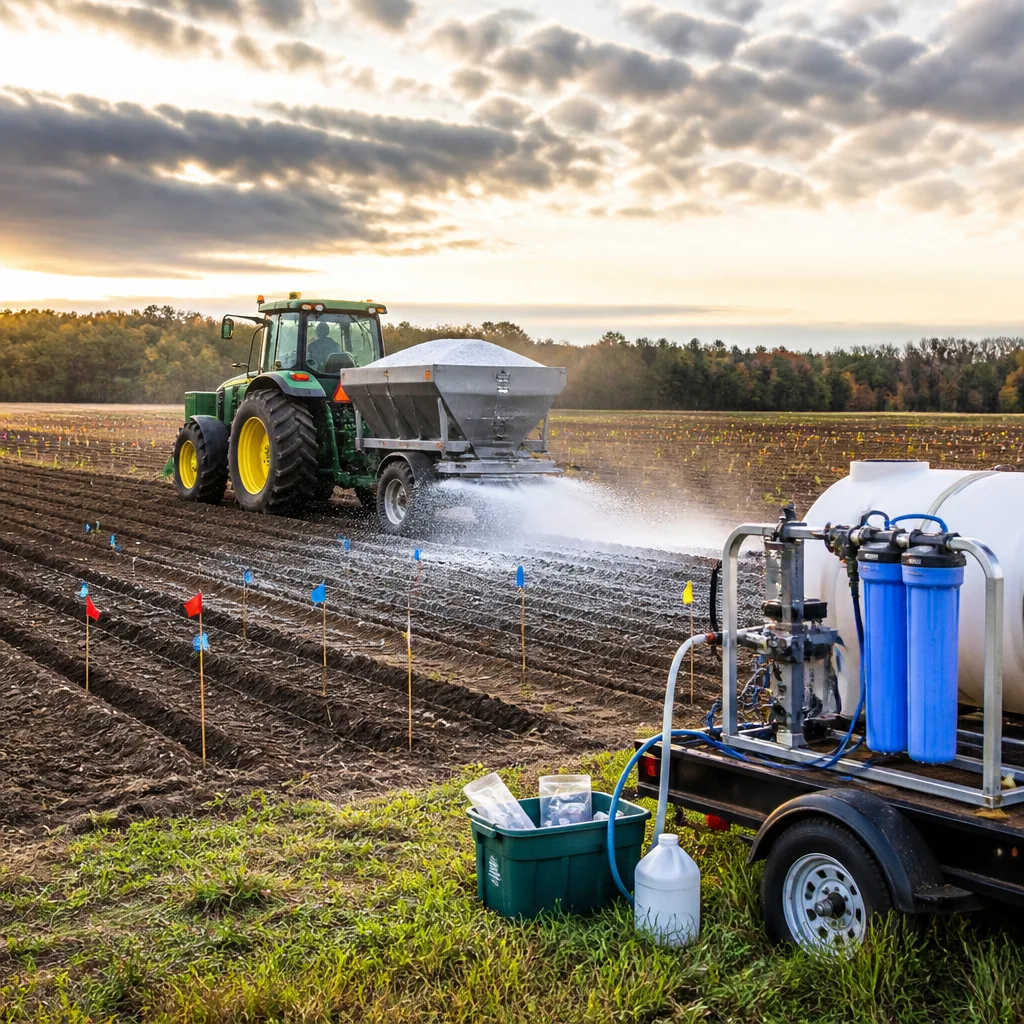
A research team led by Yale University has set out a new, lower-cost route for tackling per- and polyfluoroalkyl substances (PFAS) on agricultural land while also helping to remove carbon dioxide from the atmosphere. The method, modelled on data from farms in Maine, aims to remediate contaminated soils without placing cropland permanently out of agricultural use.
Dual-purpose approach targets ‘forever chemicals’ and carbon
PFAS are a broad family of synthetic chemicals, known for their persistence in the environment and resistance to degradation. They have been widely used for decades in everyday products, and have spread into groundwater, soils and, eventually, croplands. The Yale team says the new process could address contamination across millions of acres in the United States and beyond.
“There is an obvious need for new tools to help farmers affected by ‘forever chemicals’ contamination,”
said Noah Planavsky, a professor of Earth and planetary science and principal investigator on the study published in the Proceedings of the National Academy of Sciences. He is also a faculty member of the Yale Center for Natural Carbon Capture and comes from a farming family.
The study links PFAS remediation with enhanced weathering, a technique that accelerates natural rock weathering to lock up carbon dioxide as stable minerals in soils. The researchers suggest the two activities can be combined in ways that restore soil health while reducing PFAS levels—allowing land to remain in productive agricultural use rather than being taken out of service for lengthy remediation programmes.
Why the proposal matters
Existing PFAS remediation methods can be costly, disruptive and in many cases result in land that cannot be used for farming during or after treatment. The Yale-led approach is presented as both less expensive and more environmentally benign, and crucially it keeps farmers on their land. Backing came from Yale Planetary Solutions and Yale Ventures, highlighting institutional support for turning the research into practice.
Jake Thompson, an associate researcher in the Planavsky lab and first author of the paper, noted — based on the team’s analysis — that PFAS contamination is not only a US problem but a global one, even though the study used US data. The research therefore aims to provide a practical, scalable path that could be adapted beyond its initial US context.
What PFAS are and where they are used
PFAS are sometimes called “forever chemicals” because they do not readily break down in the environment. The source material lists a range of consumer items and industrial uses that have historically relied on PFAS for their water‑ and stain‑resistant properties.
| Example product | Context |
|---|---|
| Dental floss | Consumer oral-care products |
| Lipstick | Cosmetics |
| Frying pans | Non-stick coatings |
| Pizza boxes | Food packaging |
Practical considerations and next steps
The proposal is described in academic detail in the PNAS paper; support from university innovation hubs suggests the team will seek to move from theory to demonstration. Important practical questions remain about implementation at scale, monitoring of PFAS reductions and the long-term fate of both contaminants and sequestered carbon.
The Yale team’s emphasis on keeping land productive is significant for farmers and rural communities where livelihoods depend on crop output and where long remediation timescales can be economically devastating. If field trials and regulatory reviews confirm the method’s effectiveness and safety, it could broaden options for land managers facing PFAS contamination and add a tool to the limited arsenal of large-scale carbon removal strategies.
- Potential benefit: Restores contaminated farmland to productive use rather than removing it from agriculture.
- Climate angle: Couples remediation with enhanced weathering to store CO2 in soils.
- Backing: Study published in PNAS and supported by Yale Planetary Solutions and Yale Ventures.
For now, the method remains a proposal grounded in site data from Maine. Its real-world impact will depend on follow-up trials, regulatory assessment and whether the costs and logistics hold up beyond the initial modelling and laboratory work described by the authors.









